The Business Research Company’s 2026 market reports combine market attractiveness scoring, total addressable market sizing, company benchmarking matrices, interactive Excel dashboards, deeper supply chain intelligence, emerging startup tracking, and granular product-level insights to deliver research that is more actionable and strategically valuable.
Virtual Client Computing Software Market Value Projected To Grow At A 22.6% Compound Annual Growth Rate Through 2030
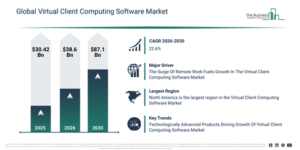
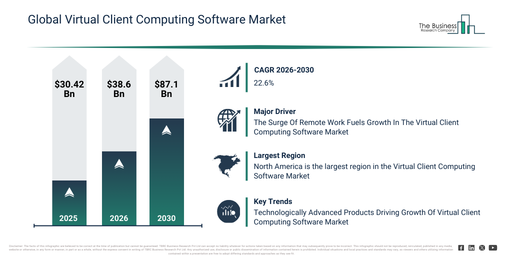
The virtual client computing software market has seen substantial expansion in recent years. It is anticipated to increase from $30.42 billion in 2025 to $38.6 billion in 2026, achieving a compound annual growth rate (CAGR) of 26.9%. The market’s growth in the past can be ascribed to factors such as the proliferation of remote and distributed workforces, the expansion of enterprise IT virtualization initiatives, a growing need for centralized IT management, the increasing adoption of thin client devices, and an enhanced focus on data security.
The virtual client computing software market is anticipated to experience substantial growth in the coming years. It is projected to expand to $87.1 billion in 2030, demonstrating a compound annual growth rate (CAGR) of 22.6%. This surge is propelled by the increasing adoption of cloud-native virtual desktops, a rising demand for scalable remote work infrastructure, the expansion of zero trust security models, growing integration with identity management platforms, and increasing investments in digital workplace solutions. Significant trends throughout the forecast period include the increasing adoption of cloud-based VDI solutions, a heightened demand for secure remote desktop access, the growing integration of centralized application virtualization, the expansion of hybrid work enablement platforms, and an enhanced focus on endpoint security and management.
Evaluate The Virtual Client Computing Software Market Report Before You Buy With A Free Sample:
Virtual Client Computing Software Market Growth Driver Analysis For The 2026–2030 Forecast Period
The expanding adoption of remote work practices is anticipated to fuel the expansion of the virtual client computing software market in the future. Remote work culture signifies a change in how organizations operate, allowing staff to carry out their duties away from a conventional office, typically from home or other distant sites. This increase in remote work is gaining traction due to desires for better work-life balance, financial benefits for both companies and employees, and technological progress facilitating smooth remote teamwork. Virtual client computing software enables organizations to adopt this remote work model by offering secure, adaptable, and effective remote access to desktop setups and applications, ensuring employees stay productive and connected wherever they are. For example, in March 2025, the US Bureau of Labor Statistics, a US federal government agency, reported that 35.5 million individuals teleworked or worked from home for compensation in the first quarter of 2024, representing an increase of 5.1 million from the previous year. These individuals constituted 22.9 percent of the total workforce, which is higher than the 19.6 percent observed a year prior. Consequently, the increasing prevalence of remote work cultures is propelling the growth of the virtual client computing software market.
Virtual Client Computing Software Market Segmentation Breakdown: Primary And Secondary Categories
The virtual client computing software market covered in this report is segmented –
1) By Service: Integration And Deployment, Support And Maintenance, Training And Consulting
2) By Solution: Terminal Service, Virtual User Session (VUS), Virtual Desktop Infrastructure (VDI), Other Solutions
3) By Deployment Model: Cloud, On-Premise
4) By Enterprise Size: Large Enterprise, Small And Medium Enterprise
5) By End Use: Banking, Financial Services And Insurance (BFSI), Government, Healthcare, Information Technology (IT) And Telecom, Manufacturing, Media And Entertainment, Retail, Other End Uses
Subsegments:
1) By Integration And Deployment: Cloud Integration Services, On-Premises Deployment, Hybrid Deployment Solutions, System Integration For VCC Software, Configuration and Customization
2) By Support And Maintenance: Software Updates And Patches, Technical Support (Helpdesk, Troubleshooting), Performance Monitoring And Optimization, Hardware Maintenance And Management, Security Patching And Compliance Support
3) By Training And Consulting: End-User Training, Administrator And IT Staff Training, VCC Software Implementation Consulting, Custom Training Programs, Strategy And Workflow Consulting
Virtual Client Computing Software Market Industry Trends: New Developments From Leading Companies
Leading firms within the virtual client computing software market are introducing inventive solutions, including thin clients, to enhance their competitive standing. A thin client is characterized as a lightweight, compact computing device built for network connectivity and for accessing applications and data stored on remote servers or a centralized infrastructure. An example of this innovation occurred in November 2023 when Amazon Web Services (AWS), a US-based provider of cloud computing platforms, introduced Amazon WorkSpaces Thin Clients. These particular devices offer a straightforward and secure approach to deploying virtual desktops broadly. Companies can acquire hardware that comes pre-configured, which is then delivered quickly and securely to their employees’ sites. Users are able to easily connect their peripheral equipment, access their designated AWS virtual desktop, and commence operations in less than five minutes.
Who Are The Top Competitors In The Virtual Client Computing Software Market?
Major companies operating in the virtual client computing software market are Google LLC, Microsoft Corporation, Dell Technologies Inc., Huawei Technologies Co. Ltd., Amazon Web Services Inc., Lenovo Group Limited, International Business Machines Corporation, Cisco Systems Inc., Oracle Corporation, Hewlett Packard Enterprise Company, Fujitsu Limited, NetApp Inc., Red Hat Inc., Citrix Systems Inc., Micro Focus International plc., Nutanix Inc., Parallels Inc., IGEL Technology GmbH, Teradici Corporation, 10ZiG Technology Inc., Scale Computing Inc., Ericom Software Inc., NComputing Co. Ltd., Liquidware Inc., Leostream Corporation, Stratodesk Inc., ThinScale Technology Ltd.
Access The Virtual Client Computing Software Market Report For Complete Segment-Level Analysis:
Which Region Leads The Virtual Client Computing Software Market, And Which Regions Are Covered?
North America was the largest region in the virtual client computing software market in 2025. Asia-Pacific is expected to be the fastest-growing region in the forecast period. The regions covered in the virtual client computing software market report are Asia-Pacific, South East Asia, Western Europe, Eastern Europe, North America, South America, Middle East, Africa.
Reach Out To Our Team:
The Business Research Company: https://www.thebusinessresearchcompany.com/
Americas: +1 310-496-7795
Asia: +44 7882 955267 & +91 8897263534
Europe: +44 7882 955267
Email us at: marketing@tbrc.info
Follow us on:
LinkedIn: https://in.linkedin.com/company/the-business-research-company
YouTube: https://www.youtube.com/channel/UC24_fI0rV8cR5DxlCpgmyFQ
Global Market Model: https://www.thebusinessresearchcompany.com/global-market-model

Wasay has over a decade of experience in market research, data modelling, and analytics, with prior experience at GlobalData and Decision Tree Consulting Services. At The Business Research Company , he leads research operations across syndicated studies, customized consulting engagements, and the Global Market Model platform. His professional experience includes supporting organizations such as Boston Consulting Group, KPMG, and Ernst & Young. Wasay holds a degree in Electronics and Communications Engineering, postgraduate management qualifications from International Management Institute Belgium and Indian School of Business and Entrepreneurship, and completed the Integrated Program in Business Analytics from Indian Institute of Management Indore.