Featuring market attractiveness scoring, total addressable market sizing, company benchmarking matrices, interactive Excel dashboards, deeper supply chain intelligence, emerging startup tracking, and granular product-level insights, The Business Research Company’s 2026 market reports are built to deliver research that is both more actionable and more strategically valuable.
Virtual Humans Market Forecast: What Value Will The Market Reach By 2030?
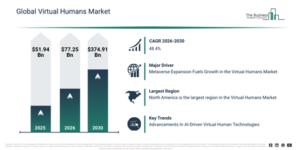
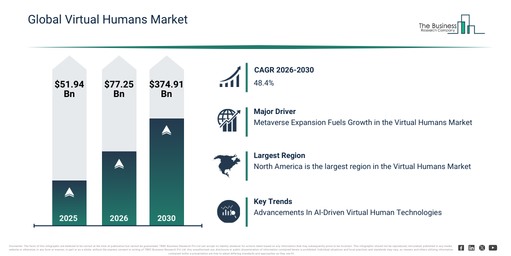
The virtual humans market has experienced significant expansion in recent years. Its valuation is set to rise from $51.94 billion in 2025 to $77.25 billion in 2026, demonstrating a compound annual growth rate (CAGR) of 48.7%. This historical growth can be attributed to various factors, including advancements in computer graphics, the proliferation of virtual reality and augmented reality platforms, the widespread adoption of digital assistants, a growing demand for immersive gaming experiences, and the ongoing development of AI algorithms enabling human-like interaction.
The virtual humans market size is anticipated to undergo substantial growth in the upcoming years. It is projected to expand to $374.91 billion in 2030, demonstrating a compound annual growth rate (CAGR) of 48.4%. This expected expansion during the forecast period is influenced by factors such as the incorporation of AI and machine learning, an increasing presence in customer service and virtual assistance, the proliferation of virtual influencers in marketing, their implementation in education and training simulations, and the rise of virtual human applications in healthcare. Prominent trends for the forecast period include the advent of AI-powered virtual assistants, socially interactive virtual humans, virtual influencers and brand ambassadors, lifelike 2D and 3D avatars, and their integration with gaming and VR/AR platforms.
Get A Free Sample Report With In-Depth Market Insights:
Virtual Humans Market Growth Catalysts And Demand Drivers
The swift growth of the metaverse is anticipated to significantly boost the virtual humans market moving forward. This metaverse is defined as a collective virtual shared space that emerges from blending virtually enhanced physical reality with physically persistent virtual reality. Its expansion is attributed to a surge in interest in digital experiences, the increasing adoption of remote work and social interactions, new economic possibilities, and evolving cultural dynamics. Virtual humans, also referred to as digital avatars or virtual beings, are critical within the metaverse, functioning as user representations, AI-controlled characters, or even independent entities with specific purposes. They are fundamental in shaping the user experience, facilitating richer, more tailored, and highly interactive digital environments. For instance, in March 2024, the UK Intellectual Property Office, a UK-based government office responsible for intellectual property rights, reported that the number of Metaverse users is expected to rise rapidly, reaching an estimated 1.4 billion users and a projected market size of $490.4 billion by 2030. Hence, the increasing prevalence of the metaverse is a key driver for the virtual humans market.
Virtual Humans Market Segment Trends And Revenue Contributors
The virtual humans market covered in this report is segmented –
1) By Type: Avatars, Autonomous Virtual Humans
2) By Application: Gaming And Entertainment, Simulation And Training, Virtual Reality (VR) And Augmented Reality (AR), Customer Service And Virtual Assistants, Marketing And Advertising, Other Applications
3) By Industry Type: Banking, Financial Services And Insurance (BFSI), Education, Retail, Healthcare, Automotive, Aerospace And Military, Information Technology And Telecommunications, Gaming And Entertainment, Marketing And Advertising, Other Industries
Subsegments:
1) By Avatars: 2D Avatars, 3D Avatars, Customizable Avatars, Realistic Avatars
2) By Autonomous Virtual Humans: AI-Powered Virtual Assistants, Socially Interactive Virtual Humans, Virtual Influencers, Customer Service Virtual Humans
Virtual Humans Market Industry Trends: What’s Reshaping Demand?
Leading companies in the virtual humans market are concentrating on developing technologically advanced solutions, such as AI-driven virtual human technologies, often through collaborations, to improve human-computer interaction, create more realistic avatars, and broaden their applications across various industries. AI-driven virtual human technologies refer to sophisticated systems that utilize artificial intelligence (AI) to generate digital representations of humans capable of interacting with real people in a lifelike and intelligent manner. For example, in June 2024, Nvidia Corporation, a US-based software company, and Aww Inc., a Japan-based virtual human company, formed a partnership to enhance AI-driven virtual human technology, with a specific focus on their virtual influencer, imma. This updated iteration facilitates real-time interactions, boosted by NVIDIA’s Audio2Face technology, which ensures realistic facial animations and lip-syncing. AI imma is engineered to automate the generation of character-based large language models (LLMs), thus streamlining the production and deployment of virtual humans for diverse business applications. This collaboration marks a significant progression in AI-driven virtual human technology, aiming to redefine user engagement and interaction across sectors.
Virtual Humans Market Competitive Landscape: Which Companies Lead The Industry?
Major companies operating in the virtual humans market are Google LLC, Samsung Electronics Co. Ltd., Microsoft Corporation, Alibaba Group Holding Limited, Meta Platforms Inc., NVIDIA Corporation, iFLYTEK Co. Ltd., Unity Software Inc., Epic Games Inc., Xsens Technologies B.V., Reallusion Inc., Soul Machines Limited, AltspaceVR Inc., Cubic Motion Limited, Datagen Technologies Ltd., Inworld AI Inc., 3Lateral d.o.o., Faceware Technologies Inc., Offbeat Media Group LLC, Quantum Capture Inc., UneeQ Limited, VNTANA Inc.
View The Full Virtual Humans Market Report:
Virtual Humans Market Top Region By Revenue And Market Share
North America was the largest region in the virtual humans market in 2025. Asia-Pacific is expected to be the fastest-growing region in the forecast period. The regions covered in the virtual humans market report are Asia-Pacific, South East Asia, Western Europe, Eastern Europe, North America, South America, Middle East, Africa.
Reach Out To Our Team:
The Business Research Company: https://www.thebusinessresearchcompany.com/
Americas: +1 310-496-7795
Asia: +44 7882 955267 & +91 8897263534
Europe: +44 7882 955267
Email us at: marketing@tbrc.info
Follow us on:
LinkedIn: https://in.linkedin.com/company/the-business-research-company
YouTube: https://www.youtube.com/channel/UC24_fI0rV8cR5DxlCpgmyFQ
Global Market Model: https://www.thebusinessresearchcompany.com/global-market-model

Wasay has over a decade of experience in market research, data modelling, and analytics, with prior experience at GlobalData and Decision Tree Consulting Services. At The Business Research Company , he leads research operations across syndicated studies, customized consulting engagements, and the Global Market Model platform. His professional experience includes supporting organizations such as Boston Consulting Group, KPMG, and Ernst & Young. Wasay holds a degree in Electronics and Communications Engineering, postgraduate management qualifications from International Management Institute Belgium and Indian School of Business and Entrepreneurship, and completed the Integrated Program in Business Analytics from Indian Institute of Management Indore.