Delivering more actionable and strategically valuable research, The Business Research Company’s 2026 market reports feature market attractiveness analysis, total addressable market evaluation, company benchmarking matrices, interactive Excel dashboards, expanded supply chain intelligence, emerging startup coverage, and detailed product insights.
Virtual Kitchen Market Value Analysis: What Growth Is Expected Over The Forecast Period?
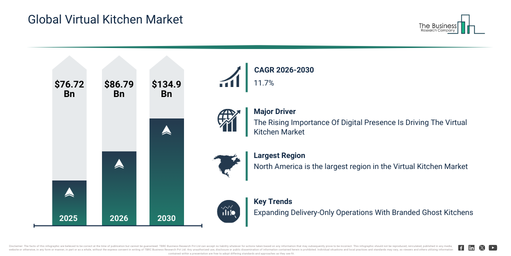
The virtual kitchen market has experienced significant expansion recently. Forecasts indicate it will expand from $76.72 billion in 2025 to $86.79 billion by 2026, demonstrating a compound annual growth rate (CAGR) of 13.1%. This historical increase is primarily due to factors such as the proliferation of online food delivery platforms, escalating urbanization, a greater need for convenient food choices, reduced hurdles for food businesses to enter the market, and the widespread use of smartphone-based ordering systems.
The virtual kitchen market is anticipated to experience substantial growth over the next few years. It is projected to expand to $134.9 billion by 2030, achieving a compound annual growth rate (CAGR) of 11.7%. This expansion during the forecast period is driven by factors such as increasing demand for cloud kitchens in tier-2 cities, rising adoption of AI-based demand forecasting, the expansion of sustainable packaging usage, a growing focus on operational scalability, and increasing integration with third-party delivery platforms. Significant trends in the forecast period involve the increasing adoption of delivery-only restaurant models, rising use of kitchen management software, a growing focus on cost-efficient food operations, the expansion of multi-brand virtual kitchens, and enhanced integration of data-driven menu optimization.
Download A Free Sample Report For Comprehensive Market Insights:
#Virtual Kitchen Market Demand Drivers Creating New Revenue Opportunities
The increasing importance of digital transformation is anticipated to fuel the expansion of the virtual kitchen market in the future. Digitalization involves transforming information, data, or physical items into a digital format for easy computer processing, storage, and transmission. The rising importance of digitalization stems from its ability to boost brand awareness and visibility, improve customer engagement, enhance customer support, and provide economical marketing solutions. Digitalization is vital for the success and efficiency of virtual kitchens, enabling streamlined operations, better customer experiences, and optimized resource management. It allows virtual kitchens to run more efficiently, cut expenses, and offer a superior customer experience, thereby fostering growth and success in the highly competitive food delivery sector. For example, data from Eurostat, a Luxembourg-based government department, indicated that by August 2024, 59% of EU enterprises had achieved at least a basic level of digital intensity in 2023, with 58% of small and medium-sized enterprises reaching this, contrasted with 91% of large enterprises. Consequently, the increasing importance of digitalization is propelling the growth of the virtual kitchen market.
Virtual Kitchen Market Categorization By Product Type And Application
The virtual kitchen market covered in this report is segmented –
1) By Component: Software, Services, Hardware, Other Components
2) By Application: Workplaces, Schools, Other Applications
3) By End-User: Commercial Space, Hospitality, Other End Users
Subsegments:
1) By Software: Kitchen Management Software, Order Management Software, Menu And Recipe Management Software, Delivery And Logistics Software, Pos (Point Of Sale) And Payment Solutions, Inventory And Supply Chain Management Software, Customer Relationship Management (Crm) Software, AI And Data Analytics Solutions For Virtual Kitchens
2) By Services: Cloud-Based Kitchen Solutions, Virtual Kitchen Setup And Integration Services, Maintenance And Support Services, Delivery And Logistics Services, Branding And Marketing Services, Consulting Services For Virtual Kitchen Operations, Packaging And Food Safety Compliance Services
3) By Hardware: Kitchen Equipment (Ovens, Fryers, Refrigerators), Pos Hardware (Tablets, Receipt Printers), Kitchen Automation Hardware (Robotic Food Prep Tools), Delivery Fleet Hardware (Vehicles, Delivery Bags), Iot Devices For Smart Kitchens, Voice-Activated Ordering Systems, Kitchen Display Systems (Kds)
4) By Other Components: Packaging Materials (Eco-Friendly Packaging, Food Containers), Cloud Infrastructure (Servers, Storage, Networking), Online Ordering And Delivery Platforms, Third-Party Integrations (Food Delivery Apps), Data Security And Compliance Tools
Virtual Kitchen Market Trends: What Is Shaping Future Industry Growth?
Major companies active in the virtual kitchen market are focusing on developing innovative solutions, such as multi-brand ghost kitchen platforms, to satisfy the growing demand for delivery-optimized food service models. This demand is fueled by convenience, the prospect of low-overhead expansion, and the swift increase in digital ordering. A multi-brand ghost kitchen platform represents a delivery-first kitchen setup that unites multiple restaurant concepts under a single, shared back-of-house operation, leading to efficient ingredient usage, centralized workflows, and lower real estate costs when compared to traditional dine-in formats. For instance, in August 2023, WOWorks, a US-based restaurant group, launched WOW Kitchens, an innovative ghost kitchen prototype designed to support multi-brand delivery and pickup. This concept streamlines cross-brand menu integration by utilizing overlapping ingredients, operates within cloud-kitchen facilities without dine-in areas, leverages a digital ordering platform to manage several virtual brands, and offers franchisees a cost-effective channel to expand their presence and capitalize on delivery-driven demand.
Virtual Kitchen Market Company Landscape And Strategic Competition
Major companies operating in the virtual kitchen market are Uber Eats, DoorDash Inc., Deliveroo, Foodpanda, CloudKitchens, GrubHub Holdings Inc., Kitopi, Postmates Inc., Rebel Foods, Kitchen United, Deliverect, Kitchen Connect, Zuul Kitchens Inc., Dahmakan, Taster Group Ltd., Franklin Junction, The Local Culinary, Smart City Kitchens, Ghost Kitchen Orlando, Kouzina FoodTech, Nextbite
Access The Complete Virtual Kitchen Market Report:
#Virtual Kitchen Market Largest Region: Which Geography Holds The Highest Market Share?
North America was the largest region in the virtual kitchen market in 2025. Asia-Pacific is expected to be the fastest-growing region in the forecast period. The regions covered in the virtual kitchen market report are Asia-Pacific, South East Asia, Western Europe, Eastern Europe, North America, South America, Middle East, Africa.
Get in touch with us:
The Business Research Company: https://www.thebusinessresearchcompany.com/
Americas: +1 310-496-7795
Asia: +44 7882 955267 & +91 8897263534
Europe: +44 7882 955267
Email us at: marketing@tbrc.info
Follow us on:
LinkedIn: https://in.linkedin.com/company/the-business-research-company
YouTube: https://www.youtube.com/channel/UC24_fI0rV8cR5DxlCpgmyFQ
Global Market Model: https://www.thebusinessresearchcompany.com/global-market-model

Wasay has over a decade of experience in market research, data modelling, and analytics, with prior experience at GlobalData and Decision Tree Consulting Services. At The Business Research Company , he leads research operations across syndicated studies, customized consulting engagements, and the Global Market Model platform. His professional experience includes supporting organizations such as Boston Consulting Group, KPMG, and Ernst & Young. Wasay holds a degree in Electronics and Communications Engineering, postgraduate management qualifications from International Management Institute Belgium and Indian School of Business and Entrepreneurship, and completed the Integrated Program in Business Analytics from Indian Institute of Management Indore.