Enhanced with market attractiveness analysis, total addressable market evaluation, company benchmarking matrices, interactive Excel dashboards, expanded supply chain intelligence, emerging startup coverage, and detailed product insights, The Business Research Company’s 2026 market reports deliver more actionable and strategically valuable research.
Virtual Reality Emergency Security Training Market Value Analysis: What Growth Is Expected Over The Forecast Period?
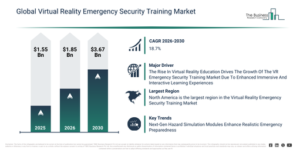
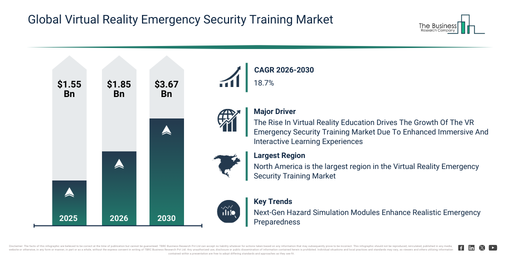
The virtual reality emergency security training market has shown rapid expansion in recent years. It is forecast to rise from $1.55 billion in 2025 to $1.85 billion in 2026, progressing at a compound annual growth rate (CAGR) of 19.1%. The growth observed in previous periods is attributable to the enforcement of workplace safety regulations, the increased adoption of simulation-based training, the growing availability of VR hardware, an uptick in emergency preparedness programs, and the wider expansion of digital training platforms.
The virtual reality emergency security training market is anticipated to experience substantial growth over the next few years. Its valuation is projected to reach $3.67 billion by 2030, expanding at a compound annual growth rate (CAGR) of 18.7%. This expansion during the forecast period is fueled by the integration of AI-driven assessment tools, the rise of remote workforce training, the adoption of metaverse learning environments, the demand for scalable safety training platforms, and the expansion of government training budgets. Prominent trends for this period include immersive scenario-based training, AI-powered adaptive learning modules, multi-user collaborative simulations, remote VR training deployment, and wearable sensor integration.
Download A Free Sample Report For Comprehensive Market Insights:
Virtual Reality Emergency Security Training Market Growth Momentum: Which Factors Are Influencing Demand?
The expansion of virtual reality education is projected to drive the growth of the virtual reality emergency security training market in the coming years. Virtual reality education involves employing immersive, computer-generated environments to simulate actual or imaginary situations for interactive and experience-based learning. The increase in virtual reality education is primarily fueled by better access to realistic simulations, which enhance immersive and interactive learning experiences. Virtual reality emergency security training further strengthens VR education by offering immersive, practical experiences that improve learners’ readiness and response capabilities in authentic crisis scenarios. VR-based emergency security training aids the wider adoption of immersive learning by showcasing VR’s practical utility in critical, real-world situations. The demand for VR education rises as academic institutions and corporate training programs increasingly incorporate immersive learning formats. For example, in October 2025, Treeview Studio, a US-based enterprise XR studio specializing in AR/VR and spatial-computing applications, noted that by 2024, educational institutions were integrating immersive technologies into their curricula more frequently, with approximately 30% of universities globally providing VR-based courses. This surge was largely due to Meta Platforms’ strategic focus on the education sector, leading to a 69.4% increase in educational VR deployments within the year and contributing to a 14.9% overall rise in commercial VR headset shipments. Consequently, the advancement of virtual reality education is anticipated to boost the virtual reality emergency security training market.
Virtual Reality Emergency Security Training Market Segments: Where Are The Largest Growth Opportunities?
The virtual reality emergency security training market covered in this report is segmented –
1) By Type: System, Service
2) By Training Type: Fire Safety Training, Weapons Training, Cybersecurity Awareness, Emergency Response Procedures, Active Shooter Scenarios, Disaster Preparedness, First Aid And Cardiopulmonary Resuscitation Training, Hazmat Training
3) By Technology Used: Virtual Reality Headsets, Augmented Reality Systems, Mixed Reality Solutions, Simulation Software, Wearable Technology, 3D Visualization Tools, Artificial Intelligence Integration
4) By Application: Law Enforcement, Fire safety, Medical Emergency, Industrial Safety, Other Applications
5) By End User: Government, Healthcare, Education, Corporate, Other End Users
Subsegments:
1) By System: Hardware, Software Platforms, Integrated Virtual Reality Training Systems
2) By Service: Installation And Integration Services, Training And Support Services, Consulting Services, Managed Services, Maintenance And Upgrades
Virtual Reality Emergency Security Training Market Innovation Trends Driving Future Development
Leading companies in the virtual reality emergency security training market are concentrating on developing immersive, AI-driven hazard simulation modules to improve realistic and effective emergency response instruction. These hazard simulation modules are virtual reality programs that replicate dangerous scenarios, training users to recognize and respond to emergencies safely. For example, in March 2025, TDW Technologies Private Limited, an India-based VR/AR company, launched the #TrainSafeWithVR campaign, demonstrating how immersive technologies can enhance workplace safety and awareness across various industries. This campaign leverages AI-powered VR to simulate dangerous, impossible-to-recreate, rare, and expensive (DIRE) scenarios, enabling employees to practice emergency responses and technical skills within a secure, immersive environment. The initiative aims to boost safety compliance, reduce workplace accidents, and increase engagement, particularly among digitally native workers, by offering a realistic, practical training experience.
Virtual Reality Emergency Security Training Market Major Participants And Competitive Dynamics
Major companies operating in the virtual reality emergency security training market are Unity Technologies SF, Axon Enterprise Inc., G-Cube Webwide Software Pvt. Ltd., STRIVR Labs Inc., zSpace Inc., Program-Ace LLC, Kompanions Edu Services Pvt. Ltd., Talespin Reality Labs Inc., NextWave Safety Solutions Inc., VR Vision Inc., Immerse Learning Inc., Cyberith GmbH, DevDen Creative Solutions Pvt. Ltd., Fusion VR, NGN International W.L.L., PIXO VR Inc., Twin Reality Technologies LLP, Immersafety Srl, Industrial Safety Training Council, Simbott Technologies Pvt. Ltd.
Access The Complete Virtual Reality Emergency Security Training Market Report:
Virtual Reality Emergency Security Training Market Largest Region By Revenue And Market Share
North America was the largest region in the virtual reality emergency security training market in 2025. Asia-Pacific is expected to be the fastest-growing region in the forecast period. The regions covered in the virtual reality emergency security training market report are Asia-Pacific, South East Asia, Western Europe, Eastern Europe, North America, South America, Middle East, Africa.
Get in touch with us:
The Business Research Company: https://www.thebusinessresearchcompany.com/
Americas: +1 310-496-7795
Asia: +44 7882 955267 & +91 8897263534
Europe: +44 7882 955267
Email us at: marketing@tbrc.info
Follow us on:
LinkedIn: https://in.linkedin.com/company/the-business-research-company
YouTube: https://www.youtube.com/channel/UC24_fI0rV8cR5DxlCpgmyFQ
Global Market Model: https://www.thebusinessresearchcompany.com/global-market-model

Wasay has over a decade of experience in market research, data modelling, and analytics, with prior experience at GlobalData and Decision Tree Consulting Services. At The Business Research Company , he leads research operations across syndicated studies, customized consulting engagements, and the Global Market Model platform. His professional experience includes supporting organizations such as Boston Consulting Group, KPMG, and Ernst & Young. Wasay holds a degree in Electronics and Communications Engineering, postgraduate management qualifications from International Management Institute Belgium and Indian School of Business and Entrepreneurship, and completed the Integrated Program in Business Analytics from Indian Institute of Management Indore.