Built to provide research that’s more actionable and strategically valuable, The Business Research Company’s 2026 market reports include market attractiveness analysis, total addressable market sizing, company benchmarking matrices, interactive Excel dashboards, broader supply chain intelligence, emerging startup tracking, and in-depth product insights.
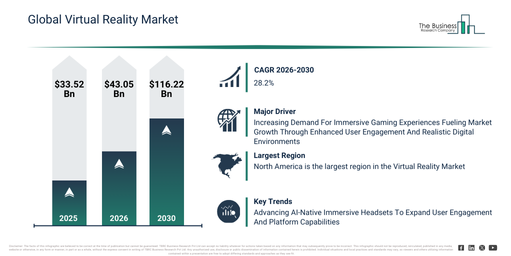
Virtual Reality Market Growth From $43.05 Billion In 2026 To $116.22 Billion By 2030 At A CAGR Of 28.2%
The virtual reality market has experienced significant expansion in recent years. It is anticipated to expand from $33.52 billion in 2025 to $43.05 billion in 2026, at a compound annual growth rate (CAGR) of 28.5%. This historical expansion is attributable to various factors, including a heightened demand for immersive gaming experiences, the escalating adoption of virtual reality for training purposes by businesses, increased capital infusion into virtual reality content development, the broader accessibility of virtual reality hardware, and the widening application of virtual reality across the education and healthcare sectors.
The virtual reality market is set to experience significant growth in the coming years. It is forecast to grow to $116.22 billion in 2030, achieving a compound annual growth rate (CAGR) of 28.2%. This projected expansion can be attributed to the increasing integration of virtual reality with artificial intelligence and 5G, the rising adoption of virtual reality for remote collaboration, increased enterprise spending on virtual reality simulations, the expansion of cloud-based virtual reality platforms, and the growing deployment of virtual reality solutions in retail and e-commerce. Noteworthy trends for the forecast period include advancements in virtual reality hardware technology, innovations in haptic feedback systems, developments in eye-tracking and motion tracking, research and development in ultra-realistic virtual reality experiences, and technological advancements in standalone virtual reality devices.
Get A Free Sample Report With In-Depth Market Insights:
Virtual Reality Market Growth Catalysts And Demand Drivers
The rising desire for immersive gaming experiences is anticipated to drive the expansion of the Virtual Reality (VR) market in the future. Immersive gaming involves interactive digital entertainment where players are deeply engaged with highly detailed, three-dimensional virtual environments, frequently accessed through VR equipment that monitors user movement and delivers reactive visual and audio feedback. The requirement for immersive gaming experiences is growing because more players are seeking greater levels of realism and interaction than conventional gaming platforms can offer. Virtual Reality (VR) facilitates immersive gaming by providing highly interactive, sensory-rich environments that fulfill evolving player expectations for engagement and realism. As an illustration, in March 2025, Meta Platforms, a US-based social technology company, reported that cumulative spending on Meta Quest titles exceeded $2 billion, with overall developer payments climbing by approximately 12% in 2024, and user engagement improving as customers dedicated 30% more monthly time to virtual reality in 2024 compared to the prior year. Consequently, the increasing demand for immersive gaming experiences is fueling the growth of the Virtual Reality (VR) market.
Virtual Reality Market Segment Breakdown: Which Categories Lead On Revenue?
The virtual reality market covered in this report is segmented –
1) By Component: Hardware, Software
2) By Deployment: On-Premises Virtual Reality (VR), Cloud-Based
3) By Device: Head-Mounted Display (HMD), Gesture-Tracking Device (GTD), Projectors And Display Wall (PDW)
4) By Technology: Semi And Fully Immersive, Non-Immersive
5) By Application: Aerospace And Defense, Consumer, Commercial, Enterprise, Healthcare, Other Applications
Subsegments:
1) By Hardware: Head Mounted Display, Motion Controllers, Haptic Devices, Tracking Cameras, Gesture Tracking Sensors
2) By Software: Rendering Engines, Simulation And Training Software, Content Management Systems, Interaction Middleware, Development Tools And Libraries
Virtual Reality Market Trends Shaping Long-Term Demand
Companies operating significantly within the virtual reality (VR) market are concentrating on developing advanced products, notably extended reality (XR) headsets. This focus aims to broaden VR experiences, enhance natural user interaction, and integrate contextual artificial intelligence within virtual environments. An extended reality (XR) headset is defined as a wearable device that projects immersive digital content onto or around the user’s real-world perspective, thereby enabling virtual, augmented, or mixed reality experiences from a single hardware platform. For example, in October 2025, Samsung Electronics Co. Ltd., a consumer electronics company based in South Korea, unveiled the Galaxy XR. This Android XR-powered extended reality headset features dual 4K micro-OLED displays with up to 27 million total pixels, a Qualcomm Snapdragon XR2+ Gen 2 processor, and supports multimodal interaction, including voice, hand, and eye tracking, powered by integrated AI. These capabilities offer high visual fidelity, intuitive interaction, and wide-ranging app compatibility, enabling users to access Android applications like Google Maps and YouTube in immersive settings, which represents a strategic effort to elevate immersive engagement and expand the practical usefulness of VR and extended reality platforms.
Virtual Reality Market Leading Players And Competitive Positioning
Major companies operating in the virtual reality market are Meta Platforms Inc., Valve Corporation, Unity Software Inc., Epic Games Inc., Crytek GmbH, HTC Corporation, Pimax Technology Co. Ltd., Varjo Technologies Oy, nDreams Limited, EON Reality Inc., Shanghai Lexiang Technology Co. Ltd., Resolution Games AB, Survios Inc., Ultraleap Ltd., VRgineers Inc., Fast Travel Games AB, HaptX Inc., Virtuix Holdings Inc., Bigscreen Inc., Lynx Mixed Reality SAS, Manus VR B.V., InstaVR Inc., WorldViz LLC
View The Full Virtual Reality Market Report:
Virtual Reality Market Regional Split: Which Areas Are Fueling Growth?
North America was the largest region in the virtual reality market in 2025. Asia-Pacific is expected to be the fastest-growing region in the forecast period. The regions covered in the virtual reality market report are Asia-Pacific, South East Asia, Western Europe, Eastern Europe, North America, South America, Middle East, Africa.
Reach Out To Our Team:
The Business Research Company: https://www.thebusinessresearchcompany.com/
Americas: +1 310-496-7795
Asia: +44 7882 955267 & +91 8897263534
Europe: +44 7882 955267
Email us at: marketing@tbrc.info
Follow us on:
LinkedIn: https://in.linkedin.com/company/the-business-research-company
YouTube: https://www.youtube.com/channel/UC24_fI0rV8cR5DxlCpgmyFQ
Global Market Model: https://www.thebusinessresearchcompany.com/global-market-model

Wasay has over a decade of experience in market research, data modelling, and analytics, with prior experience at GlobalData and Decision Tree Consulting Services. At The Business Research Company , he leads research operations across syndicated studies, customized consulting engagements, and the Global Market Model platform. His professional experience includes supporting organizations such as Boston Consulting Group, KPMG, and Ernst & Young. Wasay holds a degree in Electronics and Communications Engineering, postgraduate management qualifications from International Management Institute Belgium and Indian School of Business and Entrepreneurship, and completed the Integrated Program in Business Analytics from Indian Institute of Management Indore.