Enhanced with market attractiveness analysis, total addressable market evaluation, company benchmarking matrices, interactive Excel dashboards, expanded supply chain intelligence, emerging startup coverage, and detailed product insights, The Business Research Company’s 2026 market reports deliver more actionable and strategically valuable research.
Visual Positioning System Market Value Analysis: What Growth Is Expected Over The Forecast Period?
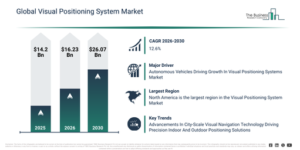
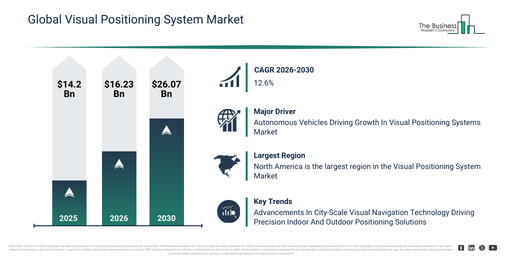
The visual positioning system market has experienced rapid growth in size over recent years. It is projected to increase from $14.2 billion in 2025 to $16.23 billion in 2026, demonstrating a compound annual growth rate (CAGR) of 14.2%. The expansion seen in the historic period can be attributed to the rising deployment of indoor mapping solutions, the development of location-based services, the scaling of smart infrastructure projects, advancements in camera and sensor technologies, and a growing demand for precise navigation systems.
The visual positioning system market is projected for significant expansion in the coming years. Its size is anticipated to reach $26.07 billion by 2030, exhibiting a compound annual growth rate (CAGR) of 12.6%. This growth during the forecast period is fueled by the increasing adoption of autonomous navigation systems, growing investments in smart cities, the broadening of robotics and drone navigation applications, greater integration of AI-driven localization algorithms, and the demand for seamless indoor-outdoor positioning solutions. Key developments expected over this period include the wider uptake of vision-based indoor navigation, enhanced integration of VPS with augmented reality (AR) applications, increased deployment of camera-based localization systems, the expansion of GPS-denied navigation alternatives, and a heightened emphasis on achieving high-accuracy positioning.
Download A Free Sample Report For Comprehensive Market Insights:
Visual Positioning System Market Expansion Supported By Key Demand Factors
The growth of the visual positioning systems market is projected to be propelled by the increasing deployment of autonomous vehicles. These self-driving cars leverage advanced sensor technologies, computer systems, and artificial intelligence to navigate and operate without constant human intervention. The rise in autonomous vehicles can be attributed to advancements in artificial intelligence and sensor technology, along with substantial investment and support from private companies and governments focused on enhancing transportation safety and efficiency. Visual positioning systems are a crucial supporting technology, providing the accuracy, integrity, and shared reference frame essential for safe, dependable self-driving capabilities as autonomous vehicles become more widespread. For instance, in December 2024, the Insurance Institute for Highway Safety, a US-based non-profit organization, anticipates that 4.5 million self-driving vehicles will be on U.S. roads by 2030, according to the National Association of Insurance Commissioners. Thus, the increasing number of autonomous vehicles is a primary driver for the expansion of the visual positioning systems market.
Visual Positioning System Market Segment Outlook: Which Categories Are Expanding The Fastest?
The visual positioning system market covered in this report is segmented –
1) By Component: Sensors, Camera Systems, Markers, Other Components
2) By Type: 1D (One-Dimensional), 2D (Two-Dimensional), 3D (Three-Dimensional)
3) By Solution: Navigation, Analytics, Tracking, Industrial Solutions, Other Solutions
4) By Location: Indoor Positioning System, Outdoor Positioning System
5) By Application: Commercial Application, Retail, Healthcare, Industrial, Transportation And Logistics, Hospitality, Defense Application, Other Applications
Subsegments:
1) By Sensors: Optical Sensors (Photodetectors), Lidar Sensors (Light Detection And Ranging), Inertial Measurement Units (Imus) (Gyroscopes, Accelerometers), Ultrasonic Sensors (For Distance Measurement), Magnetic Sensors (For Orientation And Positioning), Gps Sensors (For Hybrid Systems)
2) By Camera Systems: Monocular Cameras (Single Lens For Positioning), Stereo Camera Systems (Two Cameras For Depth Perception), 360-Degree Cameras (Panoramic Cameras For Complete Spatial Coverage), Depth Cameras (Time-Of-Flight Cameras), Infrared Cameras (Used For Low-Light Or Night-Time Positioning), Rgb Cameras (Standard Cameras For Image Processing)
3) By Markers: Qr Code Markers (For Machine Vision-Based Positioning), Fiducial Markers (Distinct Visual Patterns For Positioning), Barcodes (For Indoor Navigation And Item Tracking), Ar (Augmented Reality) Markers (Used In Ar-Based Positioning Systems), Optical Flow Markers (For Dynamic And Real-Time Positioning), Custom Visual Markers (Designed For Specific Positioning Needs)
4) By Other Components: Processing Units (Microcontrollers, Gpus For Data Processing), Software And Algorithms (For Image Processing, Position Estimation), Communication Modules (Wi-fi, Bluetooth, Li-Fi), Power Supply Units ( Batteries, Power Management Systems), Mounting Hardware (Brackets, Supports For Sensors And Cameras), Calibration Tools (To Ensure Accurate Measurements And Alignment)
Visual Positioning System Market Growth Trends Influencing Competitive Dynamics
Major companies in the visual positioning system market are prioritizing the development of innovative solutions, such as augmented reality navigation, to elevate user experience and enable precise location-based services. Augmented reality (AR) navigation is a technology that projects digital directions, information, or markers onto a real-world view through a device like a smartphone or AR glasses, helping users to navigate more intuitively, locate places swiftly, and interact efficiently with their environment. As an illustration, in February 2023, Immersal Oy, a technology company based in Finland, unveiled its Immersal City-Scale Visual Positioning System, an innovative solution specifically designed to map entire city environments for augmented reality and navigation applications. This system incorporates detailed 3D point cloud data, high-resolution imaging, and machine learning algorithms to facilitate seamless localization and mapping, supports various platforms including mobile and AR devices, and equips developers with tools to create immersive AR experiences with centimeter-level accuracy. Its broad applications cover smart city infrastructure, AR gaming, indoor navigation, and location-based marketing, representing a significant enhancement over conventional GPS-based systems by providing reliable precision in complex settings.
Visual Positioning System Market Key Companies And Competitive Benchmarking
Major companies operating in the visual positioning system market are Google LLC, Qualcomm Inc., Broadcom Inc., MediaTek Inc., STMicroelectronics, Infineon Technologies AG, Hexagon AB, Trimble Inc., Sick AG, Topcon Corporation, Pepperl + Fuchs Inc., Cognex Corporation, Niantic Inc., Sonardyne International Ltd., DJI Technology Co Ltd, Sony Corporation, Apple Inc, NVIDIA Corporation, TomTom NV, HERE Technologies
Access The Complete Visual Positioning System Market Report:
Visual Positioning System Market Geographic Landscape: Which Region Dominates Industry Growth?
North America was the largest region in the visual positioning system market in 2025. Asia-Pacific is expected to be the fastest-growing region in the forecast period. The regions covered in the visual positioning system market report are Asia-Pacific, South East Asia, Western Europe, Eastern Europe, North America, South America, Middle East, Africa.
Get in touch with us:
The Business Research Company: https://www.thebusinessresearchcompany.com/
Americas: +1 310-496-7795
Asia: +44 7882 955267 & +91 8897263534
Europe: +44 7882 955267
Email us at: marketing@tbrc.info
Follow us on:
LinkedIn: https://in.linkedin.com/company/the-business-research-company
YouTube: https://www.youtube.com/channel/UC24_fI0rV8cR5DxlCpgmyFQ
Global Market Model: https://www.thebusinessresearchcompany.com/global-market-model

Wasay has over a decade of experience in market research, data modelling, and analytics, with prior experience at GlobalData and Decision Tree Consulting Services. At The Business Research Company , he leads research operations across syndicated studies, customized consulting engagements, and the Global Market Model platform. His professional experience includes supporting organizations such as Boston Consulting Group, KPMG, and Ernst & Young. Wasay holds a degree in Electronics and Communications Engineering, postgraduate management qualifications from International Management Institute Belgium and Indian School of Business and Entrepreneurship, and completed the Integrated Program in Business Analytics from Indian Institute of Management Indore.