Built to provide research that’s more actionable and strategically valuable, The Business Research Company’s 2026 market reports include market attractiveness analysis, total addressable market sizing, company benchmarking matrices, interactive Excel dashboards, broader supply chain intelligence, emerging startup tracking, and in-depth product insights.
Voice AI In Smart Homes Market Poised To Hit $138.39 Billion By 2030 With A 47.1% CAGR
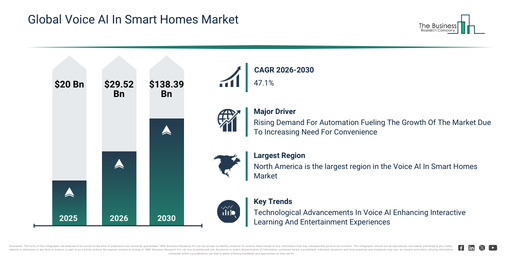
The voice AI in smart homes market size has experienced substantial growth in recent years. This market is expected to expand from $20 billion in 2025 to $29.52 billion in 2026, achieving a compound annual growth rate (CAGR) of 47.6%. The historical increase can be attributed to factors such as the rise in smart speaker adoption, the broadening of home automation systems, and increasing consumer demand.
The market for voice AI in smart homes is projected to experience substantial growth over the coming years, anticipated to reach a valuation of $138.39 billion by 2030, exhibiting a compound annual growth rate (CAGR) of 47.1%. Factors driving this expansion include the integration of edge AI for voice processing, the proliferation of multilingual voice interfaces, the increasing uptake of smart home ecosystems, the broader application of voice biometrics for security, and enhanced personalization capabilities. Key trends identified for this period encompass multi-language voice recognition, the development of context-aware voice commands, more personalized voice assistants, offline voice processing features, and advanced voice-based home automation solutions.
Get A Free Sample Report With In-Depth Market Insights:
Voice AI In Smart Homes Market Demand Drivers Opening New Revenue Streams
Rising consumer interest in automation is projected to boost the expansion of the voice AI in smart homes market in the future. Automation involves employing machines or systems to perform duties independently of human intervention, thereby enhancing the efficiency and uniformity of processes. The demand for automation among consumers is growing because of a greater desire for convenience, since automated setups streamline everyday activities and conserve time by executing routine operations autonomously. This consumer demand for automation facilitates voice AI in smart homes by creating a requirement for hands-free control, enabling individuals to easily operate various devices and features via straightforward voice commands, thereby improving both user comfort and operational efficiency. An example illustrating this trend is that, in September 2023, data from the International Federation of Robotics (IFR), a robotics association based in Germany, showed that worldwide industrial robot installations in manufacturing facilities hit 553,052 units. This represented a 5 percent increase year-over-year in 2022, with 73 percent of these installations occurring in Asia, contrasted with 10 percent in the Americas. Consequently, the expanding consumer demand for automation is set to propel the growth of the voice AI in smart homes market.
Voice AI In Smart Homes Market Segment Trends And Revenue Contributors
The voice AI in smart homes market covered in this report is segmented –
1) By Smart Home Device Type: Smart Speakers And Assistants, Smart Displays, Smart Thermostats And Environmental Control Systems, Smart Lighting Systems, Smart Security Devices, Other Smart Home Device Types
2) By Technology: Natural Language Processing (NLP), Machine Learning And Deep Learning, Edge Computing And On-Device Processing, Other Technologies
3) By Deployment Mode: Cloud-Based, On-Premise
Subsegments:
1) By Smart Speakers And Assistants: Standalone Smart Speakers, Smart Assistants Integrated Into Devices, Voice-Controlled Hubs
2) By Smart Displays: Voice-Activated Smart Displays, Video Calling Smart Displays, Smart Displays With Integrated Hubs
3) By Smart Thermostats And Environmental Control Systems: Voice-Controlled Thermostats, Smart Air Conditioners And Heaters, Smart Air Quality Monitors, Voice-Activated Humidifiers Or Dehumidifiers
4) By Smart Lighting Systems: Voice-Activated Light Bulbs, Smart Light Switches And Dimmers, Smart Ambient And Mood Lighting, Lighting Control Hubs
5) By Smart Security Devices: Smart Door Locks, Voice-Controlled Security Cameras, Smart Doorbells, Smart Motion Sensors, Alarm Systems With Voice Control
6) By Other Smart Home Device Types: Voice-Controlled Smart Appliances, Smart TVs With Voice Assistants, Voice-Activated Irrigation Systems, Smart Plugs And Power Strips, Smart Garage Door Openers
Voice AI In Smart Homes Market Transformation Trends: What Innovations Are Driving Change?
Leading companies in the voice AI in smart homes market are developing sophisticated solutions, including AI-powered interactive toys, to improve both learning and entertainment. These intelligent playthings, known as AI-powered interactive toys, are embedded with artificial intelligence, allowing them to engage with users via speech, movement, and adaptive responses to create personalized and immersive play experiences. As an illustration, in March 2025, Agora Inc., a US-based software company, unveiled the ConvoAI Device Kit, an advanced conversational AI toolkit for internet of things (IoT) devices. A distinguishing feature of the ConvoAI Device Kit is its incorporation of Beken’s high-performance AI chip modules with Agora’s cutting-edge Conversational AI technology, which facilitates ultra-low latency voice interactions and intelligent real-time dialogue processing. This potent combination considerably improves the interactivity, intuitiveness, and emotional responsiveness of AI-powered interactive toys and robots, enabling them to participate in natural, lifelike discussions that foster more immersive and engaging user experiences.
Voice AI In Smart Homes Market Competitive Landscape: Which Companies Lead The Industry?
Major companies operating in the voice AI in smart homes market are Amazon.com Inc., Google LLC, Samsung Electronics Co. Ltd., Microsoft Corporation, Comcast Corporation, Huawei Technologies Co. Ltd., Siemens AG, Lenovo Group Limited, LG Electronics Inc., Orange S.A., GE Appliances a Haier company, Signify N.V., Bose Corporation, Sonos Inc., Miele & Cie. KG, Crestron Electronics Inc., Arlo Technologies Inc., SimpliSafe Inc., Control4 Corporation, Ecobee Inc., Wyze Labs Inc., Harman International Industries Inc.
View The Full Voice AI In Smart Homes Market Report:
Voice AI In Smart Homes Market Geographic Landscape: Which Region Leads Industry Growth?
North America was the largest region in the voice AI in smart homes market in 2025. Asia-Pacific is expected to be the fastest-growing region in the forecast period. The regions covered in the voice AI in smart homes market report are Asia-Pacific, South East Asia, Western Europe, Eastern Europe, North America, South America, Middle East, Africa.
Reach Out To Our Team:
The Business Research Company: https://www.thebusinessresearchcompany.com/
Americas: +1 310-496-7795
Asia: +44 7882 955267 & +91 8897263534
Europe: +44 7882 955267
Email us at: marketing@tbrc.info
Follow us on:
LinkedIn: https://in.linkedin.com/company/the-business-research-company
YouTube: https://www.youtube.com/channel/UC24_fI0rV8cR5DxlCpgmyFQ
Global Market Model: https://www.thebusinessresearchcompany.com/global-market-model

Wasay has over a decade of experience in market research, data modelling, and analytics, with prior experience at GlobalData and Decision Tree Consulting Services. At The Business Research Company , he leads research operations across syndicated studies, customized consulting engagements, and the Global Market Model platform. His professional experience includes supporting organizations such as Boston Consulting Group, KPMG, and Ernst & Young. Wasay holds a degree in Electronics and Communications Engineering, postgraduate management qualifications from International Management Institute Belgium and Indian School of Business and Entrepreneurship, and completed the Integrated Program in Business Analytics from Indian Institute of Management Indore.