Through market attractiveness analysis, total addressable market evaluation, company benchmarking matrices, interactive Excel dashboards, expanded supply chain intelligence, emerging startup coverage, and detailed product insights, The Business Research Company’s 2026 market reports provide more actionable and strategically valuable research.
Zero Trust Security Market Value Analysis: What Growth Is Expected Over The Forecast Period?
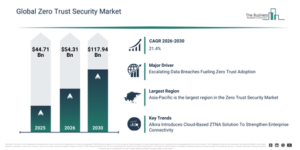
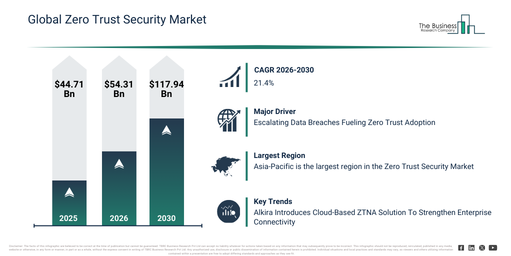
The zero trust security market has experienced substantial growth in recent years. Its valuation is anticipated to rise from $44.71 billion in 2025 to $54.31 billion in 2026, achieving a compound annual growth rate (CAGR) of 21.5%. The expansion witnessed in the past can be ascribed to a surge in cyber security breaches, increased adoption of cloud technologies, the proliferation of a remote workforce, broader enterprise digitization, and the inherent weaknesses of traditional perimeter-based security.
The zero trust security market is projected to experience substantial growth in the upcoming years, with its size set to reach $117.94 billion by 2030, exhibiting a compound annual growth rate (CAGR) of 21.4%. This expansion during the forecast period can be attributed to several factors, including more zero trust mandates from regulatory bodies, the proliferation of hybrid IT environments, increased uptake of identity access management solutions, the growth of cloud-native applications, and a heightened emphasis on mitigating insider threats. Key trends anticipated for this period encompass continuous identity verification models, the micro-segmentation of network access, a wider adoption of zero trust network access, the expansion of policy-based access control, and the integration of identity-centric security.
Download A Free Sample Report For Comprehensive Market Insights:
Zero Trust Security Market Opportunity Drivers: What Is Creating New Revenue Potential?
The expansion of the zero-trust security market is anticipated to be driven by the escalating frequency of data breaches and cyber threats. Cyber data breaches involve illicit entry into computer systems or networks to acquire confidential personal and financial details belonging to customers or users. The prevalence of numerous intentional breaches underscores the necessity for implementing zero-trust security solutions. These solutions provide a flexible and adaptive network security infrastructure, eliminating inherent trust in network access and requiring thorough user verification. As an illustration, in November 2024, the Australian Cyber Security Centre, a government body in Australia, reported that its Australian Cybersecurity Hotline, managed by ASD, recorded over 36,700 calls in the financial year 2023–24, representing a 12% increase from the prior year. Additionally, ASD addressed more than 1,100 cybersecurity incidents during this identical timeframe. Consequently, the escalation in data breaches and cyber threats will fuel the expansion of the ‘zero trust’ security market.
Zero Trust Security Market Segmentation And Category Breakdown
The zero trust security market covered in this report is segmented –
1) By Solution Type: Data Security, Network Security, API Security, Security Analytics, Endpoint Security, Security Orchestration Automation And Response, Security Policy Management
2) By Authentication: Identity-Based Authentication, Device-Based Authentication, Passwordless Authentication, Multi Factor Authentication
3) By Deployment: On Premises, Cloud
4) By Organization Size: Small And Medium Enterprises (SMEs), Large Enterprises
5) By Application Area: Information Technology (IT) And Telecom, Banking, Financial Services, and Insurance (BFSI), Healthcare, Retail, Other Application Areas
Subsegments:
1) By Data Security: Data Encryption Solutions, Data Loss Prevention (DLP) Solutions, Data Access Control Solutions, Information Rights Management (IRM)
2) By Network Security: Network Access Control (NAC), Secure Access Service Edge (SASE), Next-Generation Firewalls (NGFW), Virtual Private Networks (VPN)
3) By API Security: API Gateways, API Security Testing Tools, API Threat Protection Solutions, Runtime Application Self-Protection (RASP) for APIs
4) By Security Analytics: Security Information and Event Management (SIEM), User and Entity Behavior Analytics (UEBA), Threat Intelligence Platforms, Log Management Solutions
5) By Endpoint Security: Endpoint Detection and Response (EDR), Antivirus and Anti-Malware Solutions, Mobile Device Management (MDM), Endpoint Protection Platforms (EPP)
6) By Security Orchestration Automation And Response (SOAR): Security Automation Tools, Incident Response Platforms, Threat Hunting Solutions, Playbook Automation Solutions
7) By Security Policy Management: Policy Definition And Enforcement Tools, Compliance Management Solutions, Risk Assessment And Management Tools
Zero Trust Security Market Transformation Trends: Which Innovations Are Driving Change?
Leading companies in the Zero Trust Security market are concentrating on developing sophisticated solutions, such as unified secure access platforms, to improve connectivity reliability and performance. These unified secure access platforms are technologies that integrate identity-based, granular access control with network infrastructure capabilities to ensure that users, applications, and internet traffic adhere to a consistent security model regardless of their location. For instance, in October 2024, the US-based company Alkira introduced the Alkira Zero Trust Network Access (ZTNA) solution, which is a cloud-based service designed to unify security and performance across all traffic flows. Key attributes of this launched product include a consolidated solution for communications between users and applications, applications themselves, and users and the internet; a network-first strategy that leverages existing network segmentation without sacrificing performance; a decentralized architecture that combines a central policy enforcement engine with a distributed data plane; a single interface for management, monitoring, and visibility; integrated full-stack security allowing vendor choice for securing traffic to private applications and the internet; and scalable, on-demand delivery without requiring upfront hardware installations.
Zero Trust Security Market Competitive Analysis Of Major Industry Participants
Major companies operating in the zero trust security market are Cisco Systems Inc.; Palo Alto Networks; Check Point Software Technologies; Fortinet; Microsoft Corporation; Google Inc.; IBM Corporation; Zscaler; Cloudflare Inc.; Okta Inc.; CrowdStrike; AkamAI Technologies; VMware Inc.; Prisma Access; Sophos Group PLC; Trend Micro Inc.; Forcepoint; Delinea; Forescout Technologies; Perimeter 81
Access The Complete Zero Trust Security Market Report:
Zero Trust Security Market Regional Analysis And Leading Geography
Asia-Pacific was the largest region in the zero trust security market share in 2025. Asia-Pacific is expected to be the fastest-growing region in the forecast period. The regions covered in the zero trust security market report are Asia-Pacific, South East Asia, Western Europe, Eastern Europe, North America, South America, Middle East, Africa.
Get in touch with us:
The Business Research Company: https://www.thebusinessresearchcompany.com/
Americas: +1 310-496-7795
Asia: +44 7882 955267 & +91 8897263534
Europe: +44 7882 955267
Email us at: marketing@tbrc.info
Follow us on:
LinkedIn: https://in.linkedin.com/company/the-business-research-company
YouTube: https://www.youtube.com/channel/UC24_fI0rV8cR5DxlCpgmyFQ
Global Market Model: https://www.thebusinessresearchcompany.com/global-market-model

Wasay has over a decade of experience in market research, data modelling, and analytics, with prior experience at GlobalData and Decision Tree Consulting Services. At The Business Research Company , he leads research operations across syndicated studies, customized consulting engagements, and the Global Market Model platform. His professional experience includes supporting organizations such as Boston Consulting Group, KPMG, and Ernst & Young. Wasay holds a degree in Electronics and Communications Engineering, postgraduate management qualifications from International Management Institute Belgium and Indian School of Business and Entrepreneurship, and completed the Integrated Program in Business Analytics from Indian Institute of Management Indore.