Backed by market attractiveness analysis, total addressable market sizing, company benchmarking matrices, interactive Excel dashboards, wider supply chain intelligence, emerging startup coverage, and detailed product-level insights, The Business Research Company’s 2026 market reports are designed to offer research that is more actionable and strategically valuable than ever.
Zero User Interface (UI) Technologies Market Size, Value And Growth Trajectory Through 2030
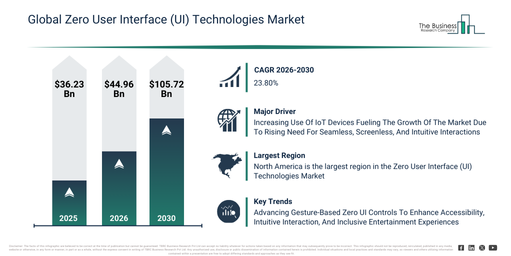
The zero user interface (UI) technologies market has experienced remarkable expansion in recent years. This market is set to increase from $36.23 billion in 2025 to $44.96 billion in 2026, achieving a compound annual growth rate (CAGR) of 24.1%. The historical growth of this market can be linked to factors such as the rising adoption of voice-enabled devices, increased investments in sensor integration, a growing reliance on gesture-based controls, the expansion of smart home ecosystems, and the increasing demand for touchless interfaces.
The zero user interface (UI) technologies market is projected to experience substantial growth in the coming years. It is anticipated to expand to $105.72 billion by 2030, exhibiting a compound annual growth rate (CAGR) of 23.8%. This expansion during the forecast period can be attributed to several factors, including the increasing implementation of artificial intelligence-driven interfaces, the rising demand for contactless interaction, the growing integration of biometrics in consumer devices, the expansion of context-aware computing, and the wider adoption of ambient intelligence platforms. Significant trends expected during this period include advancements in natural language processing, innovations in brain-computer interfaces, developments in multimodal interaction systems, ongoing research and development in context-aware intelligence, and technological improvements in sensor fusion.
Get A Free Sample Report With In-Depth Market Insights:
Zero User Interface (UI) Technologies Market Demand Drivers: What’s Powering Industry Growth?
The expansion in the deployment of internet of things (IoT) devices is anticipated to significantly boost the zero user interface (UI) technologies market in the coming period. These devices are defined as linked physical objects containing sensors, software, and communication tools, allowing them to gather, share, and autonomously react to data. The surge in Internet of Things (IoT) uptake is attributed to progress in 5G networks, which provide extremely low-latency connections for extensive real-time device interaction. Zero UI technologies facilitate the utilization of internet of things (IoT) devices by enabling interaction via voice, gestures, biometrics, environmental signals, and AI-powered automation, moving beyond conventional screens or touch interfaces, which fosters more organic and intuitive human-machine exchanges. As an illustration, VelosIOT, a US-based Internet of Things (IoT) solutions provider, reported in July 2025 that the count of connected Internet of Things (IoT) devices was forecast to hit 18.8 billion by the end of 2024, marking a 13% increase from 16.6 billion in 2023, and is expected to surpass 40 billion by 2030. Consequently, the rising prevalence of Internet of Things (IoT) devices acts as a primary catalyst for the expansion of the zero user interface (UI) technologies market.
Zero User Interface (UI) Technologies Market Segmentation And Category Overview
The zero user interface (ui) technologies market covered in this report is segmented –
1) By Component: Hardware, Software, Services
2) By Technology: Voice Or Speech Recognition, Gesture And Motion Recognition, Touch And Haptic Surfaces, Computer Vision And Gaze Tracking, Brain-Computer Interfaces, Other Technologies
3) By Interaction Type: Voice-Based Interaction, Gesture-Based Interaction, Motion-Based Interaction, Biometric-Based Interaction, Environmental-Awareness Interaction, Context-Aware Interaction
4) By Deployment Mode: On-Premise, Cloud-Based
5) By End User: Residential Users, Commercial Enterprises, Industrial Users, Government And Public Sector, Healthcare Providers
Subsegments:
1) By Hardware: Sensors, Cameras, Microphones, Processors, Displays
2) By Software: Voice Recognition Software, Gesture Recognition Software, Motion Detection Software, Biometric Recognition Software, Context Awareness Software
3) By Services: Integration Services, Consulting Services, Maintenance Services, Training Services, Implementation Services
Zero User Interface (UI) Technologies Market Innovation Trends: What Developments Are Reshaping The Industry?
Leading companies in the zero UI technologies market are concentrating on product advancements, such as gesture-enabled televisions, to allow users to control content or accessibility features without a remote or physical buttons, thereby enhancing usability and inclusive experiences. Gesture-enabled TVs are defined as televisions that use gesture recognition technology, where integrated cameras and artificial intelligence (AI) software interpret hand or body movements to manage functions like volume and channels without remotes. For example, in March 2025, Samsung Electronics Co., Ltd., a South Korea–based electronics company, introduced its Neo QLED 4K lineup. This range features three model series – QN90F, QN80F, and QN70F – all equipped with Quantum Matrix Mini LEDs for precise brightness control and vivid color accuracy. The flagship QN90F series incorporates the upgraded NQ4 AI Gen3 Processor, Neo Quantum HDR+, and Glare-Free technology to deliver ultra-realistic visuals and enhanced sound. The QN80F and QN70F series are equipped with the NQ4 AI Gen2 Processor, AI 4K upscaling, and Motion Xcelerator technology, ensuring smooth, tear-free motion during fast-paced content and gaming. Furthermore, Samsung Vision AI powers intuitive smart features across the Neo QLED, OLED, The Frame, and QLED series, enabling functions such as Click to Search, Live Translate, and Universal Gestures for simplified interaction and a personalized entertainment experience.
Zero User Interface (UI) Technologies Market Company Landscape And Competitive Strategy
Major companies operating in the zero user interface (ui) technologies market are Apple Inc., Google LLC, Microsoft Corporation, Samsung Electronics Co. Ltd., Qualcomm Incorporated, STMicroelectronics N.V., Texas Instruments Incorporated, NXP Semiconductors N.V., NCR Corporation, Zebra Technologies Corporation, Diebold Nixdorf Incorporated, IDEMIA Group, Sonos Inc., Synaptics Incorporated, Tobii AB, Cerence Inc., KIOSK Information Systems Inc., SoundHound Inc., RealWear Inc., Ultraleap Ltd., Sensory Inc., FaceTec Inc.
View The Full Zero User Interface (UI) Technologies Market Report:
Zero User Interface (UI) Technologies Market Largest Region: Which Geography Holds The Biggest Share?
North America was the largest region in the zero user interface (UI) technologies market in 2025. Asia-Pacific is expected to be the fastest-growing region in the forecast period. The regions covered in the zero user interface (ui) technologies market report are Asia-Pacific, South East Asia, Western Europe, Eastern Europe, North America, South America, Middle East, Africa.
Reach Out To Our Team:
The Business Research Company: https://www.thebusinessresearchcompany.com/
Americas: +1 310-496-7795
Asia: +44 7882 955267 & +91 8897263534
Europe: +44 7882 955267
Email us at: marketing@tbrc.info
Follow us on:
LinkedIn: https://in.linkedin.com/company/the-business-research-company
YouTube: https://www.youtube.com/channel/UC24_fI0rV8cR5DxlCpgmyFQ
Global Market Model: https://www.thebusinessresearchcompany.com/global-market-model

Wasay has over a decade of experience in market research, data modelling, and analytics, with prior experience at GlobalData and Decision Tree Consulting Services. At The Business Research Company , he leads research operations across syndicated studies, customized consulting engagements, and the Global Market Model platform. His professional experience includes supporting organizations such as Boston Consulting Group, KPMG, and Ernst & Young. Wasay holds a degree in Electronics and Communications Engineering, postgraduate management qualifications from International Management Institute Belgium and Indian School of Business and Entrepreneurship, and completed the Integrated Program in Business Analytics from Indian Institute of Management Indore.