The Business Research Company’s 2026 market reports are designed to deliver research that is more actionable and strategically valuable. Key offerings include market attractiveness scoring, total addressable market sizing, company benchmarking matrices, interactive Excel dashboards, deeper supply chain intelligence, emerging startup tracking, and granular product-level insights.
Which Factors Will Shape The ZR+ Coherent-Optics Market Size Through 2030?
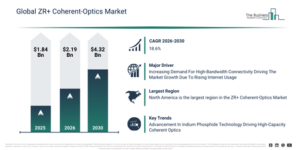
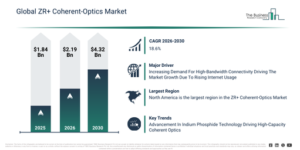
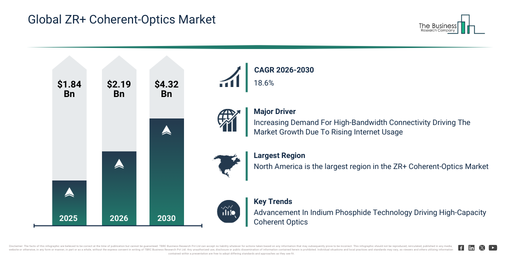
The zr+ coherent-optics market has experienced substantial expansion in its size over recent years. This market is projected to expand from $1.84 billion in 2025 to $2.19 billion in 2026, demonstrating a compound annual growth rate (CAGR) of 18.9%. Historically, this expansion has been driven by factors such as the early implementation of coherent optics within metro networks, an increasing need for high-capacity data center interconnects, the rollout of 100g and 400g transceivers, the enlargement of cloud infrastructure, and the necessity for streamlined network architecture in long-haul networks.
The zr+ coherent-optics market is set for significant expansion over the next few years. It is projected to reach a value of $4.32 billion in 2030, demonstrating a compound annual growth rate (CAGR) of 18.6%. This anticipated growth during the forecast period can be attributed to factors like the increased development of 800g and higher optical modules, broader deployment in regional and metro networks, rising demand for energy-efficient high-speed data transport, the adoption of pluggable coherent transceivers, and integration with AI-driven network management systems. Prominent trends for the forecast period include enhancements in coherent transceivers, optimization of zr+ optical modules, the development of high-capacity data transmission solutions, deployment in metro and long-haul networks, and improvements in energy-efficient optical networking.
Request A Free ZR+ Coherent-Optics Market Sample To Support Your Strategic Planning:
What Is Propelling The ZR+ Coherent-Optics Market Toward $4.32 Billion By 2030?
The ZR+ coherent-optics market is projected to experience growth due to the escalating requirement for high-bandwidth connectivity. This connectivity type refers to internet connections delivering significantly faster data transmission speeds to support data-intensive applications and services. The demand for high-bandwidth connectivity is on the rise, driven by the exponential surge in internet usage, as more individuals necessitate quicker and more reliable connections for tasks like remote work, streaming, cloud services, and emerging technologies. ZR+ coherent-optics enables high-bandwidth connectivity by allowing 400 Gbps data transmission rates over long distances up to 80 kilometers, thus providing the vital high-speed optical communication infrastructure necessary for meeting expanding bandwidth demands within data centers and telecommunications networks. For example, in November 2024, the UK Parliament’s House of Commons Library, a UK-based government administration, reported that as of January 2024, 78% of UK premises had access to gigabit-capable broadband. This figure represents an increase from 72% in January 2023 and 64% in January 2022. Consequently, the rising demand for high-bandwidth connectivity is propelling the expansion of the ZR+ coherent-optics market.
What Are The Key Segments And Subsegments In The ZR+ Coherent-Optics Market?
The zr+ coherent-optics market covered in this report is segmented –
1) By Component: Transceivers, Modules, Optical Fibers, Amplifiers, Other Components
2) By Data Rate: 100 Gigabits Per Second (G), 200 Gigabits Per Second (G), 400 Gigabits Per Second (G), 800 Gigabits Per Second (G), Above
3) By Application: Data Center Interconnect, Metro Networks, Long Haul, Cloud Infrastructure, Other Applications
4) By End-User: Telecommunications, Cloud Service Providers, Enterprises, Other End-Users
Subsegments:
1) By Transceivers: 100 Gigabit Transceivers, 400 Gigabit Transceivers, Coherent Transceivers, Pluggable Transceivers
2) By Modules: Amplifier Modules, Multiplexer Modules, Optical Line Modules, Transponder Modules
3) By Optical Fibers: Single Mode Fibers, Multimode Fibers, Polarization Maintaining Fibers, Dispersion Shifted Fibers
4) By Amplifiers: Erbium Doped Fiber Amplifiers, Raman Amplifiers, Semiconductor Optical Amplifiers, Hybrid Amplifiers
5) By Other Components: Connectors, Optical Switches, Patch Panels, Power Supply Units
ZR+ Coherent-Optics Market Trends Behind The 18.6% CAGR Forecast
Leading companies in the ZR+ coherent-optics market are focusing on utilizing innovative technologies like indium phosphide (InP) chip technology to improve optical performance, extend transmission reach, decrease power consumption, and facilitate higher-capacity pluggable modules for data center and telecom networks. Indium phosphide (InP) chip technology is a compound semiconductor material employed to construct high-speed, low-loss optical components, and it aids in enabling higher data rates, longer transmission distances, and reduced power consumption in coherent optical modules. For example, in March 2025, Coherent Inc., a US-based manufacturing company, launched its 800G ZR/ZR+ transceiver in the QSFP-DD form factor, powered by its in-house IC-TROSA optical engine built on indium phosphide (InP) chip technology. This module supports transmission distances exceeding 500 km in ZR mode and over 1000 km in ZR+ modes, providing extended reach at lower data rates, which enables high-capacity, energy-efficient pluggable solutions for metro, regional, and data center interconnect networks. The solution removes the necessity for external amplifiers and tunable filters, thereby simplifying deployment and reducing the total cost of ownership for operators. It also capitalizes on Coherent’s expertise in 400G coherent optics to offer a smooth migration path for service providers, while simultaneously addressing the growing demand for scalable bandwidth and IP-over-DWDM architectures in next-generation optical networks.
Major Companies Profiled In The ZR+ Coherent-Optics Market Report
Major companies operating in the zr+ coherent-optics market are Huawei Technologies Co. Ltd., Cisco Systems Inc., Sumitomo Electric Industries Ltd., Fujitsu Limited, NEC Corporation, Nokia Corporation, ZTE Corporation, Marvell Technology Inc., Arista Networks Inc., Juniper Networks Inc., Ciena Corporation, II-VI Incorporated, Lumentum Holdings Inc., Ribbon Communications Inc., Accelink Technologies Co. Ltd., ADTRAN Networks SE, Cambridge Industries Group (CIG), Eoptolink Technology Co. Ltd., FS.COM LIMITED, EFFECT Photonics Ltd.
Explore The Business Research Company’s Complete ZR+ Coherent-Optics Market Report:
Where Does The ZR+ Coherent-Optics Market Generate The Most Revenue?
North America was the largest region in the ZR+ coherent-optics market in 2025. Asia-Pacific is expected to be the fastest-growing region in the forecast period. The regions covered in the zr+ coherent-optics market report are Asia-Pacific, South East Asia, Western Europe, Eastern Europe, North America, South America, Middle East, Africa.
Reach Out To Our Team:
The Business Research Company: https://www.thebusinessresearchcompany.com/
Americas: +1 310-496-7795
Asia: +44 7882 955267 & +91 8897263534
Europe: +44 7882 955267
Email us at: marketing@tbrc.info
Follow us on:
LinkedIn: https://in.linkedin.com/company/the-business-research-company
YouTube: https://www.youtube.com/channel/UC24_fI0rV8cR5DxlCpgmyFQ
Global Market Model: https://www.thebusinessresearchcompany.com/global-market-model

Wasay has over a decade of experience in market research, data modelling, and analytics, with prior experience at GlobalData and Decision Tree Consulting Services. At The Business Research Company , he leads research operations across syndicated studies, customized consulting engagements, and the Global Market Model platform. His professional experience includes supporting organizations such as Boston Consulting Group, KPMG, and Ernst & Young. Wasay holds a degree in Electronics and Communications Engineering, postgraduate management qualifications from International Management Institute Belgium and Indian School of Business and Entrepreneurship, and completed the Integrated Program in Business Analytics from Indian Institute of Management Indore.