
Read more about the article Airborne Target Acquisition Systems Market Forecast To 2030: The Growing Role Of AI-Enabled Airborne Targeting Systems Enhance Precision And Mission Efficiency In Modern Combat Operations
Airborne Target Acquisition Systems Market Analysis

Airborne Target Acquisition Systems Market Forecast To 2030: The Growing Role Of AI-Enabled Airborne Targeting Systems Enhance Precision And Mission Efficiency In Modern Combat Operations

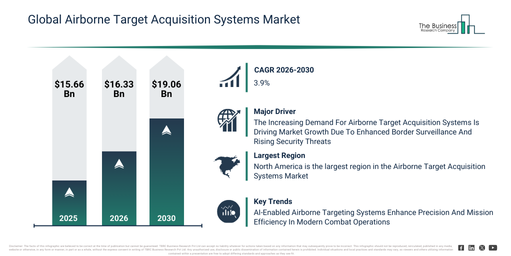
#Airborne Target Acquisition Systems Market Size Trajectory: Key Numbers Every Industry Stakeholder Should Know#_x000D_ The airborne target acquisition systems market has experienced consistent growth over recent years. It will grow from $15.66 billion in 2025 to $16.33 billion in 2026 at a compound annual growth rate (CAGR) of 4.3%. This historical expansion is largely attributable to several factors, including the increasing adoption of airborne sensors for target detection and tracking, the integration of precision targeting solutions in military aircraft, a rising demand for real-time surveillance and situational awareness, the deployment of advanced sensor payloads for reconnaissance missions, and the development of communication and fire control systems for coordinated targeting._x000D_ _x000D_ The airborne target acquisition systems market size is projected to experience consistent expansion over the coming years. It is forecasted to reach $19.06 billion in 2030, demonstrating a compound annual growth rate (CAGR) of 3.9%. This anticipated growth during the forecast period can be attributed to factors such as increased investment in AI-powered target acquisition and automated threat identification, the broadening application of airborne systems for unmanned aerial vehicles (UAVs), an emphasis on integrating multiple sensors for improved precision, a growing need for connected and interoperable targeting systems, and the increased acquisition of next-generation combat aircraft and defense platforms. Key trends anticipated over this period encompass a wider adoption of multi-sensor fusion, an increase in high-resolution electro-optical/infrared (EO/IR) targeting, the expansion of UAV-driven target acquisition, the seamless integration of fire-control and communication systems, and a sustained demand for sophisticated threat detection capabilities._x000D_ _x000D_ #Looking For Reliable Airborne Target Acquisition Systems Market Data? Request A Free Sample:#_x000D_ https://thebusinessresearchcompany.com/sample_request?id=45695191&type=smp&name=Airborne%20Target%20Acquisition%20Systems%20Market%20Report%202026&utm_source=Blogs&utm_medium=Paid&utm_campaign=Oct_PR_x000D_ _x000D_ #What Is Behind The Rising Demand In The Airborne Target Acquisition Systems Market?#_x000D_ The growing demand for border surveillance is projected to boost the expansion of the airborne target acquisition systems market. This involves utilizing cutting-edge technologies for real-time monitoring of border areas, with the goal of identifying, deterring, and addressing illicit entries or potential dangers. Escalating security risks are accelerating the adoption of border surveillance, leading to a greater deployment of sophisticated systems to monitor threats and unauthorized crossings. Airborne target acquisition systems aid border surveillance by providing aerial detection, tracking, and threat identification capabilities in real time. Their advanced sensor technology and extensive coverage facilitate rapid responses in remote or challenging-to-monitor border regions. For instance, in October 2025, as reported by KXAN Austin, a US-based television station, US Border Patrol agents detained 10,203 individuals in September, marking a 26% increase compared to the previous month. Consequently, the heightened requirement for border surveillance is a key driver for the growth of the airborne target acquisition systems market._x000D_ _x000D_ #Airborne Target Acquisition Systems Market Segment Coverage And Subsegment Analysis#_x000D_ The airborne target acquisition systems market covered in this report is segmented –_x000D_ _x000D_ 1) By Platform: Fixed-Wing Aircraft, Helicopters, Unmanned Aerial Vehicles (UAVs)_x000D_ 2) By Technology: Radar, Electro-Optical Or Infrared (EO Or IR) Systems, Electronic Support Measures (ESM)_x000D_ 3) By Range: Short Range (0-8 Kilometers (Km)), Medium Range (8-250 Kilometers (Km)), Long Range (Above 250 Kilometers (Km))_x000D_ 4) By Applications: Air-To-Air Combat, Air-To-Ground Surveillance, Maritime Surveillance, Electronic Warfare_x000D_ 5) By End-User: Military, Homeland Security_x000D_ _x000D_ Subsegments:_x000D_ 1) By Fixed-Wing Aircraft: Fighter Aircraft, Transport Aircraft, Maritime Patrol Aircraft, Surveillance Aircraft, Reconnaissance Aircraft_x000D_ 2) By Helicopters: Attack Helicopters, Reconnaissance Helicopters, Transport Helicopters, Maritime Helicopters_x000D_ 3) By Unmanned Aerial Vehicles (UAVs): Tactical Unmanned Aerial Vehicles (UAVs), Strategic Unmanned Aerial Vehicles (UAVs), Combat Unmanned Aerial Vehicles (UAVs), Mini Or Micro Unmanned Aerial Vehicles (UAVs), Medium Altitude Long Endurance Unmanned Aerial Vehicles (UAVs), High Altitude Long Endurance (HALE) Unmanned Aerial Vehicles (UAVs)_x000D_ _x000D_ #Airborne Target Acquisition Systems Market Future Trends: Where Is The Industry Heading?#_x000D_ Prominent companies within the airborne target acquisition systems market are concentrating on developing cutting-edge solutions like AI-enabled airborne targeting systems to elevate operational effectiveness in challenging combat environments. An AI-enabled airborne targeting system is an advanced aerial solution that harnesses artificial intelligence to autonomously detect, classify, and track targets with improved speed and accuracy. It substantially enhances situational awareness, threat evaluation, and targeting effectiveness in evolving combat and surveillance situations. For instance, in September 2024, Hensoldt, a Germany-based defense electronics company, revealed the ARGOS-15 at the Africa Aerospace and Defense Expo 2024. This 15-inch gimbal system integrates AI-powered object detection, classification, and tracking features, thereby boosting real-time decision-making and mission efficiency. The ARGOS-15 is engineered for both manned and unmanned airborne platforms, delivering superior performance for intelligence, surveillance, target acquisition, and reconnaissance (ISTAR) operations._x000D_ _x000D_ #Airborne Target Acquisition Systems Market Top Players List For 2026#_x000D_ Major companies operating in the airborne target acquisition systems market are Raytheon Technologies Corporation, The Boeing Company, Lockhee Martin Corporation, Airbus, General Dynamics Corporation, Northrop Grumman Corporation, BAE Systems plc, Safran SA, Thales Group, L3Harris Technologies Inc., Leidos Holdings Inc., Rheinmetall AG, Saab AB, Hensoldt AG, Aselsan A.S., Kratos Defense & Security Solutions Inc., Teledyne FLIR, Kearfott Corporation, Thermoteknix Systems Ltd., Blighter Surveillance Systems Limited_x000D_ _x000D_ #Order Your Copy Of The Airborne Target Acquisition Systems Market Report 2026:#_x000D_ https://thebusinessresearchcompany.com/report/airborne-target-acquisition-systems-global-market-report?utm_source=Blogs&utm_medium=Paid&utm_campaign=Oct_PR_x000D_ _x000D_ #How Does The Airborne Target Acquisition Systems Market Vary By Region?#_x000D_ North America was the largest region in the airborne target acquisition systems market in 2025. Asia-Pacific is expected to be the fastest-growing region in the forecast period. The regions covered in the airborne target acquisition systems market report are Asia-Pacific, South East Asia, Western Europe, Eastern Europe, North America, South America, Middle East, Africa._x000D_ _x000D_ #Reach Out To Our Team:#_x000D_ _x000D_ The Business Research Company: https://www.thebusinessresearchcompany.com/_x000D_ Americas: +1 310-496-7795_x000D_ Asia: +44 7882 955267 & +91 8897263534_x000D_ Europe: +44 7882 955267_x000D_ Email us at: marketing@tbrc.info_x000D_ _x000D_ #Follow us on:#_x000D_ _x000D_ LinkedIn: https://in.linkedin.com/company/the-business-research-company_x000D_ YouTube: https://www.youtube.com/channel/UC24_fI0rV8cR5DxlCpgmyFQ_x000D_ Global Market Model: https://www.thebusinessresearchcompany.com/global-market-model
Continue ReadingAirborne Target Acquisition Systems Market Forecast To 2030: The Growing Role Of AI-Enabled Airborne Targeting Systems Enhance Precision And Mission Efficiency In Modern Combat Operations
Read more about the article Airborne Swarm Coordination System Market Set To Reach $4.77 Billion By 2030, Driven By Rising Defense Expenditure
Airborne Swarm Coordination System Market Analysis

Airborne Swarm Coordination System Market Set To Reach $4.77 Billion By 2030, Driven By Rising Defense Expenditure

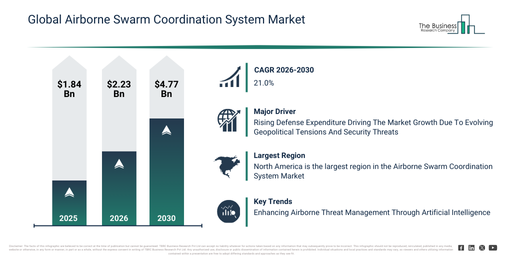
#What Is The Airborne Swarm Coordination System Market Size In 2026, And Where Is It Heading By 2030?#_x000D_ Recent years have seen exponential growth in the size of the airborne swarm coordination system market. This market is projected to expand from $1.84 billion in 2025 to $2.23 billion by 2026, exhibiting a compound annual growth rate (CAGR) of 21.2%. The historical expansion can be attributed to factors such as the increasing adoption of autonomous drone fleets, advancements in real-time communication protocols, rising defense modernization budgets, improvements in multi-agent coordination algorithms, and the demand for resilient mission-critical operations._x000D_ _x000D_ The airborne swarm coordination system market is projected to experience substantial expansion over the upcoming years. This market is anticipated to reach a valuation of $4.77 billion by 2030, exhibiting a compound annual growth rate (CAGR) of 21.0%. Key factors fueling this expansion during the projected period include the incorporation of AI-driven decision-making, the broadening of commercial uses beyond military applications, strengthened cybersecurity for swarm networks, the creation of interoperable hardware modules, and the uptake of cloud-based platforms for swarm management. Noteworthy trends observed over the forecast duration encompass swarm-based mission optimization, continuous data communication, algorithms for multi-UAV coordination, autonomous navigation at the fleet level, and system validation driven by simulations._x000D_ _x000D_ #Request Your Free Airborne Swarm Coordination System Market Sample With Segment And Regional Data:#_x000D_ https://thebusinessresearchcompany.com/sample_request?id=52084090&type=smp&name=Airborne%20Swarm%20Coordination%20System%20Market%20Report%202026&utm_source=Blogs&utm_medium=Paid&utm_campaign=Oct_PR_x000D_ _x000D_ #Airborne Swarm Coordination System Market Growth Drivers And Their Impact On Future Demand#_x000D_ The increasing defense expenditure is anticipated to propel the expansion of the airborne swarm coordination system market. This spending encompasses government allocations for military forces, defense ministries, and associated security infrastructure, covering personnel, operations, procurement, and research and development. A primary factor behind this rise is evolving geopolitical tensions and security challenges, prompting nations to prioritize modernizing their military and acquiring advanced defense capabilities. This ensures strategic deterrence and operational preparedness amidst a complex global security landscape. Larger defense budgets stimulate the demand for airborne swarm coordination systems, as military forces seek sophisticated autonomous technologies to improve battlefield effectiveness and enable coordinated operations across numerous unmanned platforms. For example, according to the UK Parliament's House of Commons Library in May 2025, UK defence spending is projected to reach around $70.5 billion(£56.9 billion) in the 2024-25 financial year, with a further increase to approximately $73.9 billion(£59.8 billion) in 2025-26. Consequently, the increase in defense expenditure is a key driver for the growth of the airborne swarm coordination system market._x000D_ _x000D_ #What Categories Define The Airborne Swarm Coordination System Market?#_x000D_ The airborne swarm coordination system market covered in this report is segmented –_x000D_ _x000D_ 1) By Component: Hardware, Software, Services_x000D_ 2) By Technology: Artificial Intelligence, Machine Learning, Communication Systems, Sensor Integration, Other Technologies_x000D_ 3) By Platform: Unmanned Aerial Vehicles, Manned Aircraft, Hybrid Systems_x000D_ 4) By End-User: Government, Defense, Commercial, Other End-Users_x000D_ _x000D_ Subsegments:_x000D_ 1) By Hardware: Sensors, Communication Devices, Navigation Systems, Control Units, Power Supply Systems_x000D_ 2) By Software: Mission Planning Software, Flight Control Software, Data Analytics Software, Simulation Software, Communication Management Software_x000D_ 3) By Services: System Integration, Maintenance And Support, Training And Consultation, Testing And Certification, Deployment Services_x000D_ _x000D_ #What New Developments Are Emerging In The Airborne Swarm Coordination System Market?#_x000D_ Leading companies within the airborne swarm coordination system market are prioritizing the utilization of innovative technologies, such as artificial intelligence (AI)-enabled detection, to improve real-time threat identification, tracking, and response effectiveness. AI-enabled detection involves the application of AI algorithms to automatically locate and monitor objects or threats, including drones, through real-time analysis of sensor data, thereby boosting the speed, precision, and efficiency in discerning, classifying, and reacting to airborne dangers. For instance, in February 2025, Lockheed Martin Corporation, a U.S.-based aerospace and defense company, introduced a scalable Counter-Unmanned Aerial System (C-UAS) solution. This solution integrates AI-enabled detection, advanced command and control (C2), and modular effectors to identify, track, classify, and neutralize both individual drones and drone swarms. This offering demonstrates swift, networked coordination between sensors and mitigation systems, emphasizing the company's commitment to leveraging AI and open-architecture designs to enhance real-time threat reactions and maintain operational superiority against evolving aerial threats. The system's modular architecture permits the integration of various sensors and effectors, allowing for customized responses to different threat scenarios and ensuring adaptability as drone technology advances._x000D_ _x000D_ #Major Players Driving Competition In The Airborne Swarm Coordination System Market#_x000D_ Major companies operating in the airborne swarm coordination system market are The Boeing Company, Lockheed Martin Corporation, Northrop Grumman Corporation, Bae Systems Plc, Thales S.A., Leonardo S.P.A., Elbit Systems Ltd., Teledyne Technologies Incorporated, Saab AB, General Atomics Aeronautical Systems, Inc., Kratos Defense & Security Solutions, Inc., Telespazio S.P.A., AeroVironment, Inc., Havelsan A.S., Aevex Aerospace, Quantum Systems GmbH, Charles River Analytics, Inc., UAV Navigation S.L., Sky-Drones Technologies Ltd., Swarmer_x000D_ _x000D_ #View The Comprehensive Airborne Swarm Coordination System Market Analysis:#_x000D_ https://thebusinessresearchcompany.com/report/airborne-swarm-coordination-system-global-market-report?utm_source=Blogs&utm_medium=Paid&utm_campaign=Oct_PR_x000D_ _x000D_ #Airborne Swarm Coordination System Market Regional Leaders: Insights From The 2026 Report#_x000D_ North America was the largest region in the airborne swarm coordination system market in 2025. Asia-Pacific is expected to be the fastest-growing region in the forecast period. The regions covered in the airborne swarm coordination system market report are Asia-Pacific, South East Asia, Western Europe, Eastern Europe, North America, South America, Middle East, Africa._x000D_ _x000D_ #Reach Out To Our Team:#_x000D_ _x000D_ The Business Research Company: https://www.thebusinessresearchcompany.com/_x000D_ Americas: +1 310-496-7795_x000D_ Asia: +44 7882 955267 & +91 8897263534_x000D_ Europe: +44 7882 955267_x000D_ Email us at: marketing@tbrc.info_x000D_ _x000D_ #Follow us on:#_x000D_ _x000D_ LinkedIn: https://in.linkedin.com/company/the-business-research-company_x000D_ YouTube: https://www.youtube.com/channel/UC24_fI0rV8cR5DxlCpgmyFQ_x000D_ Global Market Model: https://www.thebusinessresearchcompany.com/global-market-model

Continue ReadingAirborne Swarm Coordination System Market Set To Reach $4.77 Billion By 2030, Driven By Rising Defense Expenditure

Artificial Intelligence (AI) Business Intelligence Market Analysis: Understanding The Drivers Behind 29.5% CAGR Through 2030 Growth

Artificial Intelligence (AI) Business Intelligence market size was valued at $18.59 billion in 2026, projected to reach $52.29 billion by 2030 at a 29.5% CAGR. Key players: Microsoft Corporation, Google LLC, Amazon Web Services Inc.

Continue ReadingArtificial Intelligence (AI) Business Intelligence Market Analysis: Understanding The Drivers Behind 29.5% CAGR Through 2030 Growth
Read more about the article Airborne Sensors Market CAGR Of 6.5% Forecast For 2026–2030: What It Means For The Industry
Airborne Sensors Market Analysis

Airborne Sensors Market CAGR Of 6.5% Forecast For 2026–2030: What It Means For The Industry

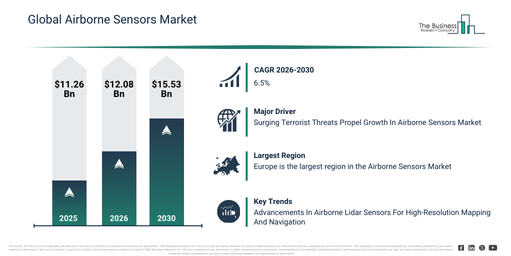
#Airborne Sensors Market To Expand At A 6.5% CAGR: Size And Growth Projections Through 2030#_x000D_ The airborne sensors market has experienced robust growth in recent years. It is anticipated to increase from $11.26 billion in 2025 to $12.08 billion in 2026, reflecting a compound annual growth rate (CAGR) of 7.3%. This historical expansion can be attributed to several factors, such as the rising uptake of airborne imaging and sensing technologies for geospatial surveying, the increasing use of sensors on drones for efficient data collection, the expansion of defense and intelligence applications requiring advanced airborne sensing capabilities, enhancements in pressure and temperature sensor technologies leading to improved measurement accuracy, and the broader application of airborne sensors in environmental monitoring and climate research._x000D_ _x000D_ The airborne sensors market is anticipated to experience substantial expansion over the next few years, with its size projected to reach $15.53 billion by 2030, demonstrating a compound annual growth rate (CAGR) of 6.5%. This growth during the forecast period is fueled by an increasing demand for multi-sensor payloads integrating speed and thermal sensing, coupled with rising investments in high-resolution and real-time airborne data acquisition systems. Further contributing factors include the growing adoption of autonomous airborne platforms that require advanced sensor suites, the development of lightweight and energy-efficient sensors for extended flight endurance, and the expansion of commercial applications. Key trends expected in this period encompass AI-powered data analysis for real-time airborne sensor interpretation, the deployment of autonomous drones and UAVs for remote data collection, the utilization of cloud-based storage and processing for high-volume sensor data, the integration of IoT-enabled sensors for connected airborne platforms, and the advancement of multi-modal sensors combining optical, infrared, and radar capabilities._x000D_ _x000D_ #Get Your Free Airborne Sensors Market Report Sample Today:#_x000D_ https://thebusinessresearchcompany.com/sample_request?id=50069687&type=smp&name=Airborne%20Sensors%20Market%20Report%202026&utm_source=Blogs&utm_medium=Paid&utm_campaign=Oct_PR_x000D_ _x000D_ #Which Factor Is Expected To Drive The Airborne Sensors Market Over The Forecast Period?#_x000D_ The airborne sensors market is anticipated to expand due to a rise in terrorist activities. These activities, defined as criminal or violent acts by individuals or groups linked to terrorist organizations, fuel the need for airborne sensors in defense to safeguard borders. For example, the Institute for Economics & Peace (IEP), an Australia-based non-profit think tank, reported in February 2024 that terrorism remains a major global threat, with 8,352 deaths in 2023, an increase from 6,823 in 2022, and the lethality rate seeing its first increase in five years. Consequently, a surge in terrorist activities will stimulate growth in the airborne sensors market._x000D_ _x000D_ #Airborne Sensors Market Segmentation Insights: How Is The Industry Categorized?#_x000D_ The airborne sensors market covered in this report is segmented –_x000D_ _x000D_ 1) By Type: Non-Scanning, Scanning_x000D_ 2) By Component: Hardware, Software_x000D_ 3) By Application: Defense Aircraft, Commercial Aircraft, Other Application_x000D_ _x000D_ Subsegments:_x000D_ 1) By Non-Scanning Sensors: Electro-Optical Sensors, Infrared Sensors, Multi-Spectral Sensors_x000D_ 2) By Scanning Sensors: Synthetic Aperture Radar (SAR), Imaging Radar, Lidar Sensors_x000D_ _x000D_ #Airborne Sensors Market Trends Explained: What Is Changing And Why It Matters#_x000D_ Leading firms within the airborne sensors market are prioritizing the creation of sophisticated airborne LiDAR sensors to improve capabilities in high-resolution terrain mapping, obstacle detection, and precision navigation. An airborne LiDAR sensor functions as a laser-based remote sensing system, installed on aircraft, designed to gather precise distance measurements from the ground or other targets, thereby producing comprehensive 3D maps useful for applications like topography, forestry, and infrastructure monitoring. As an example, in March 2024, JOUAV, a drone manufacturer situated in China, introduced its JoLiDAR-1000 airborne LiDAR sensor. This novel sensor, engineered for drones, marks a substantial progression in LiDAR technology for UAV applications, including GIS, surveying, and precision power line inspection. It incorporates a 1000 m medium-range laser scanner, full-frequency RTK+IMU fusion technology, a 5 mm measurement accuracy, and a 100° field of view, all within a compact, lightweight design that ensures straightforward deployment. The JoLiDAR-1000 removes the requirement for base stations or ground control points, thereby allowing for swift and accurate data collection across various applications._x000D_ _x000D_ #Airborne Sensors Market Competitor Landscape: Who Are The Major Companies?#_x000D_ Major companies operating in the airborne sensors market are Hexagon AB, Thales Group, Raytheon Technologies Corp., Lockheed Martin Corporation, information systems laboratories, Teledyne Geospatial, General Dynamics Corporation, Honeywell International Inc., ITT Inc., AVT Airborne Sensing GmbH, Northrop Grumman Corporation, L3Harris Technologies Inc., Conax Technologies, Meggitt PLC, Curtiss-Wright Corporation, Ametek Inc., Safran SA, General Electric Co., Airbus SE, BAE Systems PLC, Optasense, Rolta India Ltd._x000D_ _x000D_ #See The Full Airborne Sensors Market Report For Complete Market Sizing And Trends:#_x000D_ https://thebusinessresearchcompany.com/report/airborne-sensors-global-market-report?utm_source=Blogs&utm_medium=Paid&utm_campaign=Oct_PR_x000D_ _x000D_ #Airborne Sensors Market Regional Demand Analysis And Leading Geography#_x000D_ Europe was the largest region in the airborne sensors market in 2025. Asia-Pacific is expected to be the fastest-growing region in the forecast period. The regions covered in the airborne sensors market report are Asia-Pacific, South East Asia, Western Europe, Eastern Europe, North America, South America, Middle East, Africa._x000D_ _x000D_ #Reach Out To Our Team:#_x000D_ _x000D_ The Business Research Company: https://www.thebusinessresearchcompany.com/_x000D_ Americas: +1 310-496-7795_x000D_ Asia: +44 7882 955267 & +91 8897263534_x000D_ Europe: +44 7882 955267_x000D_ Email us at: marketing@tbrc.info_x000D_ _x000D_ #Follow us on:#_x000D_ _x000D_ LinkedIn: https://in.linkedin.com/company/the-business-research-company_x000D_ YouTube: https://www.youtube.com/channel/UC24_fI0rV8cR5DxlCpgmyFQ_x000D_ Global Market Model: https://www.thebusinessresearchcompany.com/global-market-model

Continue ReadingAirborne Sensors Market CAGR Of 6.5% Forecast For 2026–2030: What It Means For The Industry