With a focus on actionable insights and strategic value, The Business Research Company’s 2026 market reports include market attractiveness scoring, total addressable market sizing, company benchmarking matrices, interactive Excel dashboards, deeper supply chain intelligence, emerging startup tracking, and granular product-level insights.
Automated Material Handling (AMH) Market Size Snapshot: 2026 Valuation, 2030 Projection And Key Growth Factors
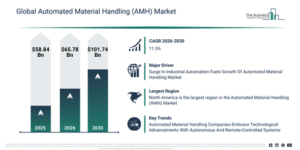
The automated material handling (AMH) market has experienced rapid expansion in recent years. It is projected to grow from $58.84 billion in 2025 to $65.78 billion in 2026, demonstrating a compound annual growth rate (CAGR) of 11.8%. Historically, this market expansion can be attributed to factors such as e-commerce growth, difficulties arising from labor shortages, the modernization of warehouses, increased manufacturing automation, and continuous supply chain optimization efforts.
The automated material handling (AMH) market is projected to expand significantly over the next few years. It will grow to $101.74 billion in 2030 at a compound annual growth rate (CAGR) of 11.5%. This anticipated growth is primarily driven by factors such as the increasing adoption of smart factories, the expansion of omnichannel retail, the development of more logistics hubs, AI-driven warehouse management solutions, and the demand for rapid order fulfillment. Important trends expected in this period include the wider use of autonomous guided vehicles, the ongoing expansion of warehouse automation, the integration of robotics with warehouse management systems (WMS), the development of high-speed sortation systems, and an increasing need for flexible material handling capabilities.
Get A No-Cost Sample Of The Automated Material Handling (AMH) Market Study:
Major Factor Fueling The Automated Material Handling (AMH) Market Through 2030
The increasing demand for automation across various sectors is projected to fuel the expansion of the automated material handling market moving forward. Industrial automation involves the application of technology and systems to execute tasks and processes with minimal human input, thereby boosting efficiency, accuracy, and productivity. This rising necessity for automation in diverse industries is attributed to factors like labor shortages, efforts to reduce costs, enhanced scalability, and the facilitation of data-driven decision-making. Automated material handling streamlines numerous operations by efficiently managing the movement, storage, and processing of materials, which consequently reduces manual labor, minimizes errors, and enhances overall productivity.
Automated Material Handling (AMH) Market Segment Landscape: Main Categories And Subcategories Covered
The automated material handling (amh) market covered in this report is segmented –
1) By Product Type: Hardware, Software, Services
2) By System Type: Unit Load Material Handling System, Bulk Load Material Handling System
3) By Function: Storage, Transportation, Assembly, Other Functions
4) By End-User: Airport, Automotive, Food And Beverages, Retail, Warehousing, And Distribution, Logistic Centers, General Manufacturing, Pharmaceuticals, Post and Parcel, Other End-Users
Subsegments:
1) By Hardware: Automated Guided Vehicles (AGVs), Robotic Arms, Conveyor Systems, Sortation Systems, Palletizing Systems
2) By Software: Warehouse Management Systems (WMS), Inventory Management Software, Robotics Software, Fleet Management Software, Control Systems
3) By Services: Consulting Services, Installation and Integration Services, Maintenance and Support Services, Training Services, System Upgrades and Optimization Services
How Are Emerging Trends Influencing The Automated Material Handling (AMH) Market’s Growth Path?
Leading companies in the automated material handling market are concentrating on developing innovative solutions, such as freight movement systems, to meet the rising demand for more efficient, flexible, and resilient supply chain operations. A Freight Movement System, as part of automated material handling, specifically focuses on transporting goods or materials within a warehouse, factory, or distribution center. This system integrates various automated technologies to enhance the efficiency, accuracy, and safety of material handling operations.
Automated Material Handling (AMH) Market Leading Players And Key Industry Participants In 2026
Major companies operating in the automated material handling (AMH) market are Mitsubishi Group, Honeywell International Inc., Toyota Industries Corporation, Murata Machinery Ltd., KION Group AG, Omron Corporation, Jungheinrich AG, FANUC Corporation, Crown Equipment Corporation, Daifuku Co. Ltd., Hyster-Yale Materials Handling Inc., KUKA AG, Dematic, SSI Schaefer Group, Vanderlande, SICK AG, BEUMER Group, Beckhoff Automation GmbH & Co. KG, Kardex Group, Swisslog AG , Bastian Solutions LLC
Check Out The Full Automated Material Handling (AMH) Market Report 2026:
Automated Material Handling (AMH) Market By Geography: Revenue Leaders Among Global Regions
North America was the largest region in the automated material handling (AMH) market in 2025. Asia-Pacific is expected to be the fastest-growing region in the market going forward. The regions covered in the automated material handling (AMH) market report are Asia-Pacific, South East Asia, Western Europe, Eastern Europe, North America, South America, Middle East, Africa
Reach Out To Our Team:
The Business Research Company: https://www.thebusinessresearchcompany.com/
Americas: +1 310-496-7795
Asia: +44 7882 955267 & +91 8897263534
Europe: +44 7882 955267
Email us at: marketing@tbrc.info
Follow us on:
LinkedIn: https://in.linkedin.com/company/the-business-research-company
YouTube: https://www.youtube.com/channel/UC24_fI0rV8cR5DxlCpgmyFQ
Global Market Model: https://www.thebusinessresearchcompany.com/global-market-model

Wasay has over a decade of experience in market research, data modelling, and analytics, with prior experience at GlobalData and Decision Tree Consulting Services. At The Business Research Company , he leads research operations across syndicated studies, customized consulting engagements, and the Global Market Model platform. His professional experience includes supporting organizations such as Boston Consulting Group, KPMG, and Ernst & Young. Wasay holds a degree in Electronics and Communications Engineering, postgraduate management qualifications from International Management Institute Belgium and Indian School of Business and Entrepreneurship, and completed the Integrated Program in Business Analytics from Indian Institute of Management Indore.