Built to provide research that’s more actionable and strategically valuable, The Business Research Company’s 2026 market reports include market attractiveness analysis, total addressable market sizing, company benchmarking matrices, interactive Excel dashboards, broader supply chain intelligence, emerging startup tracking, and in-depth product insights.
Automated Milking Systems Market Expansion Outlook: What Revenue Opportunities Are Ahead?
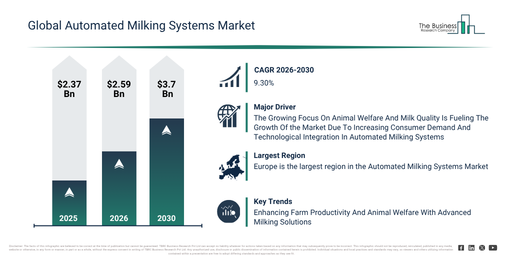
The automated milking systems market has demonstrated strong growth recently. It is forecast to expand from $2.37 billion in 2025 to $2.59 billion in 2026, at a compound annual growth rate (CAGR) of 9.1%. This historic growth can be ascribed to several factors, including increasing labor shortages in dairy farming operations, a rising demand for high quality milk production, the growing adoption of precision livestock farming practices, the global expansion of commercial dairy farm infrastructure, and an increasing focus on animal welfare and hygiene standards.
The automated milking systems market size is anticipated to experience significant expansion in the coming years. It is projected to reach $3.7 billion by 2030, progressing at a compound annual growth rate (CAGR) of 9.3%. This expansion during the forecast period can be attributed to increasing investment in AI-enabled herd management technologies, the rising adoption of cloud-based dairy monitoring platforms, a growing demand for automated and scalable dairy farming solutions, the expanding implementation of smart sensors in livestock management, and a heightened focus on sustainable and energy-efficient dairy operations. Prominent trends observed during this period include the increasing incorporation of robotic milking units for labor-efficient dairy operations, an escalating demand for real-time cow health and milk yield monitoring systems, a rising emphasis on improving dairy farm productivity and operational efficiency, the increasing integration of automated teat cleaning and milk storage technologies, and a growing preference for multi-stall automated milking systems in large dairy farms.
Get A Free Sample Report With In-Depth Market Insights:
Automated Milking Systems Market Development Factors: What’s Supporting Demand?
The automated milking systems market is expected to grow as a result of an increasing focus on animal welfare and milk quality. This commitment to animal welfare and milk quality entails the industry’s dedication to ensuring the health, well-being, and proper care of dairy animals, while also upholding high standards for milk safety, composition, and hygiene. The heightened emphasis on these areas stems from rising consumer demand for ethically produced and safe dairy products, which in turn encourages producers to adopt improved animal care practices and stricter milk quality standards. This increasing demand for animal welfare and milk quality is particularly relevant for automated milking systems, as they enable precise monitoring, consistent milking procedures, and real-time health data, directly supporting both cow well-being and high-quality milk production. For example, in July 2024, the Government of Canada, a Canada-based federal administration, stated that Dairy Farmers of Canada is slated to receive funding of up to $2.64 million (CAD 3.57 million) over a five-year period to enhance its DairyTrace platform, thereby strengthening capabilities in animal health monitoring, milk quality assurance, and traceability to promote farm sustainability and public confidence. Therefore, the growing focus on animal welfare and milk quality is a primary driver for the expansion of the automated milking systems market.
Automated Milking Systems Market Segment Outlook: Which Categories Are Growing Fastest?
The automated milking systems market covered in this report is segmented –
1) By Offering: Hardware, Software, Services
2) By System Type: Single-Stall Unit, Multi-Stall Unit, Rotary System
3) By Herd Size: Up to One Hundred, One Hundred to One Thousand, Above One Thousand
4) By Application: Dairy Farms, Research Institutes, Other Applications
Subsegments:
1) By Hardware: Milking Robots, Milk Storage Tanks, Teat Cleaning Units, Sensors And Detectors, Other Hardware
2) By Software: Herd Management Software, Milk Monitoring Software, Data Analytics Platforms, Cloud Based Management Software, Other Software
3) By Services: Installation Services, Maintenance Services, Training Services, Consulting Services, Other Services
Automated Milking Systems Market Transformation Trends: What Innovations Are Driving Change?
Leading companies active in the automated milking systems market are focusing on developing advanced solutions, including future-proof automated milking robots, to enhance farm productivity, animal welfare, and operational efficiency. Future-proof automated milking robots are characterized as robotic milking systems engineered with sophisticated precision, AI-powered monitoring, modular upgrade capabilities, and digital integration to provide superior efficiency, better animal health, and adaptability for changing dairy farm requirements. For instance, in June 2025, Lely, a Netherlands-based agricultural robotics company, introduced Astronaut A5 Next and Astronaut Max. The Astronaut A5 Next features a resilient operating system with over-the-air software updates, a precision robot arm utilizing laser and camera vision for improved teat detection, and an automatic milk filter to automate remaining manual milking tasks, thereby improving milk quality monitoring, animal welfare, and serviceability. Astronaut Max is designed for large-scale farms, capable of controlling up to 18 Astronaut robots from a single control room, centralizing milking and cleaning operations, increasing milking capacity, reducing labor needs, and ensuring uninterrupted operation during service and cleaning routines.
Automated Milking Systems Market Competitive Landscape: Who Leads The Industry?
Major companies operating in the automated milking systems market are Tetra Laval Group, GEA Group, Lely Holding S. à r. l., Nedap N. V., Paul Mueller Company, Dairymaster Ltd., BouMatic LLC, System Happel GmbH, Stellapps Technologies Pvt Ltd., MSD Animal Health, Fabdec Ltd., Afimilk Ltd., Milkplan SA, Hanskamp AgroTech BV, Modern Dairy Machines (MDM), ADF Milking Ltd., LAKTO Dairy Technologies, AMS Galaxy USA, BECO Dairy Automation Inc., Vansun Milking, Milkomax, Milky Way Farm
View The Full Automated Milking Systems Market Report:
Automated Milking Systems Market Geographic Landscape: Which Region Leads Industry Growth?
Europe was the largest region in the automated milking systems market in 2025. Asia-Pacific is expected to be the fastest-growing region in the forecast period. The regions covered in the automated milking systems market report are Asia-Pacific, South East Asia, Western Europe, Eastern Europe, North America, South America, Middle East and Africa.
Reach Out To Our Team:
The Business Research Company: https://www.thebusinessresearchcompany.com/
Americas: +1 310-496-7795
Asia: +44 7882 955267 & +91 8897263534
Europe: +44 7882 955267
Email us at: marketing@tbrc.info
Follow us on:
LinkedIn: https://in.linkedin.com/company/the-business-research-company
YouTube: https://www.youtube.com/channel/UC24_fI0rV8cR5DxlCpgmyFQ
Global Market Model: https://www.thebusinessresearchcompany.com/global-market-model

Wasay has over a decade of experience in market research, data modelling, and analytics, with prior experience at GlobalData and Decision Tree Consulting Services. At The Business Research Company , he leads research operations across syndicated studies, customized consulting engagements, and the Global Market Model platform. His professional experience includes supporting organizations such as Boston Consulting Group, KPMG, and Ernst & Young. Wasay holds a degree in Electronics and Communications Engineering, postgraduate management qualifications from International Management Institute Belgium and Indian School of Business and Entrepreneurship, and completed the Integrated Program in Business Analytics from Indian Institute of Management Indore.