
Backed by market attractiveness analysis, total addressable market sizing, company benchmarking matrices, interactive Excel dashboards, wider supply chain intelligence, emerging startup coverage, and detailed product-level insights, The Business Research Company’s 2026 market reports are designed to offer research that is more actionable and strategically valuable than ever.
Automated Riveting Systems Market Growth Potential: How Will Market Size Shift Through 2030?
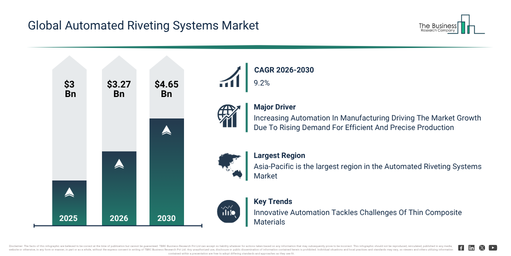
The automated riveting systems market size has experienced robust expansion in recent years. This market is projected to expand from $3 billion in 2025 to $3.27 billion in 2026, demonstrating a compound annual growth rate (CAGR) of 9.0%. Historically, the growth has been influenced by increasing demand for mass production efficiency, growth of automotive manufacturing output, expansion of aerospace assembly lines, rising labor cost pressures, and adoption of mechanized fastening systems.
The automated riveting systems market size is anticipated to undergo significant growth in the coming years, with expectations to reach $4.65 billion by 2030, demonstrating a compound annual growth rate (CAGR) of 9.2%. This expansion during the forecast period is attributed to the increasing shift toward fully automated factories, the growing demand for lightweight electric vehicles, the broadening of aerospace modernization programs, the rising need for precision manufacturing, and an increasing investment in smart production infrastructure. Key trends foreseen in this period include the wider adoption of high-precision riveting for assembling lightweight materials, an escalating demand for high-speed production line riveting operations, the expanding use of multi-material joining in automotive and aerospace structures, the deployment of automated riveting systems for large-scale manufacturing facilities, and a heightened focus on enhancing joint consistency and structural durability.
Get A Free Sample Report With In-Depth Market Insights:
Automated Riveting Systems Market Industry Drivers: What’s Behind The Revenue Growth?
The projected expansion of the Automated Riveting Systems market is anticipated to be driven by the increasing integration of automation within manufacturing operations. Automation in manufacturing encompasses the utilization of machines, robots, and control systems to execute production tasks with minimal human intervention. The rise in manufacturing automation is primarily due to the imperative for greater production efficiency, as companies seek to elevate output, reduce errors, and lower labor costs through the application of advanced machinery and robotic frameworks. Automated riveting systems enhance manufacturing automation by streamlining assembly workflows, ensuring precise and consistent fastening, minimizing manual labor, and enabling accelerated production cycles with reduced human involvement. For instance, according to the World Robotics 2024 report released by the International Federation of Robotics, a Germany-based non-profit organization, the operational stock of industrial robots reached 4,281,585 units in factories worldwide, representing a 10% year-on-year increase. Therefore, the growing automation in manufacturing is propelling the growth of the Automated Riveting Systems market.
Automated Riveting Systems Market Segment Landscape: Which Areas Lead Development?
The automated riveting systems market covered in this report is segmented –
1) By Product Type: Hydraulic Riveting Systems, Pneumatic Riveting Systems, Electric Riveting Systems, Other Product Types
2) By Automation Level: Semi-Automatic, Fully Automatic
3) By Installation Type: Stand-Alone Systems, Integrated Production Line Systems
4) By Application: Aerospace, Automotive, Shipbuilding, Electronics, Construction, Other Applications
5) By End-User: Original Equipment Manufacturers (OEMs), Aftermarket
Subsegments:
1) By Hydraulic Riveting Systems: High-Force Hydraulic Riveting Systems, Compact Hydraulic Riveting Systems, Multi-Station Hydraulic Riveting Systems, Custom Hydraulic Riveting Systems
2) By Pneumatic Riveting Systems: Air-Driven Pneumatic Riveting Systems, Portable Pneumatic Riveting Systems, High-Speed Pneumatic Riveting Systems, Multi-Tool Pneumatic Riveting Systems
3) By Electric Riveting Systems: Servo Motor Driven Electric Riveting Systems, Programmable Electric Riveting Systems, High-Precision Electric Riveting Systems, Robotic Electric Riveting Systems
4) By Other Product Types: Hybrid Riveting Systems, Manual Assisted Riveting Systems, Portable Battery-Operated Riveting Systems, Specialty Application Riveting Systems
#Automated Riveting Systems Market Growth Trends: What’s Shaping The Future Outlook?
Leading companies in the automated riveting systems market are concentrating on developing advanced products, such as robotic riveting cells, to enhance fastening speed, precision, and efficiency in composite manufacturing. Robotic riveting cells are automated systems that utilize robotic arms and specialized riveting heads for the precise application of rivets and inserts, which helps to boost production speed, minimize manual labor, and ensure consistent quality in the fastening of composite components. For instance, in March 2025, Belotti S.p.A., an Italy-based manufacturing company, introduced the Belotti Automatic Riveting Cell (ARC), an innovative robotic system tailored for composite frames and components. The Belotti ARC integrates a Comau six-axis anthropomorphic robot, a compact floating riveting head, four-position rotary tables, Siemens Sinumerik One CNC with Run MyRobot, and an automatic feeding system. This cell can manage rivets and Time-Sert inserts of varying diameters without requiring a head change, offers ISO programming for seamless operation, and provides real-time process tracking and feedback for optimal accuracy. Its applications span automotive monocoques, doors, roofs, and structural elements, as well as aerospace wings and aircraft components, enabling high-speed, precise, and flexible fastening on thin or delicate composite surfaces.
Automated Riveting Systems Market Company Landscape And Competitive Strategy
Major companies operating in the automated riveting systems market are ABB Ltd., Atlas Copco AB, Grob-Werke GmbH & Co. KG, Kawasaki Heavy Industries Ltd., FANUC Corporation, LISI Aerospace, Triumph Group Inc., Comau S.p.A., PennEngineering LLC, Broetje-Automation GmbH, MTorres, PaR Systems Inc., Advanced Integration Technology Inc. (AIT), Electroimpact Inc., Chicago Rivet and Machine Co., BalTec AG, SP Automation and Robotics, Strothmann Machines and Handling GmbH, Groupe Latécoère, Aerospace Industrial Development Corporation, Rivetmach Machinery Industries Inc.
View The Full Automated Riveting Systems Market Report:
Automated Riveting Systems Market Largest Region: Which Geography Holds The Biggest Share?
Asia-Pacific was the largest region in the automated riveting systems market in 2025. Asia-Pacific is expected to be the fastest-growing region in the forecast period. The regions covered in the automated riveting systems market report are Asia-Pacific, South East Asia, Western Europe, Eastern Europe, North America, South America, Middle East, Africa.
Reach Out To Our Team:
The Business Research Company: https://www.thebusinessresearchcompany.com/
Americas: +1 310-496-7795
Asia: +44 7882 955267 & +91 8897263534
Europe: +44 7882 955267
Email us at: marketing@tbrc.info
Follow us on:
LinkedIn: https://in.linkedin.com/company/the-business-research-company
YouTube: https://www.youtube.com/channel/UC24_fI0rV8cR5DxlCpgmyFQ
Global Market Model: https://www.thebusinessresearchcompany.com/global-market-model

Wasay has over a decade of experience in market research, data modelling, and analytics, with prior experience at GlobalData and Decision Tree Consulting Services. At The Business Research Company , he leads research operations across syndicated studies, customized consulting engagements, and the Global Market Model platform. His professional experience includes supporting organizations such as Boston Consulting Group, KPMG, and Ernst & Young. Wasay holds a degree in Electronics and Communications Engineering, postgraduate management qualifications from International Management Institute Belgium and Indian School of Business and Entrepreneurship, and completed the Integrated Program in Business Analytics from Indian Institute of Management Indore.