Built to provide research that’s more actionable and strategically valuable, The Business Research Company’s 2026 market reports include market attractiveness analysis, total addressable market sizing, company benchmarking matrices, interactive Excel dashboards, broader supply chain intelligence, emerging startup tracking, and in-depth product insights.
Automated Welding Cell Market Revenue Growth On Track For A 9.5% CAGR Through 2030
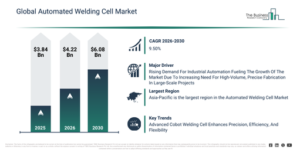
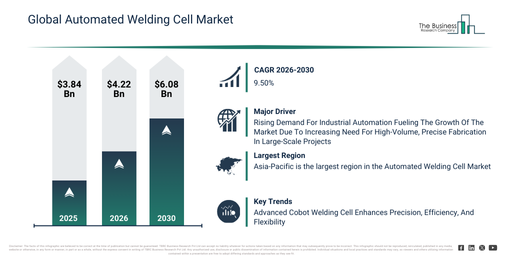
The automated welding cell market has experienced robust expansion in recent years. It is anticipated to increase from $3.84 billion in 2025 to $4.22 billion in 2026, exhibiting a compound annual growth rate (CAGR) of 9.8%. The historical rise in this market size can be attributed to increasing demand for automated manufacturing, the rising need for welding accuracy, growing adoption in automotive production, expanding industrial automation, and an increasing focus on worker safety.
The automated welding cell market is expected to witness substantial growth over the next few years. This market is projected to expand to $6.08 billion by 2030, showing a compound annual growth rate (CAGR) of 9.5%. This anticipated growth during the forecast period can be attributed to an increasing shift towards smart factories, rising investment in industrial robotics, the growing adoption of AI-based welding systems, the expanding use of automation in heavy industries, and a growing preference for cost-efficient welding operations. Key trends for the forecast period include technological advancements in robotic welding, innovations in sensor-based welding control, developments in AI-driven welding analytics, ongoing research and development in adaptive welding systems, and progress in collaborative welding robots.
Get A Free Sample Report With In-Depth Market Insights:
Automated Welding Cell Market Growth Drivers: What’s Behind The Acceleration?
The escalating need for industrial automation is anticipated to fuel the expansion of the automated welding cell market in the foreseeable future. This automation involves the deployment of control systems, various machines, specialized software, and robotics to manage and oversee industrial operations with significantly reduced human involvement. The increase in industrial automation adoption stems from the necessity for greater operational effectiveness, as companies strive to cut expenses, minimize inaccuracies, and enhance overall output. Furthermore, expanding infrastructure projects bolster automated welding cells by generating a need for high-volume, accurate construction and industrial fabrication, positioning them as optimal for major undertakings. These cells boost efficiency by automating intricate welding tasks, thereby reducing manual labor requirements and guaranteeing uniform, superior quality outcomes. For example, data from the International Federation of Robotics, a Germany-based non-profit organization, indicates that in September 2025, a total of 4,664,000 robotic units were operational in factories worldwide in 2024, representing a 9% rise from the 4,281,585 units recorded in 2023. Consequently, the growing demand for industrial automation is propelling the advancement of the automated welding cell market.
Automated Welding Cell Market Segment Landscape And Growth Outlook
The automated welding cell market covered in this report is segmented –
1) By Type: Robotic Welding Cells, Plasma Arc Welding Cells, Laser Welding Cells, Metal Inert Gas Cells
2) By Welding Process: Gas Metal Arc Welding, Gas Tungsten Arc Welding, Resistance Spot Welding, Plasma Arc Welding
3) By Level Of Automation: Fully Automated Welding Cells, Semiautomated Welding Cells, Manual Welding Cells
4) By Application: Aerospace, Automotive, Construction, Electronics, Shipbuilding, Manufacturing
5) By End-User: Small And Medium Enterprises, Large Enterprises
Subsegments:
1) By Robotic Welding Cells: Articulated Robot Cell, Gantry Robot Cell, Cartesian Robot Cell, Delta Robot Cell, Parallel Robot Cell, Collaborative Robot Cell, Modular Robot Cell
2) By Plasma Arc Welding Cells: Conventional Plasma Arc Cell, Pilot Arc Plasma Cell, Plasma Transfer Arc Cell, High Precision Plasma Arc Cell, Plasma Arc Cutting And Welding Cell, Automated Plasma Pierce Control Cell
3) By Laser Welding Cells: Fiber Laser Cell, Carbon Dioxide Laser Cell, Disk Laser Cell, Ultrafast Pulsed Laser Cell, Hybrid Laser Arc Welding Cell, Scanner Head Laser Cell, Portable Laser Welding Cell
4) By Metal Inert Gas Cells: Pulsed Metal Inert Gas Cell, Short Circuit Transfer Metal Inert Gas Cell, Spray Transfer Metal Inert Gas Cell, Flux Cored Metal Inert Gas Cell, Twin Wire Metal Inert Gas Cell, Robotic Metal Inert Gas Cell
Automated Welding Cell Market Trends: What’s Defining The Industry’s Next Phase?
Major companies operating in the automated welding cell market are focusing on developing advanced systems, such as cobot laser welding systems, to boost efficiency, enhance flexibility, and reduce manual effort and production costs. Cobot laser welding systems refer to collaborative robotic cells that combine high-speed laser processing with intuitive, safe human-robot interaction for precise joining and surface cleaning applications. For instance, in May 2024, IPG Photonics Corporation, a US-based manufacturer of high-performance fiber lasers and laser systems, launched the LightWELD Cobot Laser Welding and Cleaning System. This fully integrated, portable system features a collaborative robot arm paired with IPG’s proprietary LightWELD laser welder. The system includes a patented vision-based alignment tool that simplifies programming and ensures precise weld placement, drastically reducing setup time and the risk of rework. It also incorporates automated parameter selection and a safety-rated, contactless scanning system, enabling rapid switching between welding and cleaning functions without operator intervention.
Automated Welding Cell Market Competitive Landscape: Which Companies Lead The Industry?
Major companies operating in the automated welding cell market are Hyundai Welding Co. Ltd., Panasonic Corporation, Mitsubishi Electric Corporation, Kawasaki Heavy Industries Ltd., FANUC Corporation, Lincoln Electric Holdings Inc., Yaskawa Electric Corporation, ESAB Corporation, DAIHEN Corporation, Miller Electric Mfg. LLC, Estun Automation Co. Ltd., Siasun Robot & Automation Co. Ltd., Universal Robots A/S, Kemppi Oy, Fronius International GmbH, Migatronic A/S, AMADA WELD TECH Inc., AMET Inc., Guangzhou Heron Intelligent Equipment Co. Ltd., EVS Tech Co. Ltd., United ProArc Corporation
View The Full Automated Welding Cell Market Report:
Automated Welding Cell Market Regional Breakdown: Where Is Demand Concentrated?
Asia-Pacific was the largest region in the automated welding cell market in 2025. North America is expected to be the fastest-growing region in the forecast period. The regions covered in the automated welding cell market report are Asia-Pacific, South East Asia, Western Europe, Eastern Europe, North America, South America, Middle East, Africa.
Reach Out To Our Team:
The Business Research Company: https://www.thebusinessresearchcompany.com/
Americas: +1 310-496-7795
Asia: +44 7882 955267 & +91 8897263534
Europe: +44 7882 955267
Email us at: marketing@tbrc.info
Follow us on:
LinkedIn: https://in.linkedin.com/company/the-business-research-company
YouTube: https://www.youtube.com/channel/UC24_fI0rV8cR5DxlCpgmyFQ
Global Market Model: https://www.thebusinessresearchcompany.com/global-market-model

Wasay has over a decade of experience in market research, data modelling, and analytics, with prior experience at GlobalData and Decision Tree Consulting Services. At The Business Research Company , he leads research operations across syndicated studies, customized consulting engagements, and the Global Market Model platform. His professional experience includes supporting organizations such as Boston Consulting Group, KPMG, and Ernst & Young. Wasay holds a degree in Electronics and Communications Engineering, postgraduate management qualifications from International Management Institute Belgium and Indian School of Business and Entrepreneurship, and completed the Integrated Program in Business Analytics from Indian Institute of Management Indore.