Market attractiveness scoring, total addressable market sizing, company benchmarking matrices, interactive Excel dashboards, deeper supply chain intelligence, emerging startup tracking, and granular product-level insights are among the key offerings featured in The Business Research Company’s 2026 market reports, designed to deliver more actionable and strategically valuable research.
Biomass Boilers Market Size Estimate For 2026 And Revenue Forecast Through 2030
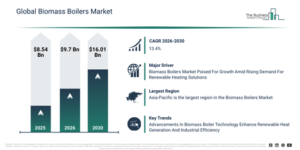
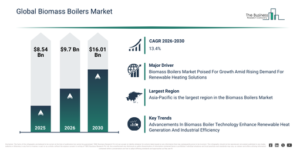
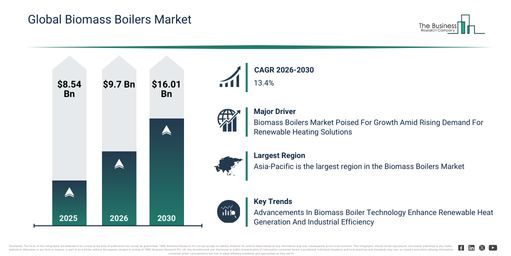
The biomass boilers market has experienced rapid growth recently. The market is projected to expand from $8.54 billion in 2025 to $9.7 billion in 2026, achieving a compound annual growth rate (CAGR) of 13.6%. Historically, this growth can be ascribed to several factors, including the proliferation of renewable energy policies, greater utilization of agricultural and forestry residues, the implementation of biomass heating in rural regions, advancements in boiler efficiency, and increased industrial heat requirements.
The biomass boilers market is anticipated to undergo significant growth in the upcoming years, with projections indicating it will reach $16.01 billion by 2030, demonstrating a compound annual growth rate (CAGR) of 13.4%. This expansion during the forecast period is primarily due to escalating investments in carbon-neutral heating solutions, increasing uptake within commercial and industrial sectors, the expansion of decentralized energy systems, a heightened focus on energy security, and the broader integration of smart boiler controls. Noteworthy trends expected over this period include the wider deployment of renewable heating systems, a rising adoption of automated biomass combustion controls, growing consumer demand for high-efficiency boilers, the expansion of biomass-based district heating projects, and an enhanced emphasis on technologies aimed at reducing emissions.
Free Biomass Boilers Market Report Sample Available For Download:
Why Is Demand In The Biomass Boilers Market Expected To Keep Rising?
The increasing need for renewable heating solutions is anticipated to drive the expansion of the biomass boilers market in the coming period. Renewable heating solutions are defined as systems or technologies that use energy sources derived from sustainable resources to generate heat for residential, commercial, or industrial applications. Biomass boilers are utilized in renewable heating because they are environmentally friendly, cost-effective, and offer stability. They also contribute to lowering greenhouse gas emissions, improving energy security, and fostering a move towards a cleaner, more sustainable energy future.
How Is The Biomass Boilers Market Divided Across Segments And Subsegments?
The biomass boilers market covered in this report is segmented –
1) By Type: Stoker, Bubbling Fluidized Bed, Circulating Fluidized Bed, Other Types
2) By Application: Heating, Power Generation
3) By End-Use: Residential, Commercial, Industrial
Subsegments:
1) By Stoker: Chain Grate Stoker, Dumping Grate Stoker, Other Stoker Types
2) By Bubbling Fluidized Bed: Natural Circulation, Forced Circulation
3) By Circulating Fluidized Bed: High-Temperature Circulating Fluidized Bed, Low-Temperature Circulating Fluidized Bed
4) By Other Types: Moving Bed, Batch Type
Biomass Boilers Market Trends Reshaping Customer Demand And Business Strategies
Leading companies operating in the biomass boilers market are concentrating on developing and commissioning advanced biomass-fired boiler systems to enhance renewable heat generation, improve fuel efficiency, and support industrial decarbonization efforts. Biomass boilers utilize organic materials such as wood chips, agricultural residues, or biofuels to produce steam and heat, offering a low-carbon alternative to fossil-fuel-based thermal systems. These systems assist industries in reducing greenhouse gas emissions, lowering operating costs, and complying with tightening environmental regulations.
Biomass Boilers Market Major Players: Companies At The Forefront Of The Industry
Major companies operating in the biomass boilers market are ANDRITZ AG, Thermax Limited, Babcock & Wilcox Enterprises, Inc., Aalborg Energie Technik A/S (AET), Hurst Boiler & Welding Company, Inc., Schmid Energy Solutions, Wellons, Inc., Amec Foster Wheeler plc (now part of Wood Group), Mawera Holzfeuerungsanlagen GmbH, Kohlbach Group, Jernforsen Energy AB, Lin-Ka Energy Systems A/S, IHI Corporation, Doosan Enerbility, Harbin Electric Corporation, Bharat Heavy Electricals Limited (BHEL), VAS Energy Systems GmbH, LAMBION Energy Solutions GmbH, Alstom SA, Baxi Group Limited, Nexterra Systems Corp., Energy Innovations, LLC
Read More About The Biomass Boilers Market In The Full Report:
Biomass Boilers Market Regional Share Analysis For 2025
Asia-Pacific was the largest region in the biomass boilers market in 2025. Asia-Pacific is expected to be the fastest-growing region in the forecast period. The regions covered in the biomass boilers market report are Asia-Pacific, South East Asia, Western Europe, Eastern Europe, North America, South America, Middle East, Africa
Reach Out To Our Team:
The Business Research Company: https://www.thebusinessresearchcompany.com/
Americas: +1 310-496-7795
Asia: +44 7882 955267 & +91 8897263534
Europe: +44 7882 955267
Email us at: marketing@tbrc.info
Follow us on:
LinkedIn: https://in.linkedin.com/company/the-business-research-company
YouTube: https://www.youtube.com/channel/UC24_fI0rV8cR5DxlCpgmyFQ
Global Market Model: https://www.thebusinessresearchcompany.com/global-market-model

Wasay has over a decade of experience in market research, data modelling, and analytics, with prior experience at GlobalData and Decision Tree Consulting Services. At The Business Research Company , he leads research operations across syndicated studies, customized consulting engagements, and the Global Market Model platform. His professional experience includes supporting organizations such as Boston Consulting Group, KPMG, and Ernst & Young. Wasay holds a degree in Electronics and Communications Engineering, postgraduate management qualifications from International Management Institute Belgium and Indian School of Business and Entrepreneurship, and completed the Integrated Program in Business Analytics from Indian Institute of Management Indore.