Enhanced with market attractiveness analysis, total addressable market evaluation, company benchmarking matrices, interactive Excel dashboards, expanded supply chain intelligence, emerging startup coverage, and detailed product insights, The Business Research Company’s 2026 market reports deliver more actionable and strategically valuable research.
Biomass Gasification Market Growth Potential: How Will Market Size Change Through 2030?
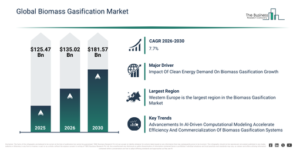
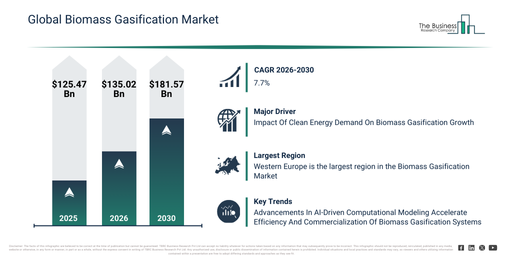
The biomass gasification market has experienced substantial expansion in recent years. Its value is anticipated to rise from $125.47 billion in 2025 to $135.02 billion in 2026, reflecting a compound annual growth rate (CAGR) of 7.6%. This historical growth can be attributed to factors such as government initiatives supporting renewable energy projects, the increasing use of agricultural residues, a growing demand for cleaner fuel alternatives, the advancement of decentralized power generation, and the adoption of biomass-based chemical production.
The biomass gasification market is projected for significant expansion in the coming years, reaching $181.57 billion by 2030, driven by a compound annual growth rate (CAGR) of 7.7%. This anticipated growth stems from several factors, including the expansion of hydrogen production initiatives, increased investments in circular economy projects, a growing demand for low-carbon fuels, the scaling up of municipal waste-to-energy facilities, and advancements in gasifier efficiency through technological improvements. Key trends anticipated during this period encompass the broadening of waste-to-energy infrastructure, an increased uptake of advanced gasification reactors, greater integration of process control and monitoring systems, a heightened emphasis on optimizing syngas quality, and the implementation of modular biomass gasification plants.
Download A Free Sample Report For Comprehensive Market Insights:
Biomass Gasification Market Growth Drivers: What Factors Are Accelerating Expansion?
The increasing global emphasis on clean energy sources is projected to drive the expansion of the biomass gasification market moving forward. Clean energy encompasses power derived from renewable, sustainable origins, characterized by minimal ecological impact and producing low or no greenhouse gas emissions during its generation. The primary catalyst for this transition to clean energy sources is the urgent need to mitigate climate change, as these sources generate electricity with negligible or zero greenhouse gas emissions, making them crucial for reducing the energy sector’s carbon footprint. Biomass gasification is increasingly adopted to satisfy clean energy requirements through the conversion of organic materials into renewable syngas, which can then be utilized for electricity production and fuel creation. For instance, in January 2024, the U.S. Energy Information Administration, a US-based federal agency tasked with collecting and analyzing energy information, reported that planned solar initiatives are expected to elevate the electric power sector’s solar capacity by 38%, increasing from 95 gigawatts (GW) at the close of 2023 to 131 GW by the end of 2024. Hence, the heightened focus on clean energy sources will stimulate the biomass gasification market.
Biomass Gasification Market Segment Landscape: Which Areas Lead Market Development?
The biomass gasification market covered in this report is segmented –
1) By Gasifier Type: Moving Or Fixed Bed, Fluidized Bed, Entrained, Other Gasifier Types
2) By Source: Solid Biomass, Biogas, Municipal Waste, Liquid Biomass
3) By Application: Chemicals, Liquid Fuels, Power, Gas Fuels
Subsegments:
1) By Moving Or Fixed Bed Gasifiers: Updraft Gasifiers, Downdraft Gasifiers, Cross-Draft Gasifiers
2) By Fluidized Bed Gasifiers: Bubbling Fluidized Bed Gasifiers, Circulating Fluidized Bed Gasifiers
3) By Entrained Flow Gasifiers: High-Temperature Entrained Flow Gasifiers, Low-Temperature Entrained Flow Gasifiers
4) By Other Gasifier Types: Plasma Gasifiers, Rotary Kiln Gasifiers, Pyrolysis Gasifiers
#Biomass Gasification Market Growth Trends: What Is Influencing The Future Outlook?
Leading companies and research institutions operating in the biomass gasification market are increasingly implementing advanced computational modeling techniques, especially AI-enabled hybrid models, to improve prediction accuracy, optimize reactor performance, and accelerate large-scale deployment. These next-generation modeling approaches integrate traditional simulation tools with machine-learning methods, such as neural networks, enabling more precise estimation of syngas composition, enhanced process optimization, and significantly lower computational requirements compared to conventional thermodynamic equilibrium or CFD models. For instance, in July 2025, the Royal Society of Chemistry (RSC), a UK-based scientific publisher, released a study titled “Recent advances and computational approaches in biomass gasifier modeling: from thermodynamics to AI-driven techniques,” which was conducted by a team of renewable-energy researchers. The study demonstrated that AI-driven and hybrid models can reliably simulate the generation of hydrogen-enriched syngas from a wide variety of biomass feedstocks, offering superior accuracy, enhanced computational efficiency, and improved scalability over classical methods.
Biomass Gasification Market Industry Leaders And Market Competition
Major companies operating in the biomass gasification market are Siemens Energy AG, Engie SA, Andritz AG, Air Products and Chemicals, Inc., Air Liquide S.A., Mitsubishi Heavy Industries, Ltd., Thyssenkrupp AG, Lahti Energia Oy, Babcock & Wilcox Enterprises, Inc., Shangqiu Haiqi Machinery Equipment Co., Ltd., Sedin Engineering Co., Ltd., Chanderpur Group, Case Group, GGE Power Pvt. Ltd., EnviTec Biogas AG, First Biogas International AG, Shenzhen Puxin Science & Technology Co., Ltd., Mingshuo Environment Technology Group Co., Ltd., Clarke Energy Ltd., Seko Industries Srl, HC Energy, Agraferm Technologies AG, Sunpower Group Ltd., Outotec Oyj (now part of Metso Outotec), Valmet Oyj, Drax Power Limited, Hitachi Zosen Inova AG, EcoTerra BioGas, CEZ Group, Romelectro SA, ZiO-Podolsk (Machine-Building Plant named after Ordzhonikidze), Notus Energy, Polish Energy Group (PGE Polska Grupa Energetyczna S.A.), H3-CHP Clean Energy Systems, Emispec, Inc., PyroGenesis Canada Inc., Lambion Energy Solutions GmbH, Triple Green Energy, Klean Industries Inc., Wright Tech Systems Inc., V&F Analyse- und Messtechnik GmbH, Western Research Institute, CleanTech Biofuels, Inc.
Access The Complete Biomass Gasification Market Report:
Biomass Gasification Market Largest Region By Revenue And Market Share
Western Europe was the largest region in the biomass gasification market in 2025, and it is also expected to be the fastest-growing region in the forecast period. The regions covered in the biomass gasification market report are Asia-Pacific, South East Asia, Western Europe, Eastern Europe, North America, South America, Middle East, Africa
Get in touch with us:
The Business Research Company: https://www.thebusinessresearchcompany.com/
Americas: +1 310-496-7795
Asia: +44 7882 955267 & +91 8897263534
Europe: +44 7882 955267
Email us at: marketing@tbrc.info
Follow us on:
LinkedIn: https://in.linkedin.com/company/the-business-research-company
YouTube: https://www.youtube.com/channel/UC24_fI0rV8cR5DxlCpgmyFQ
Global Market Model: https://www.thebusinessresearchcompany.com/global-market-model

Wasay has over a decade of experience in market research, data modelling, and analytics, with prior experience at GlobalData and Decision Tree Consulting Services. At The Business Research Company , he leads research operations across syndicated studies, customized consulting engagements, and the Global Market Model platform. His professional experience includes supporting organizations such as Boston Consulting Group, KPMG, and Ernst & Young. Wasay holds a degree in Electronics and Communications Engineering, postgraduate management qualifications from International Management Institute Belgium and Indian School of Business and Entrepreneurship, and completed the Integrated Program in Business Analytics from Indian Institute of Management Indore.