Market attractiveness scoring, total addressable market sizing, company benchmarking matrices, interactive Excel dashboards, deeper supply chain intelligence, emerging startup tracking, and granular product-level insights are among the key offerings featured in The Business Research Company’s 2026 market reports, designed to deliver more actionable and strategically valuable research.
Combine Harvester Market On Course To Reach $74.16 Billion By 2030: Size And Growth Overview
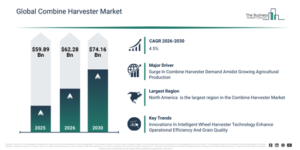
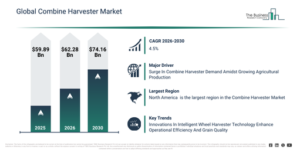
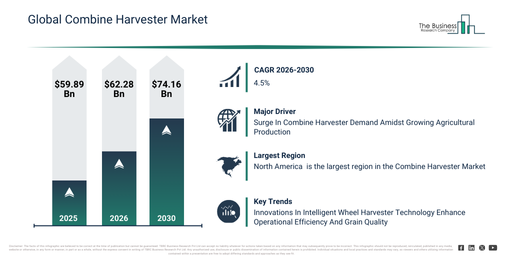
The combine harvester market has seen consistent growth in recent years. It is projected to expand from $59.89 billion in 2025 to $62.28 billion in 2026, achieving a compound annual growth rate (CAGR) of 4.0%. Historically, this growth can be ascribed to an increase in large-scale farming operations, growing labor shortages in agriculture, heightened mechanization of harvesting processes, the availability of advanced harvesting machinery, and the expansion of commercial farming practices.
The combine harvester market is projected to experience consistent expansion over the upcoming years, with its size anticipated to reach $74.16 billion by 2030, demonstrating a compound annual growth rate (CAGR) of 4.5%. This projected growth can be linked to factors such as the increasing acceptance of autonomous and semi-autonomous harvesting machinery, the expanded application of data-centric agricultural solutions, a surge in smart agriculture investments, a heightened need for eco-friendly farming tools, and ongoing enhancements in harvester operational effectiveness. Key trends during this forecast timeframe encompass the wider embrace of high-capacity self-propelled harvesters, the escalating integration of precision agriculture technologies, a burgeoning requirement for energy-efficient harvesting machinery, the broadening of multi-crop harvesting functionalities, and a sharpened emphasis on maximizing crop yields.
Need Combine Harvester Market Forecasts? Get Your Free Sample Report Here:
Combine Harvester Market Growth Factors: What Is Strengthening Demand Worldwide?
The growing need for agricultural output is anticipated to fuel the expansion of the combine harvester market in the future. Agricultural output involves both crop cultivation and animal husbandry to produce food, fiber, and diverse other goods. This process includes activities like tilling soil, sowing, harvesting, raising livestock, and overseeing farm assets. The combine harvester stands as crucial machinery in agricultural operations, particularly in extensive farming, providing numerous benefits that streamline, accelerate, and enhance farming efficiency.
Combine Harvester Market By Segment: Complete Category And Subcategory Breakdown
The combine harvester market covered in this report is segmented –
1) By Type: Tractor Pulled Or PTO Powered Combine Harvester, Self-Propelled Combine Harvester
2) By Movement: Wheel Type Combine Harvester, Crawler Type Combine Harvester
3) By Cutting Width: Small Size Combine Harvester, Large Size Combine Harvester
4) By Power Type: Below 150 HP, 150-300 HP, 300-450 HP, 450-550 HP, Above 550 HP
5) By Application: Wheat Harvesting, Rice Harvesting, Soybeans Harvesting, Other Applications
Subsegments:
1) By Tractor Pulled Or PTO Powered Combine Harvester: Standard Tractor Pulled, High-Capacity PTO Powered
2) By Self-Propelled Combine Harvester: Standard Self-Propelled, High-Capacity Self-Propelled, Compact Self-Propelled, Hybrid Models
Combine Harvester Market Trend Outlook: Developments Defining The Forecast Period
Companies operating in the combine harvester market are concentrating on developing advanced solutions, including real-time machine tracking and operational parameter monitoring, to improve harvesting efficiency, reduce grain loss, and enhance overall crop quality. Real-time machine tracking refers to a technology in modern wheel harvesters that enables owners to observe live location, fuel consumption, and acres harvested, aiding in the optimization of operational decisions and maintenance schedules.
Who Is Competing For Share In The Combine Harvester Market?
Major companies operating in the combine harvester market are Deere & Company, CNH Industrial NV, Kubota Corporation, New Holland Agriculture, Mahindra & Mahindra Ltd., Yanmar Co. Ltd., Zoomlion Heavy Industry Science & Technology Co. Ltd., Claas KGaA GmbH, Lovol Heavy Industry Co. Ltd., Sonalika International Tractors Limited, Iseki & Co. Ltd., Same Deutz-Fahr S.p.A, Tractors and Farm Equipment Limited (TAFE), Sampo Rosenlew Ltd., Malkit Agrotech Private Limited, Zhengzhou Amisy Machinery Co. Ltd., Hind Agro Industries, KS Group, Buhler Versatile Incorporated, Kartar Agro Industries Private Limited, OAO Rostselmash, Massey Ferguson Limited, Preet Agro Industries Pvt Ltd., Jiangsu World Agriculture Machinery Co. Ltd., Gomselmash Oao, Mitsubishi Agricultural Machinery Co. Ltd., Agrinar SA, Wuhan Wubota Machinery Co. Ltd.
Get The Full Picture With The Combine Harvester Market Report:
Combine Harvester Market Regional Snapshot: Leading Geography In 2025
North America was the largest region in the combine harvester market in 2025. Asia Pacific is expected to be the fastest-growing region in the forecast period. The regions covered in the combine harvester market report are Asia-Pacific, South East Asia, Western Europe, Eastern Europe, North America, South America, Middle East, Africa
Reach Out To Our Team:
The Business Research Company: https://www.thebusinessresearchcompany.com/
Americas: +1 310-496-7795
Asia: +44 7882 955267 & +91 8897263534
Europe: +44 7882 955267
Email us at: marketing@tbrc.info
Follow us on:
LinkedIn: https://in.linkedin.com/company/the-business-research-company
YouTube: https://www.youtube.com/channel/UC24_fI0rV8cR5DxlCpgmyFQ
Global Market Model: https://www.thebusinessresearchcompany.com/global-market-model

Wasay has over a decade of experience in market research, data modelling, and analytics, with prior experience at GlobalData and Decision Tree Consulting Services. At The Business Research Company , he leads research operations across syndicated studies, customized consulting engagements, and the Global Market Model platform. His professional experience includes supporting organizations such as Boston Consulting Group, KPMG, and Ernst & Young. Wasay holds a degree in Electronics and Communications Engineering, postgraduate management qualifications from International Management Institute Belgium and Indian School of Business and Entrepreneurship, and completed the Integrated Program in Business Analytics from Indian Institute of Management Indore.