Built to provide research that’s more actionable and strategically valuable, The Business Research Company’s 2026 market reports include market attractiveness analysis, total addressable market sizing, company benchmarking matrices, interactive Excel dashboards, broader supply chain intelligence, emerging startup tracking, and in-depth product insights.
Commercial Robots Market Poised To Hit $67.95 Billion By 2030 With A 17.7% CAGR
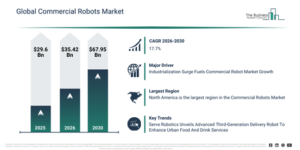
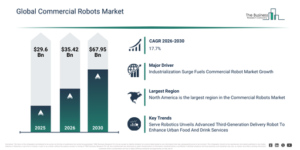
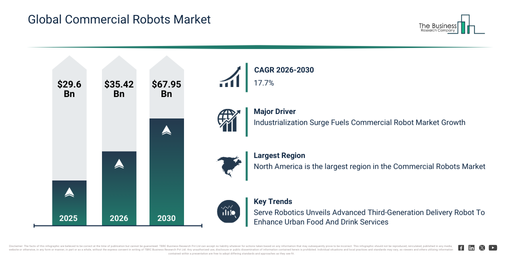
The commercial robots market size has experienced rapid growth in recent years. It is forecasted to expand from $29.6 billion in 2025 to $35.42 billion in 2026, at a compound annual growth rate (CAGR) of 19.6%. The historical growth can be attributed to a combination of rising labor shortages across industries, the expansion of automation in services, increased adoption of robots in healthcare and agriculture, the availability of collaborative robot platforms, and investments in robotics startups.
The commercial robots market size is projected to experience rapid expansion over the next few years, reaching $67.95 billion by 2030 with a compound annual growth rate (CAGR) of 17.7%. This growth during the forecast period is driven by the wider adoption of AI-enabled commercial robots, increased deployment of robots in public services, the imperative for cost-efficient automation, the incorporation of advanced sensors and vision systems, and the emergence of robotics-as-a-service models. Significant trends anticipated for this period include the broader application of service robots in commercial settings, a rise in the deployment of autonomous mobile robots, the integration of AI-based human-robot interaction, an escalating demand for safety and collaborative functionalities, and the customization of robots for specific industry tasks.
Get A Free Sample Report With In-Depth Market Insights:
Commercial Robots Market Development Factors: What’s Supporting Demand?
The expansion of the commercial robot market going forward is expected to be propelled by heightened industrialization. Industrialization entails the mechanization of production, the use of non-human energy sources, and the structuring of labor within extensive factories and businesses, which enables mass production and economic advancement. This rise in industrialization is attributable to various factors, such as the flourishing industrial revolution and an expanding manufacturing sector. Commercial robots are utilized by businesses to replicate, assist with, or fully replace human tasks and functions. For example, data released by the National Bureau of Statistics (NBS) of China, the body responsible for collecting, investigating, researching, and publishing statistics, revealed that the nation’s industrial output saw a 4.6% increase year over year in October 2023, outperforming the projected 4.4% increase. This rate of growth was swifter than the 4.5% observed in September 2023. Hence, growing industrialization is a key driver for the commercial robot market’s expansion.
Commercial Robots Market Segment Outlook: Which Categories Are Growing Fastest?
The commercial robots market covered in this report is segmented –
1) By Type: Service Robots, Medical Robots, Field Robots, Commercial Mobile Robots, Professional Drones
2) By Level Of Autonomy: Fully Autonomous, Semi-Autonomous, Human-Supervised Autonomous
3) By Application: Healthcare And Medical Services, Retail And Hospitality, Agriculture And Forestry, Logistics And Commercial Facilities, Security And Surveillance, Construction And Infrastructure, Environmental And Utility Services
Subsegments:
1) By Service Robots: Cleaning Robots, Security And Surveillance Robots, Hospitality And Delivery Robots, Retail And Customer Assistance Robots
2) By Medical Robots: Surgical Robots, Rehabilitation Robots, Therapy And Assistive Robots, Diagnostic And Imaging Robots
3) By Field Robots: Agricultural Robots, Construction Robots, Environmental Monitoring Robots
4) By Commercial Mobile Robots: Autonomous Mobile Robots (AMRs), Service-Oriented Guided Vehicles (SGVs)
5) By Professional Drones: Inspection And Mapping Drones, Commercial Delivery Drones, Surveillance And Monitoring Drones
Commercial Robots Market Transformation Trends: What Innovations Are Driving Change?
Companies operating in the commercial robot market are strategically investing in sophisticated robotic technologies, particularly third-generation delivery robots, to elevate urban delivery services, aiming to bolster efficiency and customer satisfaction. A third-generation delivery robot signifies an advanced category of autonomous delivery robot, incorporating numerous enhancements over prior versions concerning technology, functionality, and user experience. For instance, in October 2024, Serve Robotics, Inc., a US-based firm specializing in developing and deploying robotic delivery solutions, launched its latest third-generation delivery robot to improve food and drink delivery in Los Angeles, according to a company report. This advanced robot features expanded capacity for larger items like pizzas, improved speed and battery life for greater travel distances on a single charge, heightened water resistance, and faster braking capabilities for superior performance in adverse weather conditions. Originally a part of Postmates, which was later acquired by Uber, Serve Robotics seeks to capitalize on L.A.’s dense delivery market, operating in neighborhoods such as Hollywood and Koreatown. The company underscores the environmental and economic advantages of these robots, projecting potential reductions in delivery costs, a boost to local commerce, and the creation of new employment opportunities within the gig economy.
Commercial Robots Market Leading Companies And Competitive Benchmarking
Major companies operating in the commercial robots market are Honda Motor Co. Ltd., Omron Corporation, Teradyne Inc. (Universal Robots), Techman Robot Inc., iRobot Corporation, SoftBank Robotics Group, UBTECH Robotics Corp. Ltd., Pudu Technology Inc., Fourier Intelligence, Boston Dynamics, Sarcos Technology and Robotics Corporation, inVia Robotics Inc., Agrobot, Keenon Robotics Co. Ltd., Universal Robots A/S, Robocath, Wingcopter, 3DR Inc., Vecow Co. Ltd., PickNik Inc.
View The Full Commercial Robots Market Report:
Commercial Robots Market Top Region: Where Does Most Revenue Come From?
North America was the largest region in the commercial robots market in 2025. Asia-Pacific is expected to be the fastest-growing region in the forecast period. The regions covered in the commercial robots market report are Asia-Pacific, South East Asia, Western Europe, Eastern Europe, North America, South America, Middle East, Africa
Reach Out To Our Team:
The Business Research Company: https://www.thebusinessresearchcompany.com/
Americas: +1 310-496-7795
Asia: +44 7882 955267 & +91 8897263534
Europe: +44 7882 955267
Email us at: marketing@tbrc.info
Follow us on:
LinkedIn: https://in.linkedin.com/company/the-business-research-company
YouTube: https://www.youtube.com/channel/UC24_fI0rV8cR5DxlCpgmyFQ
Global Market Model: https://www.thebusinessresearchcompany.com/global-market-model

Wasay has over a decade of experience in market research, data modelling, and analytics, with prior experience at GlobalData and Decision Tree Consulting Services. At The Business Research Company , he leads research operations across syndicated studies, customized consulting engagements, and the Global Market Model platform. His professional experience includes supporting organizations such as Boston Consulting Group, KPMG, and Ernst & Young. Wasay holds a degree in Electronics and Communications Engineering, postgraduate management qualifications from International Management Institute Belgium and Indian School of Business and Entrepreneurship, and completed the Integrated Program in Business Analytics from Indian Institute of Management Indore.