Delivering more actionable and strategically valuable research, The Business Research Company’s 2026 market reports feature market attractiveness analysis, total addressable market evaluation, company benchmarking matrices, interactive Excel dashboards, expanded supply chain intelligence, emerging startup coverage, and detailed product insights.
Cooking Robot Market Expected To Reach $7.86 Billion By 2030 At 13.1% CAGR
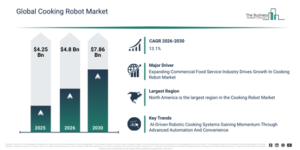
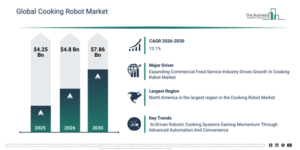
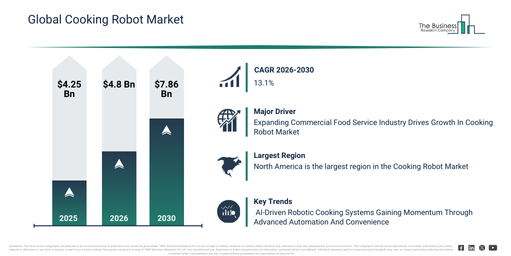
The cooking robot market size has experienced significant expansion recently. This market is projected to expand from $4.25 billion in 2025 to $4.8 billion in 2026, demonstrating a compound annual growth rate (CAGR) of 12.9%. Factors contributing to its historical growth include the proliferation of quick service restaurant chains, increasing labor scarcity in the foodservice industry, a rising need for consistent food quality, the rise of cloud kitchens, and developments in robotic hardware.
The cooking robot market is poised for significant expansion over the coming years, projected to reach $7.86 billion by 2030 at a compound annual growth rate (CAGR) of 13.1%. This anticipated growth is driven by several factors, including the increasing integration of robotic kitchens in residential settings, greater investments in intelligent appliances, the expansion of automated food preparation in healthcare facilities and other institutions, a heightened emphasis on cooking solutions that require no physical contact, and the growing incorporation of artificial intelligence within food robotics. Key trends anticipated during this period encompass the wider embrace of fully automated cooking methods, the increasing implementation of AI for optimizing recipes, an escalating need for automated systems that ensure consistent food quality, the broadening deployment of robotic kitchens in commercial environments, and an intensified commitment to food safety and hygiene.
Download A Free Sample Report For Comprehensive Market Insights:
#Cooking Robot Market Demand Drivers Creating New Revenue Opportunities
The future growth of the cooking robot market is anticipated to be significantly propelled by the expanding commercial food service industry. This sector comprises profit-driven businesses and establishments that prepare and serve food and beverages to customers. The expansion of this industry is fueled by the rising popularity of fast-casual restaurants, which offer superior quality food at more accessible prices than traditional full-service establishments. Moreover, higher disposable incomes and technological advancements, including online ordering, food delivery applications, and digital payments, enhance customer convenience and stimulate industry development. Cooking robots play a crucial role by simplifying and optimizing operations within the commercial food service industry, enabling businesses to manage expenses, ensure product uniformity, and uphold stringent food safety and quality benchmarks. For example, in June 2024, figures from the US Bureau of Labor Statistics, a US-based federal fact-finding agency, indicated that the number of private industry establishments in food services and drinking places reached 711,159 in the 4th quarter of 2023. This represents a 4.28% increase from the 695,817 establishments reported during the 1st quarter of 2023. Thus, the expansion of the commercial food service industry will undeniably drive the cooking robot market.
Cooking Robot Market Segmentation And Category Breakdown
The cooking robot market covered in this report is segmented –
1) By Robot Type: Fixed Kitchen Cooking Robots, Robotic Food Preparation And Assembly Systems, Beverage Preparation Robots, Mobile And Modular Cooking Robots
2) By Application: Fast Food And Quick-Service Restaurants (QSRs), Beverage Preparation, Protein And Meat Cooking, Bakery And Dessert Preparation, Multi-Cuisine Meal Preparation
3) By End-User: Commercial, Residential
Subsegments:
1) By Fixed Kitchen Cooking Robots: Robotic Frying Systems, Robotic Grilling Systems, Robotic Stir-Frying And Sautéing Systems
2) By Robotic Food Preparation And Assembly Systems: Ingredient Dispensing Robots, Mixing And Portioning Robots, Assembly & Plating Robots
3) By Beverage Preparation Robots: Robotic Coffee And Tea Machines, Robotic Bartenders And Drink Mixing Robots
4) By Mobile And Modular Cooking Robots: Mobile Cooking Stations, Modular Multi-Cuisine Cooking Robots
Cooking Robot Market Transformation Trends: Which Innovations Are Driving Change?
Leading companies in the cooking-robot market are concentrating on technological advancements, such as AI-powered countertop robotic chefs, to meet the increasing demand for convenience, time-saving meal preparation, and consistent quality in both domestic and professional kitchens. AI-powered countertop robotic chefs are compact kitchen appliances that utilize computer vision, sensors, and recipe automation algorithms to mimic cooking processes like stirring, heating, and ingredient addition, thereby minimizing manual labor compared to traditional cooking methods or simple appliances. For example, in May 2025, Posha, a US-based kitchen-robotics startup previously known as Nymble, launched its flagship product, the Posha kitchen robot, an innovative countertop cooking robot designed for home use. Posha’s robot incorporates a camera, ingredient hoppers, a spice carousel, an induction cooktop, and automated stirring and heating controls to prepare a wide variety of meals. Users simply load prepped ingredients, select a recipe, and the robot dispenses ingredients, adjusts heat, stirs, and delivers a cooked meal with minimal supervision. Its benefits over conventional cooking include automated temperature control, precise timing, reduced manual involvement, and enhanced convenience, significantly cutting down cooking time while achieving consistent results. This trend reflects broader market drivers such as demanding lifestyles, a growing preference for convenience, and the increasing adoption of smart-kitchen technologies.
Cooking Robot Market Competitive Analysis Of Major Industry Participants
Major companies operating in the cooking robot market are Moley Robotics Ltd., Miso Robotics Inc., Nala Robotics Inc., Chowbotics Ltd., Picnic Works, Inc., SavorEat Ltd., Dexai Robotics Inc., Briggo, Inc., Truebird Inc., Karakuri Ltd., Kitchen Robotics Ltd., Chefee Robotics Inc., Bear Robotics Inc., Spyce Foods, LLC, Creator Global Inc., Cafe X Technologies, Inc., Makr Shakr S.r.l., Rozum Robotics Food Solutions, Milkit Ltd., Sally Robotics Inc., Coffee Bar Robotics, Euphotic Labs Pvt. Ltd., Wobot AI Pvt. Ltd., Soft Robotics Kitchen Systems, RoboChef Systems Inc.
Access The Complete Cooking Robot Market Report:
Cooking Robot Market Regional Distribution: Which Areas Drive Market Expansion?
North America was the largest region in the cooking robot market in 2025. Asia-Pacific is expected to be the fastest-growing region in the forecast period. The regions covered in the cooking robot market report are Asia-Pacific, South East Asia, Western Europe, Eastern Europe, North America, South America, Middle East, Africa
Get in touch with us:
The Business Research Company: https://www.thebusinessresearchcompany.com/
Americas: +1 310-496-7795
Asia: +44 7882 955267 & +91 8897263534
Europe: +44 7882 955267
Email us at: marketing@tbrc.info
Follow us on:
LinkedIn: https://in.linkedin.com/company/the-business-research-company
YouTube: https://www.youtube.com/channel/UC24_fI0rV8cR5DxlCpgmyFQ
Global Market Model: https://www.thebusinessresearchcompany.com/global-market-model

Wasay has over a decade of experience in market research, data modelling, and analytics, with prior experience at GlobalData and Decision Tree Consulting Services. At The Business Research Company , he leads research operations across syndicated studies, customized consulting engagements, and the Global Market Model platform. His professional experience includes supporting organizations such as Boston Consulting Group, KPMG, and Ernst & Young. Wasay holds a degree in Electronics and Communications Engineering, postgraduate management qualifications from International Management Institute Belgium and Indian School of Business and Entrepreneurship, and completed the Integrated Program in Business Analytics from Indian Institute of Management Indore.