With a focus on actionable insights and strategic value, The Business Research Company’s 2026 market reports include market attractiveness scoring, total addressable market sizing, company benchmarking matrices, interactive Excel dashboards, deeper supply chain intelligence, emerging startup tracking, and granular product-level insights.
How Much Will The Corn Wet-Milling Market Be Worth By 2030?
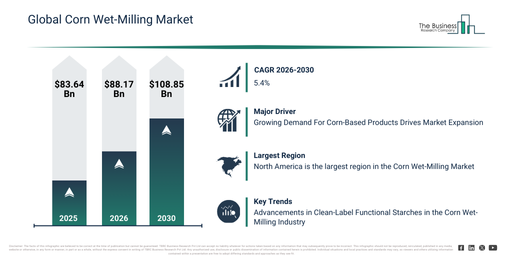
The corn wet-milling market size has experienced significant expansion in recent years. It is anticipated to grow from $83.64 billion in 2025 to $88.17 billion in 2026, achieving a compound annual growth rate (CAGR) of 5.4%. The factors contributing to this historic growth include the expansion of food and beverage processing industries, an increase in animal feed production, the rising demand for corn-derived sweeteners, more stringent ethanol blending mandates, and the widespread availability of large-scale wet-milling facilities.
The corn wet-milling market is projected to experience substantial expansion over the coming years. Its valuation is predicted to reach $108.85 billion by 2030, demonstrating a compound annual growth rate (CAGR) of 5.4%. This growth during the forecast period is primarily driven by factors such as the increasing need for bio-based chemicals, a heightened emphasis on sustainable starch manufacturing, the broadening scope of industrial fermentation applications, greater investments in operational efficiency, and the wider implementation of advanced separation technologies. Key developments anticipated within this timeframe involve advancements in corn fractionation process efficiency, an increase in the deployment of automated steeping and milling systems, a rising need for high-purity starch and sweeteners, the broadening of ethanol and bio-based byproduct manufacturing, and a greater emphasis on optimizing water and energy usage.
Get Access To A Free Corn Wet-Milling Market Report Sample:
The Key Driver Behind The Corn Wet-Milling Market’s 5.4% CAGR
The escalating demand for corn-based products is driving the future expansion of the corn wet-milling market. Corn-based products encompass items crafted from corn, such as corn flakes and flours. This increasing demand for corn-based products, in turn, fuels the need for corn wet-milling, as it contributes to improved product purity. The growing demand for corn-based products is set to propel the growth of the corn wet-milling market.
Corn Wet-Milling Market Classification: Main Segments And Detailed Subsegments
The corn wet-milling market covered in this report is segmented –
1) By Source: Dent Corn, Waxy Corn
2) By Equipment: Milling Equipment, Steeping Equipment, Centrifuge Systems, Washing And Filtration Systems, Other Equipment
3) By End-product: Starch, Sweetener, Corn Gluten Meal And Gluten Feed, Other End-Products
Subsegments:
1) By Dent Corn: Field Corn, Yellow Dent Corn, White Dent Corn
2) By Waxy Corn: High-Amylose Waxy Corn, Low-Amylose Waxy Corn
Corn Wet-Milling Market Strategic Shifts: What Leading Players Are Prioritizing
Leading companies in the corn wet-milling market are prioritizing technological advancements, particularly clean-label functional native starches, to address the rising consumer demand for natural, label-friendly food ingredients and facilitate the increased incorporation of corn-derived starch in processed foods, clean-label dairy/alternative-dairy products, and plant-based applications. A clean-label functional native starch is defined as corn-extracted and processed starch that is non-GMO, minimally modified, and can be straightforwardly declared as “corn starch” (or “corn flour”) on ingredient labels. This contrasts with traditional modified starches, which often necessitate more significant chemical or physical alterations to gain enhanced functional properties such as thickening, gelling, or stabilizing across heat and freeze/thaw cycles.
Corn Wet-Milling Market Company Analysis: Major Industry Participants
Major companies operating in the corn wet-milling market are Archer Daniels Midland Company, Cargill Incorporated, Ingredion Incorporated, Tate & Lyle PLC, Roquette Frères SA, Grain Processing Corporation, Agrana Beteiligungs-AG, China Agri-Industries Holding Limited, Global Bio-Chem Technology Group Company Limited, National Starch LLC, Penford Corporation, Cereal Ingredients Inc., LifeLine Foods LLC, Bunge Limited, The Andersons Inc., Flint Hills Resources LP, Valero Energy Corporation, GreenField Specialty Alcohols Inc., Pacific Ethanol Inc., Green Plains Inc., Roquette America Inc., Ingredion Mexico S.A. de C.V.
Get Full Access To The Corn Wet-Milling Market Report 2026:
Corn Wet-Milling Market Global Regional Breakdown: Key Regions Analyzed
North America was the largest region in the corn wet-milling market share in 2025. North America is expected to be the fastest-growing region in the forecast period. The regions covered in the corn wet-milling market report are Asia-Pacific, South East Asia, Western Europe, Eastern Europe, North America, South America, Middle East, Africa
Reach Out To Our Team:
The Business Research Company: https://www.thebusinessresearchcompany.com/
Americas: +1 310-496-7795
Asia: +44 7882 955267 & +91 8897263534
Europe: +44 7882 955267
Email us at: marketing@tbrc.info
Follow us on:
LinkedIn: https://in.linkedin.com/company/the-business-research-company
YouTube: https://www.youtube.com/channel/UC24_fI0rV8cR5DxlCpgmyFQ
Global Market Model: https://www.thebusinessresearchcompany.com/global-market-model

Wasay has over a decade of experience in market research, data modelling, and analytics, with prior experience at GlobalData and Decision Tree Consulting Services. At The Business Research Company , he leads research operations across syndicated studies, customized consulting engagements, and the Global Market Model platform. His professional experience includes supporting organizations such as Boston Consulting Group, KPMG, and Ernst & Young. Wasay holds a degree in Electronics and Communications Engineering, postgraduate management qualifications from International Management Institute Belgium and Indian School of Business and Entrepreneurship, and completed the Integrated Program in Business Analytics from Indian Institute of Management Indore.