Designed to make market research more actionable and strategically valuable, The Business Research Company’s 2026 market reports feature market attractiveness scoring, total addressable market sizing, company benchmarking matrices, interactive Excel dashboards, deeper supply chain intelligence, emerging startup tracking, and granular product-level insights.
What Is The Projected CAGR Of The Desktop 3D Printing Market Through 2030?
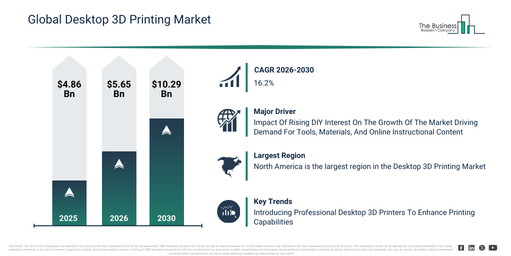
The desktop 3d printing market size has seen significant growth in recent years. It is anticipated to expand from $4.86 billion in 2025 to $5.65 billion in 2026, achieving a compound annual growth rate (CAGR) of 16.3%. The historical increase can be attributed to several factors including the expansion of maker and hobbyist communities, greater adoption within academic institutions, a rising demand for swift product iteration, the availability of cost-effective printing materials, and the growth of small-scale manufacturing.
The desktop 3D printing market is projected for swift expansion in the coming years. It is anticipated to reach $10.29 billion by 2030, exhibiting a compound annual growth rate (CAGR) of 16.2%. This growth throughout the forecast period can be ascribed to several factors, including the increasing integration of cloud-based printing software, a rising demand for sustainable printing materials, the expansion of distributed manufacturing models, an increased application in customized product design, and continuous advancements in desktop printer performance. Key trends during this period encompass the growing adoption of low-cost desktop 3D printers, an escalating demand for rapid prototyping functionalities, broader utilization in education and training, enhanced material compatibility, and a stronger emphasis on user-friendly interfaces.
Claim Your Free Desktop 3D Printing Market Sample Report With Key Data And Trends:
Desktop 3D Printing Market Demand Analysis: The Driving Force Behind Expansion
The increasing enthusiasm for DIY activities is anticipated to fuel the expansion of the desktop 3D printing market moving ahead. DIY, or do-it-yourself projects, involve individuals independently crafting, constructing, or mending items, generally without professional help. This growing interest in do-it-yourself endeavors stems from various elements such as financial savings, easier availability of tools and resources, the aspiration for customisation, and the sense of fulfillment and achievement from self-completed tasks. Desktop 3D printing significantly supports the increasing appeal of DIY projects by offering enthusiasts a cost-effective and convenient method to produce bespoke components, instruments, or prototypes from home. The expanding enthusiasm for DIY initiatives is propelling the growth of the desktop 3D printing market.
Breaking Down The Desktop 3D Printing Market By Segment
The desktop 3d printing market covered in this report is segmented –
1) By Component: Hardware, Software, Services
2) By Technology: Stereolithography, Fuse Deposition Modeling, Digital Light Processing
3) By Application: Prototyping, Tooling, Functional Parts
4) By End User: Individuals Or Hobbyists, Small And Medium Enterprises, Educational Institutions, Research And Development
Subsegments:
1) By Hardware: 3D Printers, Print Heads And Extruders, Build Platforms And Enclosures, Power Supply Units
2) By Software: 3D Modeling Software, Slicing Software, Simulation And Optimization Software, Printer Control Software
3) By Services: Consulting And Training Services, Maintenance And Repair Services, Custom Design And Prototyping Services, Subscription And Cloud-Based Services
Top Trend Influencing The Desktop 3D Printing Market Outlook
Leading companies within the desktop 3D printing market are actively developing innovative products, such as professional desktop 3D printers, to enhance printing accuracy, speed, and material compatibility across a broad spectrum of industries. A professional desktop 3D printer is characterized as a high-quality, precision 3D printing device intended for application in business, engineering, and design sectors, offering advanced functionalities like improved print resolution, larger build volumes, and compatibility with diverse materials for both prototyping and small-scale manufacturing.
Desktop 3D Printing Market Competitive Landscape And Major Players
Major companies operating in the desktop 3d printing market are MakerBot Industries LLC, Prusa Research s.r.o., Zortrax S.A., Monoprice Inc., Artillery 3D Technology Co. Ltd., XYZprinting Inc., LulzBot, FAME 3D Inc., Zhejiang Flashforge 3D Technology Co. Ltd., Raise 3D Technologies Inc., Shenzhen Elegoo Technology Co. Ltd., Shenzhen Creality 3D Technology Co. Ltd., Zhejiang Wanhao 3D Technology Co. Ltd., Robo 3D Inc., Fusion3 Innovations LLC, Zhejiang Qidi Technology Co. Ltd., Anycubic 3D Technology Co. Ltd., Phrozen Tech Co. Ltd., Voxelab, Peopoly Limited
Read The Full Desktop 3D Printing Market Report By The Business Research Company:
Where Is The Desktop 3D Printing Market Largest? Key Regional Insights
North America was the largest region in the desktop 3D printing market in 2025. The regions covered in the desktop 3d printing market report are Asia-Pacific, South East Asia, Western Europe, Eastern Europe, North America, South America, Middle East, Africa
Reach Out To Our Team:
The Business Research Company: https://www.thebusinessresearchcompany.com/
Americas: +1 310-496-7795
Asia: +44 7882 955267 & +91 8897263534
Europe: +44 7882 955267
Email us at: marketing@tbrc.info
Follow us on:
LinkedIn: https://in.linkedin.com/company/the-business-research-company
YouTube: https://www.youtube.com/channel/UC24_fI0rV8cR5DxlCpgmyFQ
Global Market Model: https://www.thebusinessresearchcompany.com/global-market-model

Wasay has over a decade of experience in market research, data modelling, and analytics, with prior experience at GlobalData and Decision Tree Consulting Services. At The Business Research Company , he leads research operations across syndicated studies, customized consulting engagements, and the Global Market Model platform. His professional experience includes supporting organizations such as Boston Consulting Group, KPMG, and Ernst & Young. Wasay holds a degree in Electronics and Communications Engineering, postgraduate management qualifications from International Management Institute Belgium and Indian School of Business and Entrepreneurship, and completed the Integrated Program in Business Analytics from Indian Institute of Management Indore.