Backed by market attractiveness analysis, total addressable market sizing, company benchmarking matrices, interactive Excel dashboards, wider supply chain intelligence, emerging startup coverage, and detailed product-level insights, The Business Research Company’s 2026 market reports are designed to offer research that is more actionable and strategically valuable than ever.
Engine Crankshaft Torsional Vibration Damper Market Growth Potential: How Will Market Size Shift Through 2030?
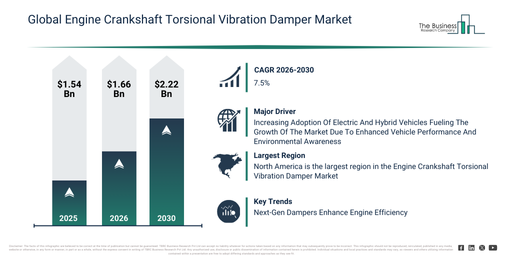
The market size for engine crankshaft torsional vibration dampers has experienced robust expansion in recent years. This market is projected to grow from $1.54 billion in 2025 to $1.66 billion in 2026, achieving a compound annual growth rate (CAGR) of 7.8%. Historically, the growth witnessed in this sector can be attributed to factors like increasing automotive production, the growing usage of heavy-duty engines, a rising demand for engine reliability, the expansion of industrial machinery manufacturing, and increasing aftermarket replacement needs.
The engine crankshaft torsional vibration damper market is projected to expand significantly in the coming years. Its value is anticipated to reach $2.22 billion by 2030, exhibiting a compound annual growth rate (CAGR) of 7.5%. This expansion during the forecast period is primarily driven by the increasing use of high-torque engines, a heightened emphasis on fuel efficiency, a greater need for advanced NVH control, the proliferation of hybrid powertrain engines, and expanding manufacturing capabilities within the Asia-Pacific region. Key market developments expected in this period encompass technological progress in damper materials, novelties in viscous and dual-mass designs, progress in precision CNC manufacturing, extensive research and development pertaining to high-temperature elastomers, and enhancements in simulation and CAE-based optimization techniques.
Get A Free Sample Report With In-Depth Market Insights:
Engine Crankshaft Torsional Vibration Damper Market Growth Factors Behind Sustained Expansion
The expanding embrace of electric and hybrid vehicles is projected to propel the engine crankshaft torsional vibration damper market in the future. This adoption signifies the rate at which individuals, businesses, and public entities are transitioning to these vehicle types from traditional internal combustion engine vehicles for their real-world fleets and daily transportation needs. The increase in electric and hybrid vehicle usage stems from heightened environmental consciousness, as consumers increasingly opt for cleaner transportation to mitigate air pollution and carbon emissions. Engine crankshaft torsional vibration dampers facilitate this rising adoption by minimizing vibrations and bolstering engine reliability, thereby enhancing overall vehicle performance and extending longevity. For instance, according to the International Council on Clean Transportation (ICCT), a US-based nonprofit research organization, passenger electric vehicle sales reached approximately 1.56 million in 2024, representing 10% of all light-duty vehicle sales, an increase from 2023 figures, as reported in April 2025. Consequently, the growing integration of electric and hybrid vehicles is a primary catalyst for the engine crankshaft torsional vibration damper market’s expansion. Increasing vehicle manufacturing is anticipated to boost the engine crankshaft torsional vibration damper market moving forward. Vehicle production refers to the industrial process involved in fabricating motor vehicles, including cars, trucks, buses, and other automotive units. This surge in vehicle production is driven by an escalating demand for both personal and commercial transport, the expansion of logistics networks, and an improvement in consumer purchasing power across the globe. Engine crankshaft torsional vibration dampers play a crucial role in supporting this heightened vehicle production by enhancing engine durability, performance, and noise control, thereby enabling manufacturers to produce dependable, high-efficiency vehicles on a large scale while adhering to stringent quality and regulatory mandates. For example, in May 2025, the European Automobile Manufacturers’ Association (ACEA), a Belgium-based motor vehicle manufacturing company, reported that South American car production saw a 1.7% rise in 2024 compared to 2023, largely fueled by Brazil’s 6.3% increase, which accounted for roughly 1.9 million cars. Concurrently, global bus production reached 362,005 units last year, marking a 10.3% increase over 2023. Hence, the rising volume of vehicle production is a key factor driving the engine crankshaft torsional vibration damper market.
Engine Crankshaft Torsional Vibration Damper Market Segment Analysis And Revenue Potential
The engine crankshaft torsional vibration damper market covered in this report is segmented –
1) By Product Type: Elastomeric Torsional Vibration Dampers, Viscous Torsional Vibration Dampers, Friction or Rubber-Bonded Harmonic Balancers, Dual-Mass or Tuned Dampers, Other Damper Types
2) By Material Type: Rubber-Based Dampers, Polymer or Composite Dampers, Metal-Based Dampers (Steel, Aluminum), Hybrid Material Dampers
3) By Engine Type: Gasoline Engines, Diesel Engines, Hybrid Engines, Industrial Engines (Non-Automotive)
4) By Sales Channel: Original Equipment Manufacturer (OEM), Aftermarket (Replacement / Repair), Original Equipment Supplier (OES)
5) By Application: Automotive Passenger Vehicles, Commercial Vehicles (Light, Medium, Heavy Trucks), Off-Highway Equipment (Agriculture, Construction, Mining), Industrial Machinery Engines, Marine Engines, Power Generation Engines
Subsegments:
1) By Elastomeric Torsional Vibration Dampers: Standard Elastomer, High Temperature Elastomer, Low Stiffness Elastomer, High Stiffness Elastomer, Custom Elastomer
2) By Viscous Torsional Vibration Dampers: Single Chamber Viscous, Dual Chamber Viscous, High Torque Viscous, Low Torque Viscous, Temperature Resistant Viscous
3) By Friction or Rubber-Bonded Harmonic Balancers: Single Mass Friction, Dual Mass Friction, High Torque Rubber-Bonded, Low Torque Rubber-Bonded, Custom Rubber-Bonded
4) By Dual-Mass or Tuned Dampers: Automotive Dual-Mass, Heavy Duty Dual-Mass, High Performance Tuned, Standard Tuned, Custom Tuned
5) By Other Damper Types: Overrunning Alternator Decoupler, Hydraulic Dampers, Magnetic Dampers, Composite Dampers, Specialty Dampers
Engine Crankshaft Torsional Vibration Damper Market Industry Trends Fueling Future Revenue Growth
Leading companies operating in the engine crankshaft torsional vibration damper market are concentrating on developing sophisticated products, such as torsional vibration dampers with overrunning functions, to enhance efficiency, boost smoothness, and lessen component strain and emissions. Torsional vibration dampers with overrunning functions refer to advanced components that disconnect the belt drive from the crankshaft, isolating high torsional vibrations to allow for low belt tension and reduced friction. For instance, in April 2024, Continental AG, a Germany-based automotive technology company, introduced its new range of torsional vibration dampers. These dampers feature an advanced multi-layered design that incorporates high-quality rubber and friction materials to absorb vibrations more effectively. This technology offers superior durability and noise reduction compared to traditional steel-based dampers, making them ideal for modern powertrains, including those found in electric and hybrid vehicles. The product’s innovative characteristics help improve engine smoothness, decrease fuel consumption, and extend overall engine life by mitigating wear and tear on engine components.
Engine Crankshaft Torsional Vibration Damper Market Competitive Landscape: Which Companies Lead The Industry?
Major companies operating in the engine crankshaft torsional vibration damper market are Continental AG, ZF Friedrichshafen AG, Magna International Inc., Valeo SA, Schaeffler Technologies AG & Co. KG, Knorr-Bremse AG, Voith Group, Vibracoustic GmbH, Trelleborg AB, Metaldyne Performance Group Inc., Anhui Zhongding Group Co. Ltd., Dongfeng (Shiyan) Automotive Component Co. Ltd., Tsubakimoto Chain Co., FUKOKU Co. Ltd., Dayco Products LLC, Geislinger GmbH, Premier Seals Ltd., Vibratech TVD, Hasse & Wrede GmbH, Ningbo Sedsun Vibration Damper Co. Ltd.
View The Full Engine Crankshaft Torsional Vibration Damper Market Report:
Engine Crankshaft Torsional Vibration Damper Market Regional Outlook: Where Is Opportunity Concentrated?
North America was the largest region in the engine crankshaft torsional vibration damper market in 2025. Asia-Pacific is expected to be the fastest-growing region in the forecast period. The regions covered in the engine crankshaft torsional vibration damper market report are Asia-Pacific, South East Asia, Western Europe, Eastern Europe, North America, South America, Middle East, Africa.
Reach Out To Our Team:
The Business Research Company: https://www.thebusinessresearchcompany.com/
Americas: +1 310-496-7795
Asia: +44 7882 955267 & +91 8897263534
Europe: +44 7882 955267
Email us at: marketing@tbrc.info
Follow us on:
LinkedIn: https://in.linkedin.com/company/the-business-research-company
YouTube: https://www.youtube.com/channel/UC24_fI0rV8cR5DxlCpgmyFQ
Global Market Model: https://www.thebusinessresearchcompany.com/global-market-model

Wasay has over a decade of experience in market research, data modelling, and analytics, with prior experience at GlobalData and Decision Tree Consulting Services. At The Business Research Company , he leads research operations across syndicated studies, customized consulting engagements, and the Global Market Model platform. His professional experience includes supporting organizations such as Boston Consulting Group, KPMG, and Ernst & Young. Wasay holds a degree in Electronics and Communications Engineering, postgraduate management qualifications from International Management Institute Belgium and Indian School of Business and Entrepreneurship, and completed the Integrated Program in Business Analytics from Indian Institute of Management Indore.