Featuring market attractiveness scoring, total addressable market sizing, company benchmarking matrices, interactive Excel dashboards, deeper supply chain intelligence, emerging startup tracking, and granular product-level insights, The Business Research Company’s 2026 market reports are built to deliver research that is both more actionable and more strategically valuable.
Heavy Engineering Equipment Market Revenue Growth On Track For A 3.9% CAGR Through 2030
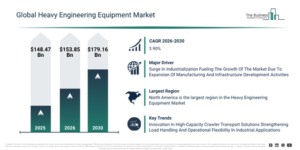
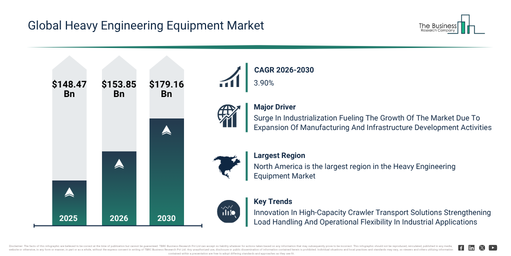
The heavy engineering equipment market has experienced consistent growth in recent years. It is projected to expand from $148.47 billion in 2025 to $153.85 billion in 2026, demonstrating a compound annual growth rate (CAGR) of 3.6%. This historical expansion can be attributed to elements such as swift urbanization and extensive infrastructure projects, a rise in mining and natural resource extraction, increased mechanization within the construction and agricultural industries, a growing need for significant energy projects, and the broadening of industrial manufacturing capacities.
The heavy engineering equipment market is anticipated to experience consistent growth over the next few years. It is projected to reach $179.16 billion by 2030, demonstrating a compound annual growth rate (CAGR) of 3.9%. This expansion during the projection period stems from the increasing adoption of autonomous heavy machinery systems, the growing electrification of construction and mining fleets, a rising demand for low-emission, high-efficiency equipment, the broadening of smart connected equipment ecosystems, and increased investments in large-scale infrastructure modernization projects. Prominent trends expected within this period include the integration of predictive maintenance in heavy machinery operations, the expanding use of hybrid and electric heavy equipment, the development of modular and multifunctional equipment designs, a heightened demand for fuel-efficient, high-capacity machinery, and the wider deployment of remote-controlled and teleoperated construction equipment systems.
Get A Free Sample Report With In-Depth Market Insights:
Heavy Engineering Equipment Market Growth Catalysts And Demand Drivers
The expansion of industrialization is projected to fuel the growth of the heavy engineering equipment market moving forward. Industrialization is defined as the transformation of an economy from one primarily based on agriculture to one predominantly driven by machine-based manufacturing and factory production. This increase in industrialization is largely propelled by a rising demand for goods, which encourages industries to leverage machines and factories for more efficient and larger-scale production. Heavy engineering equipment facilitates industrialization by enabling significant construction, mining, and infrastructure development, which in turn boosts production capacity, improves operational efficiency, and accelerates the progress of industries and factories. For example, in February 2024, the Xinhua News Agency, a China-based government agency, indicated that Mexico’s industrial activity grew by 3.5% in 2023 compared to the previous year. Thus, increasing industrialization is a significant driver for the heavy engineering equipment market’s growth.
Heavy Engineering Equipment Market Segment Trends And Revenue Contributors
The heavy engineering equipment market covered in this report is segmented –
1) By Vertical: Excavators, Crushers, Loaders, Bulldozers, Dump Trucks, Scrapers, Forklifts
2) By Propulsion Type: Diesel-Powered, Electric-Powered, Hybrid, Hydrogen Fuel Cell
3) By Automation Level: Manual Or Conventional, Semi-Autonomous, Fully Autonomous
4) By Sales Channel: Direct Sales, Dealer Or Distributor Sales, Leasing And Rental
5) By End-User Industry: Construction, Mining, Energy, Manufacturing And Heavy Fabrication, Agriculture
Subsegments:
1) By Excavators: Crawler Excavators, Wheeled Excavators, Mini Or Compact Excavators, Long-Reach Excavators, Dragline Excavators
2) By Crushers: Jaw Crushers, Cone Crushers, Impact Crushers, Gyratory Crushers, Hammer Crushers
3) By Loaders: Wheel Loaders, Backhoe Loaders, Skid Steer Loaders, Crawler Loaders, Compact Track Loaders
4) By Bulldozers: Crawler Bulldozers, Wheel Bulldozers, Mini Bulldozers, Swamp Bulldozers, Pipe Layer Bulldozers
5) By Dump Trucks: Articulated Dump Trucks, Rigid Dump Trucks, Mining Dump Trucks, Off-Highway Dump Trucks, Rear Dump Trucks
6) By Scrapers: Elevating Scrapers, Open Bowl Scrapers, Tandem Scrapers, Self-Propelled Scrapers, Tractor-Towed Scrapers
7) By Forklifts: Counterbalance Forklifts, Reach Trucks, Pallet Jacks, Rough Terrain Forklifts, Order Picker Forklifts
Heavy Engineering Equipment Market Trends Shaping Long-Term Demand
Major companies within the heavy engineering equipment market are concentrating on developing advanced solutions, specifically rotating crawler carriers, to boost material handling effectiveness, enhance operational flexibility across challenging terrains, and increase overall productivity in construction and industrial applications. These rotating crawler carriers are tracked, robust transport machines equipped with a rotating upper structure that enables them to efficiently move and position loads in rough, uneven, and confined working environments. As an illustration, in March 2026, Prinoth Ltd., an Italy-based heavy equipment company, unveiled the Panther T23r crawler carrier, which features an unprecedented PowerForce undercarriage, a 22. 5-short-ton payload capacity, and adaptive independent suspension engineered to provide superior terrain handling and improved fuel efficiency. This innovation supports enhanced performance on demanding jobsites while addressing the increasing demand for high-mobility hauling solutions.
Heavy Engineering Equipment Market Leading Players And Competitive Positioning
Major companies operating in the heavy engineering equipment market are Caterpillar Inc., Komatsu Ltd., Deere & Company, XCMG Group, Liebherr Group, Sany Heavy Industry Co Ltd., Hitachi Construction Machinery, Volvo Construction Equipment, JCB (J. C. Bamford Excavators Limited), Sandvik AB, Doosan Infracore, Atlas Copco, Zoomlion Heavy Industry Science & Technology Co Ltd., Terex Corporation, Kubota Corporation, LiuGong Machinery, CNH Industrial N. V., HD Hyundai Infracore, Kobelco Construction Machinery, BEML Limited
View The Full Heavy Engineering Equipment Market Report:
Heavy Engineering Equipment Market Regional Split: Which Areas Are Fueling Growth?
North America was the largest region in the heavy engineering equipment market in 2025. Asia-Pacific is expected to be the fastest-growing region in the forecast period. The regions covered in the heavy engineering equipment market report are Asia-Pacific, South East Asia, Western Europe, Eastern Europe, North America, South America, Middle East and Africa.
Reach Out To Our Team:
The Business Research Company: https://www.thebusinessresearchcompany.com/
Americas: +1 310-496-7795
Asia: +44 7882 955267 & +91 8897263534
Europe: +44 7882 955267
Email us at: marketing@tbrc.info
Follow us on:
LinkedIn: https://in.linkedin.com/company/the-business-research-company
YouTube: https://www.youtube.com/channel/UC24_fI0rV8cR5DxlCpgmyFQ
Global Market Model: https://www.thebusinessresearchcompany.com/global-market-model

Wasay has over a decade of experience in market research, data modelling, and analytics, with prior experience at GlobalData and Decision Tree Consulting Services. At The Business Research Company , he leads research operations across syndicated studies, customized consulting engagements, and the Global Market Model platform. His professional experience includes supporting organizations such as Boston Consulting Group, KPMG, and Ernst & Young. Wasay holds a degree in Electronics and Communications Engineering, postgraduate management qualifications from International Management Institute Belgium and Indian School of Business and Entrepreneurship, and completed the Integrated Program in Business Analytics from Indian Institute of Management Indore.