Enhanced with market attractiveness analysis, total addressable market evaluation, company benchmarking matrices, interactive Excel dashboards, expanded supply chain intelligence, emerging startup coverage, and detailed product insights, The Business Research Company’s 2026 market reports deliver more actionable and strategically valuable research.
#Household Robots Market Size And Revenue Forecast Through 2030
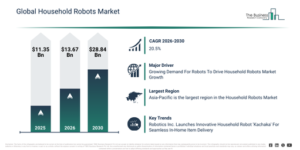
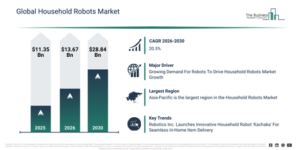
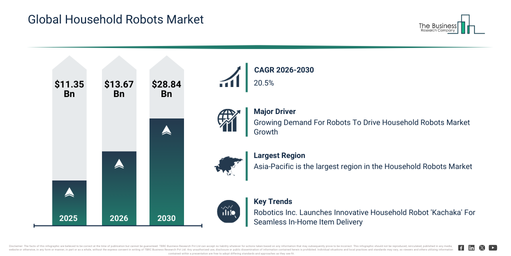
The household robots market size has experienced rapid expansion in recent years. It is projected to expand from $11.35 billion in 2025 to $13.67 billion in 2026, exhibiting a compound annual growth rate (CAGR) of 20.4%. Historically, this growth can be linked to advancements in robotics technology, an increase in dual-income households, the demand for convenience appliances, demographic shifts toward an aging population, and the proliferation of smart home devices.
The market for household robots is projected to experience rapid expansion over the upcoming years. This market is predicted to reach $28.84 billion by 2030, exhibiting a compound annual growth rate (CAGR) of 20.5%. Factors contributing to this growth during the forecast period include advancements in AI capabilities, a reduction in the costs of sensors and processors, the broadening scope of service robotics, an increasing need for home automation, and the development of assisted living solutions. Key trends anticipated for the forecast period encompass the proliferation of AI-powered domestic robots, a surging requirement for automated cleaning products, the enlargement of robot applications for elderly assistance, the integration of smart home technologies, and an emphasis on creating user-friendly robot designs.
Download A Free Sample Report For Comprehensive Market Insights:
Household Robots Market Expansion Supported By Key Demand Factors
A significant increase in robot demand is anticipated to propel the expansion of the household robots market in the future. Robots are defined as self-operating systems designed to replace human labor, with most individuals favoring their use for help with domestic tasks such as cleaning and ironing. Consequently, the escalating demand for robots is projected to stimulate the household robot market. For example, in September 2024, the International Federation of Robotics, a professional non-profit organization located in Germany, reported a 9% rise in industrial robot installations across Europe, setting a new record at 92,393 units. Out of this total, the European Union accounted for 80% of deployments, amounting to 73,534 units, which signifies a 2% increase in 2023. Thus, the need for robots is set to fuel the expansion of the household robots market.
Household Robots Market Segment Breakdown: Which Categories Generate The Most Revenue?
The household robots market covered in this report is segmented –
1) By Type: Domestic, Entertainment And Leisure
2) By Offering: Products, Services
3) By Application: Vacuuming, Lawn Mowing, Pool Cleaning, Companionship, Elderly Assistance And Handicap Assistance, Robot Toys And Hobby Systems, Other Applications
Subsegments:
1) By Domestic: Robotic Vacuum Cleaners, Robotic Mops, Lawn Mowing Robots, Window Cleaning Robots, Personal Assistants
2) By Entertainment And Leisure: Robotic Toys, Social Companion Robots, Educational Robots, Pet Robots
Household Robots Market Trends: What Is Shaping Future Industry Growth?
Major companies operating in the household robot market are focusing on product developments, such as home robots, to sustain their market position. Home robots, also recognized as service robots or domestic robots, are autonomous or semi-autonomous machines designed to perform tasks within a household setting. For instance, in May 2023, Robotics Inc., a Japanese artificial intelligence (AI) startup firm, launched the Kachaka robot for residential applications. This newly introduced robot can deliver items when given verbal commands, such as transporting condiments and dishes to the dining room table or drinks and books to the sofa. The robot attaches to the bottom of a specially designed table fitted with caster wheels and utilizes AI technology to analyze camera images, allowing it to detect and avoid obstacles like walls and furniture.
Household Robots Market Key Players And Strategic Industry Positioning
Major companies operating in the household robots market are Dyson Limited, Ecovacs Robotics, Neato Robotics Inc., Alfred Kärcher SE & Co., LG Electronics Inc, Samsung Electronics Co Ltd, Husqvarna AB, Deere & Company, Xiaomi Corporation, BSH Hausgeräte GmbH, Miele Corporate, Robomow, Blue Frog Robotics, iLIFE Innovation Ltd, iRobot Corporation, Maytronics Ltd., Neato robotics Inc., Hayward Holdings Inc., Panasonic Corporation, Roborock Technology Co. Ltd, bObsweep Inc., SharkNinja Operating LLC
Access The Complete Household Robots Market Report:
Household Robots Market Geographic Distribution And Regional Opportunities
Asia-Pacific was the largest region in the household robots market in 2025, and is expected to be the fastest-growing region in the household robots market during the forecast period. The regions covered in the household robots market report are Asia-Pacific, South East Asia, Western Europe, Eastern Europe, North America, South America, Middle East, Africa
Get in touch with us:
The Business Research Company: https://www.thebusinessresearchcompany.com/
Americas: +1 310-496-7795
Asia: +44 7882 955267 & +91 8897263534
Europe: +44 7882 955267
Email us at: marketing@tbrc.info
Follow us on:
LinkedIn: https://in.linkedin.com/company/the-business-research-company
YouTube: https://www.youtube.com/channel/UC24_fI0rV8cR5DxlCpgmyFQ
Global Market Model: https://www.thebusinessresearchcompany.com/global-market-model

Wasay has over a decade of experience in market research, data modelling, and analytics, with prior experience at GlobalData and Decision Tree Consulting Services. At The Business Research Company , he leads research operations across syndicated studies, customized consulting engagements, and the Global Market Model platform. His professional experience includes supporting organizations such as Boston Consulting Group, KPMG, and Ernst & Young. Wasay holds a degree in Electronics and Communications Engineering, postgraduate management qualifications from International Management Institute Belgium and Indian School of Business and Entrepreneurship, and completed the Integrated Program in Business Analytics from Indian Institute of Management Indore.