
Enhanced with market attractiveness analysis, total addressable market evaluation, company benchmarking matrices, interactive Excel dashboards, expanded supply chain intelligence, emerging startup coverage, and detailed product insights, The Business Research Company’s 2026 market reports deliver more actionable and strategically valuable research.
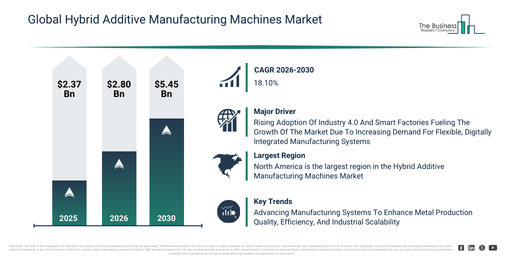
Hybrid Additive Manufacturing Machines Market Expansion From $2.8 Billion In 2026 To $5.45 Billion In 2030
The market for hybrid additive manufacturing machines has experienced rapid expansion in recent years. It is anticipated to increase from $2.37 billion in 2025 to $2.80 billion in 2026, achieving a compound annual growth rate (CAGR) of 18.4%. This historical growth can be ascribed to several factors, including increasing adoption of additive manufacturing in aerospace, growing demand for rapid prototyping, rising need for lightweight components, expansion of precision engineering applications, and increasing investments in research and development for metal 3D printing.
The hybrid additive manufacturing machines market is projected to experience significant growth in the coming years. By 2030, it is expected to expand to $5.45 billion, achieving a compound annual growth rate (CAGR) of 18.1%. This projected growth can be attributed to several factors, including the increasing integration of additive and subtractive processes, rising demand from the automotive and medical sectors, a growing emphasis on smart factories and automation, the expansion of multi-material manufacturing, and the broader adoption of Internet of Things (IoT)-enabled manufacturing systems. Key trends anticipated during this period encompass advancements in hybrid machine technology, innovations in laser and electron beam additive systems, the development of real-time monitoring and quality control, extensive research and development focused on material efficiency, and the wider integration of artificial intelligence (AI) and predictive maintenance.
Download A Free Sample Report For Comprehensive Market Insights:
Hybrid Additive Manufacturing Machines Market Expansion Supported By Key Demand Factors
The increasing implementation of Industry 4.0 and smart factories is anticipated to fuel the expansion of the hybrid additive manufacturing machines market. These concepts involve integrating advanced digital technologies such as the Internet of Things (IoT), artificial intelligence, automation, robotics, and data analytics into manufacturing processes to enable real-time monitoring, intelligent decision-making, and highly flexible production. Manufacturers are increasingly embracing Industry 4.0 and smart factories to achieve improved productivity, reduced operational costs, facilitate mass customization, and accelerate time-to-market. Hybrid additive manufacturing machines bolster Industry 4.0 and smart factories by integrating additive and subtractive manufacturing processes within a single system, enabling precise, efficient, and automated production workflows aligned with smart factory environments. For instance, in September 2025, the International Federation of Robotics, a Germany-based non-profit organization, reported 4,664,000 robotic units operating in factories globally in 2024, marking a 9% increase from 4,281,585 units in 2023. Consequently, the growing uptake of Industry 4.0 and smart factories is driving the growth of the hybrid additive manufacturing machines market.
Hybrid Additive Manufacturing Machines Market Segmentation And Category Breakdown
The hybrid additive manufacturing machines market covered in this report is segmented –
1) By Component: Hardware, Software, Services
2) By Technology Type: Directed Energy Deposition (DED), Binder Jetting, Material Extrusion, Material Jetting, Powder Bed Fusion (PBF)
3) By Machine Size: Desktop, Industrial, Large-Format, Portable, Customized Solutions
4) By Application: Repair, Production, Prototype
5) By End-Use Industry: Aerospace And Defense, Automotive, Medical And Dental, Energy And Power, Industrial Machinery, Electronics
Subsegments:
1) By Hardware: Laser Processing Units, Electron Beam Units, Milling And Machining Modules, Material Handling Systems, Control Panels
2) By Software: Design And Modeling Software, Machine Control Software, Simulation And Analysis Software, Process Monitoring Software, Data Management Software
3) By Services: Installation Services, Maintenance And Repair Services, Training And Support Services, Consulting Services, Upgrades And Retrofitting Services
Hybrid Additive Manufacturing Machines Market Growth Trends Influencing Competitive Dynamics
Major companies active in the hybrid additive manufacturing machines market are concentrating on developing advanced capabilities, such as adaptive beam control, to integrate laser management, optimized recoating mechanisms, and hybrid toolpath strategies to enhance part quality, production efficiency, and cost-effectiveness. Adaptive beam control refers to the real-time dynamic adjustment of a light or signal beam’s direction, shape, and intensity, with the goal of maximizing target illumination or reception while minimizing glare, interference, or energy wastage. For instance, in May 2023, DMG MORI Co. Ltd., a Japan-based machine tool company, launched the LASERTEC 30 SLM US powder-bed metal 3D printer. The system provides a 300 × 300 × 300 mm build volume, incorporates adaptive beam control that dynamically adjusts laser power, speed, and beam profile, utilizes non-contact powder recoating for more flexible and consistent material spreading, and supports an optional hybrid toolpath strategy with a 1.2 kW laser to optimize cost per part and overall productivity. This launch represents a significant advancement by integrating intelligent laser modulation with improved material handling and hybrid processing, offering a scalable, high-performance solution for precision metal manufacturing in aerospace, tooling, medical, and industrial production environments.
Hybrid Additive Manufacturing Machines Market Competitive Analysis Of Major Industry Participants
Major companies operating in the hybrid additive manufacturing machines market are Siemens AG, DMG MORI Co. Ltd., TRUMPF SE CO. KG, KUKA AG, Makino Inc., Renishaw plc, EOS GmbH
, Yamazaki Mazak Corporation, Hexagon AB, Nikon SLM Solutions AG, Stratasys Ltd., Okuma Corporation, Maschinenfabrik Berthold Hermle AG, AddUp, Maschinenbau Kitz GmbH, Optomec Inc., Intech Additive Solutions, General Electric Company (GE Additive), Matsuura Machinery Corporation, Multiax International S.R.L.,
Access The Complete Hybrid Additive Manufacturing Machines Market Report:
Hybrid Additive Manufacturing Machines Market Regional Outlook: Where Are The Largest Opportunities Located?
North America was the largest region in the hybrid additive manufacturing machines market in 2025. Asia-Pacific is expected to be the fastest-growing region in the forecast period. The regions covered in the hybrid additive manufacturing machines market report are Asia-Pacific, South East Asia, Western Europe, Eastern Europe, North America, South America, Middle East, Africa.
Get in touch with us:
The Business Research Company: https://www.thebusinessresearchcompany.com/
Americas: +1 310-496-7795
Asia: +44 7882 955267 & +91 8897263534
Europe: +44 7882 955267
Email us at: marketing@tbrc.info
Follow us on:
LinkedIn: https://in.linkedin.com/company/the-business-research-company
YouTube: https://www.youtube.com/channel/UC24_fI0rV8cR5DxlCpgmyFQ
Global Market Model: https://www.thebusinessresearchcompany.com/global-market-model

Wasay has over a decade of experience in market research, data modelling, and analytics, with prior experience at GlobalData and Decision Tree Consulting Services. At The Business Research Company , he leads research operations across syndicated studies, customized consulting engagements, and the Global Market Model platform. His professional experience includes supporting organizations such as Boston Consulting Group, KPMG, and Ernst & Young. Wasay holds a degree in Electronics and Communications Engineering, postgraduate management qualifications from International Management Institute Belgium and Indian School of Business and Entrepreneurship, and completed the Integrated Program in Business Analytics from Indian Institute of Management Indore.