Market attractiveness scoring, total addressable market sizing, company benchmarking matrices, interactive Excel dashboards, deeper supply chain intelligence, emerging startup tracking, and granular product-level insights are among the key offerings featured in The Business Research Company’s 2026 market reports, designed to deliver more actionable and strategically valuable research.
Hydraulic Equipment Market Size Overview: From Historical Performance To The 2030 Forecast
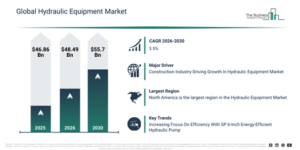
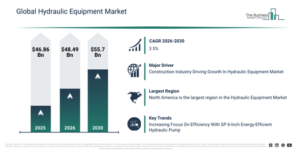
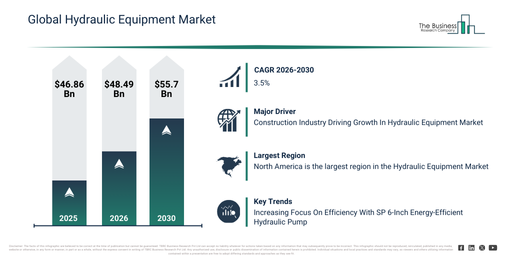
The hydraulic equipment market has demonstrated steady growth in its size over recent years. This market is projected to expand from $46.86 billion in 2025 to $48.49 billion in 2026, exhibiting a compound annual growth rate (CAGR) of 3.5%. Historically, this expansion has been driven by factors such as industrial mechanization, increased demand for construction equipment, the growth of the mining sector, developments in traditional fluid power systems, and infrastructure development.
The hydraulic equipment market size is projected for consistent expansion in the coming years. By 2030, this market is anticipated to reach $55.7 billion, demonstrating a compound annual growth rate (CAGR) of 3.5%. This expansion during the forecast period is driven by factors such as the integration of smart hydraulic systems, increased automation in industrial operations, the rise of mobile machinery, the need for predictive maintenance, and the development of energy-efficient hydraulic designs. Significant trends anticipated for this period encompass enhanced system integration across various sectors, a rising need for high-pressure hydraulic solutions, the broader deployment of mobile hydraulic equipment, an emphasis on system reliability and safety, and an increase in aftermarket services.
Get A Free Sample Of The Business Research Company’s Hydraulic Equipment Market Report:
What Factor Is Increasing Demand In The Hydraulic Equipment Market?
Anticipated future expansion in the construction industry is projected to drive the growth of the hydraulic equipment market. This sector covers a broad range of activities, including the planning, design, construction, and upkeep of buildings, infrastructure, and various physical structures. Factors contributing to this growth include increased government expenditure on construction projects, a surge in infrastructure investments, and a more stable real estate market. Due to their ability to generate significant force from compact components, hydraulic systems are perfectly suited for demanding construction operations like heavy lifting, pushing, and pulling, exemplified by their use in cranes, excavators, and bulldozers. The expansion of the construction industry is a key driver for the growth of the hydraulic equipment market.
Which Segments Make Up The Hydraulic Equipment Market?
The hydraulic equipment market covered in this report is segmented –
1) By Component: Motors, Pumps, Cylinders, Valves, Filters, Accumulators, Transmissions, Other Components
2) By Application: Mobile, Industries
3) By End User: Mining And Construction, Agriculture And Mining, Packaging, Material Handling, Other Applications
Subsegments:
1) By Motors: Hydraulic Motors, Gear Motors, Piston Motors
2) By Pumps: Gear Pumps, Vane Pumps, Piston Pumps, Screw Pumps
3) By Cylinders: Double-Acting Cylinders, Single-Acting Cylinders, Telescopic Cylinders
4) By Valves: Directional Control Valves, Pressure Control Valves, Flow Control Valves, Check Valves
5) By Filters: Hydraulic Filters, Inline Filters, Return Line Filters
6) By Accumulators: Bladder Accumulators, Piston Accumulators, Spring Accumulators
7) By Transmissions: Hydraulic Transmissions, Hydrostatic Transmissions
8) By Other Components: Hoses And Fittings, Seals And O-Rings, Coolers And Heat Exchangers
Hydraulic Equipment Market Emerging Trends: What Are Industry Leaders Focusing On?
Leading companies in the hydraulic equipment market are developing innovative products, such as energy-efficient hydraulic pumps, to provide customers with advanced features and gain a competitive advantage. An energy-efficient hydraulic pump is designed to convert mechanical energy into hydraulic energy while minimizing energy losses.
Major Companies To Know In The Hydraulic Equipment Market
Major companies operating in the hydraulic equipment market are Robert Bosch GmbH, Siemens AG, Komatsu Ltd., Motion Industries Inc., Parker Hannifin Corporation, Emerson Electric Co., Kawasaki Heavy Industries Ltd., Danfoss AS, SMC Corporation, Festo SE, Moog Inc., Concentric AB, HAWE Hydraulik SE, Linde Hydraulics Corp, Wipro Infrastructure Engineering, Casappa Corp, Norgren Limited, Hydac International GmbH, Dantal Hydraulics Pvt. Ltd., Daikin Industries Ltd., Bucher Hydraulics Inc., Hannon Hydraulics Inc., Fluitronics GmbH, American Design & Manufacturing Inc., Nachi-Fujikoshi Corp.
Read The In-Depth Hydraulic Equipment Market Report:
Hydraulic Equipment Market Regional Landscape: Largest Region In 2025
North America was the largest region in the hydraulic equipment market in 2025. Asia-Pacific is expected to be the fastest-growing region in the forecast period. The regions covered in the hydraulic equipment market report are Asia-Pacific, South East Asia, Western Europe, Eastern Europe, North America, South America, Middle East, Africa
Reach Out To Our Team:
The Business Research Company: https://www.thebusinessresearchcompany.com/
Americas: +1 310-496-7795
Asia: +44 7882 955267 & +91 8897263534
Europe: +44 7882 955267
Email us at: marketing@tbrc.info
Follow us on:
LinkedIn: https://in.linkedin.com/company/the-business-research-company
YouTube: https://www.youtube.com/channel/UC24_fI0rV8cR5DxlCpgmyFQ
Global Market Model: https://www.thebusinessresearchcompany.com/global-market-model

Wasay has over a decade of experience in market research, data modelling, and analytics, with prior experience at GlobalData and Decision Tree Consulting Services. At The Business Research Company , he leads research operations across syndicated studies, customized consulting engagements, and the Global Market Model platform. His professional experience includes supporting organizations such as Boston Consulting Group, KPMG, and Ernst & Young. Wasay holds a degree in Electronics and Communications Engineering, postgraduate management qualifications from International Management Institute Belgium and Indian School of Business and Entrepreneurship, and completed the Integrated Program in Business Analytics from Indian Institute of Management Indore.