Designed to make market research more actionable and strategically valuable, The Business Research Company’s 2026 market reports feature market attractiveness scoring, total addressable market sizing, company benchmarking matrices, interactive Excel dashboards, deeper supply chain intelligence, emerging startup tracking, and granular product-level insights.
How Fast Is The Hydraulic Self-Climbing System Market Growing? Market Size, CAGR And Forecast Insights
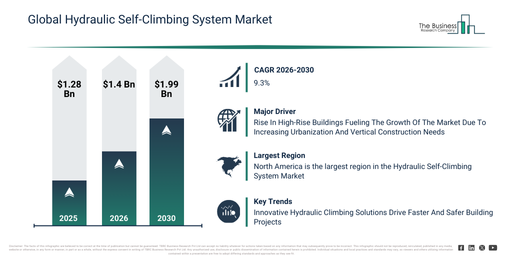
The market for hydraulic self-climbing systems has experienced substantial expansion in recent years. It is anticipated to increase from $1.28 billion in 2025 to $1.4 billion in 2026, demonstrating a compound annual growth rate (CAGR) of 9.5%. This historical expansion is primarily attributed to the rise of skyscraper construction, a shortage of skilled labor, the demand for faster project cycles, safety regulations in construction, and the growth of bridge and dam projects.
The market size for hydraulic self-climbing systems is projected to experience substantial growth in the next few years. It is anticipated to reach $1.99 billion in 2030, with a compound annual growth rate (CAGR) of 9.3%. This growth during the forecast period can be attributed to factors such as smart city development, the expansion of urban skylines, the increasing adoption of automated construction equipment, ongoing infrastructure modernization programs, and a rising demand for productivity optimization. Key trends identified for this period include the automation of vertical construction platforms, a reduced dependency on cranes for high-rise sites, improved worker safety through hydraulic control, wider adoption in mega infrastructure projects, and the integration of modular climbing formwork.
Unlock Hydraulic Self-Climbing System Market Insights With A Free Sample Report:
Hydraulic Self-Climbing System Market Momentum: Key Driver Expected To Boost Growth Through 2030
The increasing need for high-rise buildings is anticipated to boost the hydraulic self-climbing system market going forward. High-rise structures are towering edifices with numerous floors, generally requiring elevators for inter-level travel due to their considerable height. The surge in demand for these buildings stems from rapid urbanization, as growing city populations drive the necessity to optimize limited land through vertical construction. Hydraulic self-climbing systems offer benefits for high-rise construction by enabling faster and safer vertical building, as they automatically lift formwork without requiring cranes. The escalating demand for high-rise buildings is a significant catalyst for the growth of the hydraulic self-climbing system market.
Hydraulic Self-Climbing System Market Segments: A Category-By-Category Overview
The hydraulic self-climbing system market covered in this report is segmented –
1) By Type: Hydraulic Climbing Systems, Hybrid Climbing Systems
2) By Application: High-Rise Buildings, Bridges, Dams, Power Plants, Other Applications
3) By End User: Construction, Transportation
Subsegments:
1) By Hydraulic Climbing Systems: Internal Climbing Systems, External Climbing Systems, Combined Climbing Systems
2) By Hybrid Climbing Systems: Hydraulic-Electric Hybrid Systems, Hydraulic-Mechanical Hybrid Systems, Automated Hybrid Systems
Which Emerging Trends Are Gaining Traction In The Hydraulic Self-Climbing System Market?
Leading companies in the hydraulic self-climbing system market are concentrating on developing advanced solutions, such as modular hydraulic climbing systems. These efforts aim to enhance construction efficiency, improve worker safety, and provide faster, more adaptable climbing options for complex high-rise and core wall projects. A modular hydraulic climbing system is characterized as a customizable, hydraulically powered platform that ascends building structures to support formwork and safety panels in high-rise construction. For instance, in April 2025, PERI SE, a Germany-based manufacturer and supplier of formwork and scaffolding systems, introduced the RCS MAX Rail Climbing System. This modular hydraulic system is specifically engineered for the efficient climbing of formwork and protection panels in high-rise and core wall construction projects. The RCS MAX boosts climbing power and shortens cycle times, enabling quicker progress on tall building projects. Its adaptable modular design allows for straightforward customization to various building shapes while ensuring excellent safety. Additionally, the system minimizes the need for crane operations and manual labor, leading to a more streamlined and efficient construction process.
Hydraulic Self-Climbing System Market Key Participants: Prominent Companies At A Glance
Major companies operating in the hydraulic self-climbing system market are PERI GmbH, ULMA Construction, S. Coop. (ULMA Construction Group), MEVA Formwork Systems GmbH, EFCO Corporation, Alsina Formwork, S.A., Doka GmbH, Kumkang Kind Co., Ltd., Pilosio S.p.A., Condor S.p.A., Faresin Building S.p.A., RMD Kwikform Limited, PASCHAL-Werk G. Maier GmbH, TMS Formwork Systems Ltd., Acrow Engineering Group Limited, TECON Formwork Systems Sdn. Bhd., Novatec Formwork Systems Private Limited, Kitsen Formworks Private Limited, Alulite Forms Private Limited, Geto Formwork Private Limited, Sampmax Formwork Systems Co., Ltd., MFE Formwork Technology Sdn. Bhd., NOE Schaltechnik GmbH
Get Detailed Hydraulic Self-Climbing System Market Forecasts In The Complete Report:
Top Region In The Hydraulic Self-Climbing System Market: A Global Perspective
North America was the largest region in the hydraulic self-climbing system market in 2025. Asia-Pacific is expected to be the fastest-growing region in the forecast period. The regions covered in the hydraulic self-climbing system market report are Asia-Pacific, South East Asia, Western Europe, Eastern Europe, North America, South America, Middle East, Africa
Reach Out To Our Team:
The Business Research Company: https://www.thebusinessresearchcompany.com/
Americas: +1 310-496-7795
Asia: +44 7882 955267 & +91 8897263534
Europe: +44 7882 955267
Email us at: marketing@tbrc.info
Follow us on:
LinkedIn: https://in.linkedin.com/company/the-business-research-company
YouTube: https://www.youtube.com/channel/UC24_fI0rV8cR5DxlCpgmyFQ
Global Market Model: https://www.thebusinessresearchcompany.com/global-market-model

Wasay has over a decade of experience in market research, data modelling, and analytics, with prior experience at GlobalData and Decision Tree Consulting Services. At The Business Research Company , he leads research operations across syndicated studies, customized consulting engagements, and the Global Market Model platform. His professional experience includes supporting organizations such as Boston Consulting Group, KPMG, and Ernst & Young. Wasay holds a degree in Electronics and Communications Engineering, postgraduate management qualifications from International Management Institute Belgium and Indian School of Business and Entrepreneurship, and completed the Integrated Program in Business Analytics from Indian Institute of Management Indore.