The Business Research Company’s 2026 market reports are designed to deliver research that is more actionable and strategically valuable. Key offerings include market attractiveness scoring, total addressable market sizing, company benchmarking matrices, interactive Excel dashboards, deeper supply chain intelligence, emerging startup tracking, and granular product-level insights.
Which Factors Will Shape The Hydrogen Combustion Engine Market Size Through 2030?
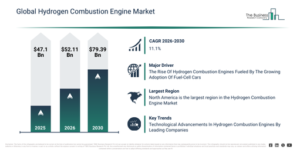
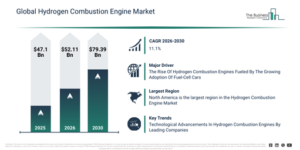
The hydrogen combustion engine market has experienced swift growth in recent years. This market is anticipated to expand from $47.1 billion in 2025 to $52.11 billion in 2026, exhibiting a compound annual growth rate (CAGR) of 10.6%. Historically, this expansion has been propelled by factors including emission reduction regulations, the reliance on fossil fuel engines, the dominance of internal combustion engines, the scale of automotive manufacturing, and early hydrogen research programs.
The market for hydrogen combustion engines is projected to experience substantial growth in the coming years. This market is anticipated to reach a valuation of $79.39 billion by 2030, demonstrating a compound annual growth rate (CAGR) of 11.1%. Factors contributing to this growth during the forecast period include governmental hydrogen strategies, increased investment in clean combustion technologies, the decarbonization of commercial fleets, broader availability of hydrogen fuel, and the rising demand for low-carbon mobility solutions. Key trends expected within this period encompass the development of platforms ready for hydrogen internal combustion engines (ICE), an emphasis on optimizing engine efficiency, the adaptation of current ICE architectures, the expansion of pilot fleets and demonstrator vehicles, and the integration with hybrid powertrains.
Request A Free Hydrogen Combustion Engine Market Sample To Support Your Strategic Planning:
What Is Propelling The Hydrogen Combustion Engine Market Toward $79.39 Billion By 2030?
The rising adoption of fuel-cell vehicles is projected to boost the expansion of the hydrogen combustion engine market in the future. A fuel cell vehicle operates as an electric car, producing power for movement through the use of a fuel cell. Hydrogen serves as the power source for these electric vehicles. These vehicles offer greater efficiency compared to conventional internal combustion engines and produce no harmful exhaust fumes. This growing adoption of fuel-cell cars supports the development of hydrogen combustion engines. The expanding adoption of fuel-cell automobiles is fueling the growth of the hydrogen combustion engine market.
What Are The Key Segments And Subsegments In The Hydrogen Combustion Engine Market?
The hydrogen combustion engine market covered in this report is segmented –
1) By Technology: Proton Membrane Exchange, Phosphoric Acid Fuel Cell, Other Technologies
2) By Installation: OEM (Original Equipment Manufacturer), Retrofit
3) By Application: Passenger Vehicle, Commercial Vehicle, Ships, Other Applications
Subsegments:
1) By Proton Membrane Exchange: Proton Exchange Membrane Fuel Cells (PEMFC), Applications In Vehicles And Power Systems
2) By Phosphoric Acid Fuel Cell: PAFC For Transportation, PAFC For Stationary Applications
3) By Other Technologies: Solid Oxide Fuel Cells (SOFC), Alkaline Fuel Cells (AFC), Direct Methanol Fuel Cells (DMFC)
Hydrogen Combustion Engine Market Trends Behind The 11.1% CAGR Forecast
Major companies in the hydrogen combustion engine market are focusing on developing innovative products like advanced hydrogen fuel cell systems to improve performance and cut down on emissions. Advanced hydrogen fuel cell systems are technologically driven engines that produce electricity by combining hydrogen and oxygen, with water as the only byproduct, and they help power vehicles efficiently while lowering greenhouse gas emissions.
Major Companies Profiled In The Hydrogen Combustion Engine Market Report
Major companies operating in the hydrogen combustion engine market are Toyota Motor Corporation, Stellantis N.V., Ford Motor Company, General Motors Company, Honda Motor Co., Ltd., Hyundai Motor Company, Cummins Inc., Caterpillar Inc., MAN Energy Solutions SE, Rolls-Royce Holdings plc, Mitsubishi Heavy Industries, Ltd., Komatsu Ltd., Mahindra & Mahindra Limited, AGCO Corporation, Renault S.A., Mazda Motor Corporation, Yamaha Motor Co., Ltd., AVL List GmbH, Bosch Mahle Turbo Systems GmbH & Co. KG, Liebherr Group, DEUTZ AG, Scania AB, IVECO Group N.V., Ricardo plc, Origin Engines Inc.
Explore The Business Research Company’s Complete Hydrogen Combustion Engine Market Report:
Where Does The Hydrogen Combustion Engine Market Generate The Most Revenue?
North America was the largest region in the hydrogen combustion engine market in 2025. Asia-Pacific is expected to be the fastest-growing region in the forecast period. The regions covered in the hydrogen combustion engine market report are Asia-Pacific, South East Asia, Western Europe, Eastern Europe, North America, South America, Middle East, Africa
Reach Out To Our Team:
The Business Research Company: https://www.thebusinessresearchcompany.com/
Americas: +1 310-496-7795
Asia: +44 7882 955267 & +91 8897263534
Europe: +44 7882 955267
Email us at: marketing@tbrc.info
Follow us on:
LinkedIn: https://in.linkedin.com/company/the-business-research-company
YouTube: https://www.youtube.com/channel/UC24_fI0rV8cR5DxlCpgmyFQ
Global Market Model: https://www.thebusinessresearchcompany.com/global-market-model

Wasay has over a decade of experience in market research, data modelling, and analytics, with prior experience at GlobalData and Decision Tree Consulting Services. At The Business Research Company , he leads research operations across syndicated studies, customized consulting engagements, and the Global Market Model platform. His professional experience includes supporting organizations such as Boston Consulting Group, KPMG, and Ernst & Young. Wasay holds a degree in Electronics and Communications Engineering, postgraduate management qualifications from International Management Institute Belgium and Indian School of Business and Entrepreneurship, and completed the Integrated Program in Business Analytics from Indian Institute of Management Indore.