
Delivering more actionable and strategically valuable research, The Business Research Company’s 2026 market reports feature market attractiveness analysis, total addressable market evaluation, company benchmarking matrices, interactive Excel dashboards, expanded supply chain intelligence, emerging startup coverage, and detailed product insights.
Industrial Fifth Generation (5G) Network Slicing For Robotics Market Expected To Reach $8.74 Billion By 2030 At 31.7% CAGR
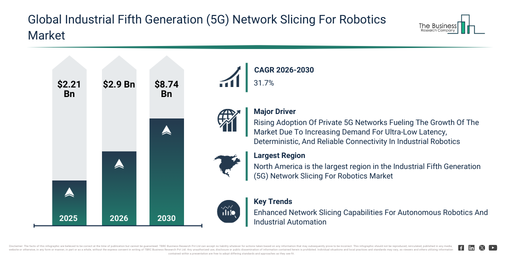
The industrial fifth generation (5g) network slicing for robotics market size has witnessed significant expansion in recent years. This market is projected to grow from $2.21 billion in 2025 to $2.9 billion in 2026, at a compound annual growth rate (CAGR) of 31.5%. The historical growth of this sector can be attributed to the early adoption of industrial robotics, the implementation of 4g/5g testbeds in manufacturing, a rising requirement for remote monitoring and control, increasing automation in logistics and warehousing, and the greater use of collaborative and autonomous robots.
The market size for industrial fifth generation (5g) network slicing for robotics is projected to experience substantial growth in the upcoming years. This market is forecast to reach $8.74 billion by 2030, exhibiting a compound annual growth rate (CAGR) of 31.7%. Key drivers of this expansion during the projection period include the broader deployment of 5G network slicing, the increasing adoption of cloud-based robotic management software, the incorporation of AI-driven robotics control systems, a growing need for connected industrial IoT devices, and an intensified emphasis on cyber-secure network slicing. Significant trends anticipated over the forecast timeframe encompass ultra-reliable low-latency connectivity, real-time robotic data analytics, advancements in network slice orchestration, the integration of edge computing, and improvements in security and access control.
Download A Free Sample Report For Comprehensive Market Insights:
#Industrial Fifth Generation (5G) Network Slicing For Robotics Market Demand Drivers Creating New Revenue Opportunities
The expanded use of private 5G networks is anticipated to boost the growth of the industrial 5G network slicing for robotics market moving forward. These networks are dedicated, enterprise-controlled mobile systems that offer enhanced security, ultra-low latency, deterministic performance, and highly reliable connectivity, making them suitable for critical industrial environments. The increased implementation of private 5G networks is fueled by the growing requirement for ultra-low latency and predictable connectivity in industrial automation and robotics. Industrial 5G network slicing for robotics facilitates this adoption by enabling organizations to establish dedicated, highly dependable, low-latency network slices specifically designed for robotic operations, positioning private 5G as a preferred choice for industrial automation connectivity. For instance, in December 2023, the Department for Science, Innovation and Technology, a UK-based government body, stated that 82% of private telecoms network providers in the UK had deployed 5G technology in private networks, signifying robust adoption of next-generation connectivity. Thus, the increasing adoption of private 5G networks is propelling the growth of the industrial 5G network slicing for robotics market.
Industrial Fifth Generation (5G) Network Slicing For Robotics Market Segmentation And Category Breakdown
The industrial fifth generation (5g) network slicing for robotics market covered in this report is segmented –
1) By Component: Hardware, Software, Services
2) By Deployment Mode: On-Premises, Cloud
3) By Enterprise Size: Small And Medium Enterprises, Large Enterprises
4) By Application: Collaborative Robots, Autonomous Mobile Robots, Industrial Internet Of Things (IoT) Devices, Remote Monitoring And Control, Other Applications
5) By Industry Vertical: Automotive, Electronics And Semiconductor, Food And Beverage, Pharmaceuticals, Logistics And Warehousing, Other Industry Verticals
Subsegments:
1) By Hardware: Radio Access Equipment, Industrial Gateways And Routers, Edge Computing Hardware, Network Interface Modules, High Reliability Connectivity Devices
2) By Software: Network Slice Orchestration Software, Network Monitoring And Analytics Software, Security And Access Management Software, Quality Of Service Management Software, Automation And Control Software
3) By Services: Deployment And Integration Services, Consulting And Advisory Services, Managed Network Services, Maintenance And Support Services, Customization And Optimization Services
Industrial Fifth Generation (5G) Network Slicing For Robotics Market Trends Driving Strategic Industry Expansion
Companies operating within the industrial 5G network slicing for robotics market are prioritizing enhancements in network slicing technologies tailored for robotics. These 5G network slices aim to deliver ultra-low latency, assured bandwidth, and secure connectivity crucial for autonomous robots and industrial automation systems. A 5G network slice signifies the capacity of a single physical 5G network to be logically segmented into numerous virtual networks, with each segment optimized for a specific application or service requirement. For example, in November 2023, STC Bahrain Company, a telecommunications provider situated in Bahrain, unveiled its 5G Network Slicing Service. This service empowers enterprises to establish dedicated 5G slices customized for critical robotics applications. Intended to bolster adoption in the industrial 5G network slicing for robotics market, this launch featured capabilities such as real-time slice provisioning for diverse robotic workloads, quality-of-service assurances to guarantee reliable autonomous operations, and flexible management of network resources to support multiple simultaneous industrial automation systems.
Industrial Fifth Generation (5G) Network Slicing For Robotics Market Competitive Analysis Of Major Industry Participants
Major companies operating in the industrial fifth generation (5g) network slicing for robotics market are Samsung Electronics Co. Ltd, Deutsche Telekom AG, Huawei Technologies Co. Ltd., Siemens AG, Hitachi Ltd., International Business Machines Corporation, Cisco Systems Inc., Intel Corporation, Oracle Corporation, Vodafone Group Plc, Schneider Electric SE, Honeywell International Inc., Mitsubishi Electric Corporation, Qualcomm Incorporated, ABB Ltd., Fujitsu Limited, Telefonaktiebolaget LM Ericsson, NEC Corporation, ZTE Corporation, Rockwell Automation Inc., Advantech Co. Ltd.
Access The Complete Industrial Fifth Generation (5G) Network Slicing For Robotics Market Report:
Industrial Fifth Generation (5G) Network Slicing For Robotics Market Regional Distribution: Which Areas Drive Market Expansion?
North America was the largest region in the industrial 5G network slicing for robotics market in 2025. Asia-Pacific is expected to be the fastest-growing region in the forecast period. The regions covered in the industrial fifth generation (5g) network slicing for robotics market report are Asia-Pacific, South East Asia, Western Europe, Eastern Europe, North America, South America, Middle East, Africa.
Get in touch with us:
The Business Research Company: https://www.thebusinessresearchcompany.com/
Americas: +1 310-496-7795
Asia: +44 7882 955267 & +91 8897263534
Europe: +44 7882 955267
Email us at: marketing@tbrc.info
Follow us on:
LinkedIn: https://in.linkedin.com/company/the-business-research-company
YouTube: https://www.youtube.com/channel/UC24_fI0rV8cR5DxlCpgmyFQ
Global Market Model: https://www.thebusinessresearchcompany.com/global-market-model

Wasay has over a decade of experience in market research, data modelling, and analytics, with prior experience at GlobalData and Decision Tree Consulting Services. At The Business Research Company , he leads research operations across syndicated studies, customized consulting engagements, and the Global Market Model platform. His professional experience includes supporting organizations such as Boston Consulting Group, KPMG, and Ernst & Young. Wasay holds a degree in Electronics and Communications Engineering, postgraduate management qualifications from International Management Institute Belgium and Indian School of Business and Entrepreneurship, and completed the Integrated Program in Business Analytics from Indian Institute of Management Indore.