Featuring market attractiveness scoring, total addressable market sizing, company benchmarking matrices, interactive Excel dashboards, deeper supply chain intelligence, emerging startup tracking, and granular product-level insights, The Business Research Company’s 2026 market reports are built to deliver research that is both more actionable and more strategically valuable.
Factory Automation Market Revenue Growth On Track For A 11.9% CAGR Through 2030
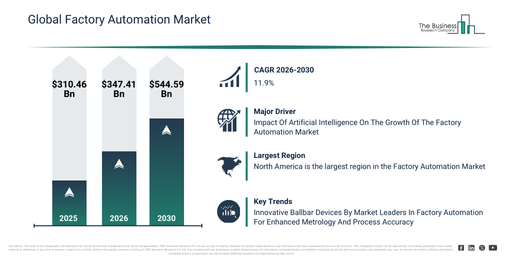
The factory automation market has experienced rapid expansion in recent years. Projections indicate its size will increase from $310.46 billion in 2025 to $347.41 billion in 2026, demonstrating a compound annual growth rate (CAGR) of 11.9%. Historically, this expansion has been driven by factors such as the broadening of mass manufacturing sectors, escalating labor expenses, a heightened need for uniform product quality, the development of electronics and automotive production, and the introduction of programmable automation technologies.
The factory automation market is projected to experience swift expansion over the coming years. This market is set to reach $544.59 billion by 2030, exhibiting a compound annual growth rate (CAGR) of 11.9%. This anticipated growth is driven by several factors, including the increasing integration of AI-enabled automation systems, the proliferation of smart factories, a surging demand for customized production, an enhanced emphasis on operational efficiency, and growing investments in industrial digitalization. Key trends anticipated during this period involve the greater deployment of industrial robots within production lines, a heightened uptake of smart sensors and controllers, the expansion of data-driven predictive maintenance solutions, increasing integration of PLC and SCADA platforms, and a strengthened focus on flexible manufacturing approaches.
Get A Free Sample Report With In-Depth Market Insights:
Factory Automation Market Expansion Drivers: What’s Shaping Future Growth?
The adoption of artificial intelligence (AI) is anticipated to propel the growth of the factory automation market. Artificial intelligence describes the simulation of human intelligence processes by machines, typically through computer systems, allowing them to perform tasks traditionally requiring human intellect, such as learning, reasoning, and problem-solving. This increasing embrace of AI is driven by technological advancements, greater data availability, industry demand for automation and efficiency, and expanding investment and research. Integrating artificial intelligence into factory automation systems enables manufacturers to achieve elevated levels of efficiency, productivity, quality, flexibility, and safety, fostering competitive advantages and improved business outcomes. For instance, according to the Eurostat, a Belgium based government agency, in 2024, 13% of EU businesses used artificial intelligence (AI) technologies. Consequently, the adoption of artificial intelligence is driving the growth of the factory automation market.
Factory Automation Market Segment Landscape And Growth Outlook
The factory automation market covered in this report is segmented –
1) By Component: Sensors, Controllers, Switches And Relays, Industrial Robots, Drives
2) By Factory Automation Technology: Supervisory Control And Data Acquisition (SCADA), Programmable Automation Controller (PAC), Programmable Logic Controller (PLC), Distributed Control System (DCS), Human Machine Interface (HMI)
3) By End-User: Manufacturing, Automotive, Packaging And Processing, Semiconductor And Electronics, Printing And Converting
Subsegments:
1) By Sensors: Proximity Sensors, Vision Sensors, Temperature Sensors, Pressure Sensors, Level Sensors, Flow Sensors, Position Sensors
2) By Controllers: Programmable Logic Controllers (PLCs), Distributed Control Systems (DCS), Human-Machine Interface (HMI), Motion Controllers, Embedded Controllers
3) By Switches And Relays: Limit Switches, Push Button Switches, Safety Switches, Electromechanical Relays, Solid-State Relays
4) By Industrial Robots: Articulated Robots, SCARA Robots, Cartesian Robots, Collaborative Robots (Cobots), Delta Robots
5) By Drives: AC Drives, DC Drives, Servo Drives, Variable Frequency Drives (VFDs), Stepper Drives
Factory Automation Market Strategic Trends: What Defines The Next Growth Phase?
Major companies active in the factory automation market are developing innovative offerings, such as ballbar devices, to secure their standing. Ballbar devices, also known as ballbar systems or testers, are precise measurement instruments utilized in metrology and precision engineering. Within factory automation, these tools ensure the quality and accuracy of machined parts by detecting errors and deviations in machine motion and positioning. For instance, in May 2023, Renishaw plc, a UK-based engineering company, launched an RCS product line that features three products: RCS L-90, RCS T-90, and RCS P-series, all supported by a dedicated software suite. The RCS L-90 is a ball-bar device that employs simple procedures managed by its companion software suite to monitor robot health, shorten deployment times, and improve robot system accuracy. The tri-ballbar RCS T-90 system assists robot users in identifying the underlying reasons for substandard performance. It also conducts extensive tests to gather vital robot data, including master-recovery procedures, plotting 3D path performance, and remastering joint offsets to calculated positions. The RCS P-series applies in-process metrology and automatic recovery to automation processes by integrating a permanent Renishaw probing solution within a robot cell.
Factory Automation Market Competitive Landscape: Who Leads The Industry?
Major companies operating in the factory automation market are Siemens AG, Mitsubishi Electric Corporation, Schneider Electric SE, Honeywell International Inc., ABB Ltd., Toshiba Corporation, Eaton Corporation, Parker Hannifin Corporation, Emerson Electric Co., Danfoss, Rockwell Automation Inc., Bosch Rexroth AG, Omron Corporation, Keyence Corporation, Fanuc Corporation, SMC Corporation, Yaskawa Electric Corporation, Festo, KUKA Robotics, Phoenix Contact, Endress+Hauser Group, Beckhoff Automation, Yokogawa Electric Corporation, Advantech Co. Ltd., WAGO GmbH & Co. KG, Pepperl+Fuchs GmbH, Pilz GmbH & Co. KG, HIMA Paul Hildebrandt GmbH
View The Full Factory Automation Market Report:
Factory Automation Market Top Region: Where Does Most Revenue Come From?
North America was the largest region in the factory automation market in 2025. The regions covered in the factory automation market report are Asia-Pacific, South East Asia, Western Europe, Eastern Europe, North America, South America, Middle East, Africa
Reach Out To Our Team:
The Business Research Company: https://www.thebusinessresearchcompany.com/
Americas: +1 310-496-7795
Asia: +44 7882 955267 & +91 8897263534
Europe: +44 7882 955267
Email us at: marketing@tbrc.info
Follow us on:
LinkedIn: https://in.linkedin.com/company/the-business-research-company
YouTube: https://www.youtube.com/channel/UC24_fI0rV8cR5DxlCpgmyFQ
Global Market Model: https://www.thebusinessresearchcompany.com/global-market-model

Wasay has over a decade of experience in market research, data modelling, and analytics, with prior experience at GlobalData and Decision Tree Consulting Services. At The Business Research Company , he leads research operations across syndicated studies, customized consulting engagements, and the Global Market Model platform. His professional experience includes supporting organizations such as Boston Consulting Group, KPMG, and Ernst & Young. Wasay holds a degree in Electronics and Communications Engineering, postgraduate management qualifications from International Management Institute Belgium and Indian School of Business and Entrepreneurship, and completed the Integrated Program in Business Analytics from Indian Institute of Management Indore.