With a focus on actionable insights and strategic value, The Business Research Company’s 2026 market reports include market attractiveness scoring, total addressable market sizing, company benchmarking matrices, interactive Excel dashboards, deeper supply chain intelligence, emerging startup tracking, and granular product-level insights.
How Large Could The Industrial Hydraulic Elevators Market Become By 2030 At A 6.4% CAGR?
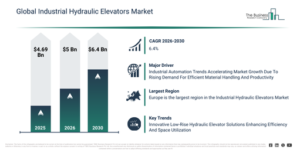
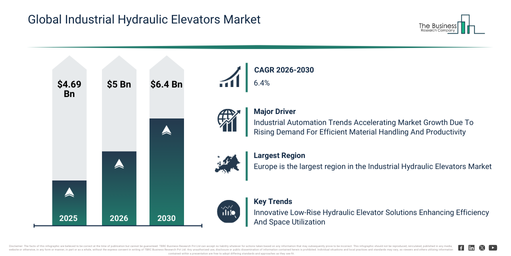
The industrial hydraulic elevators market has demonstrated strong growth in recent years. It is projected to expand from $4.69 billion in 2025 to $5 billion in 2026, exhibiting a compound annual growth rate (CAGR) of 6.7%. The historical growth of this market can be attributed to industrial expansion, an increase in factory automation, warehouse verticalization, the demand for material handling systems, and safety compliance requirements.
The market for industrial hydraulic elevators is anticipated to experience substantial expansion over the upcoming years. This market is projected to reach $6.4 billion by 2030, exhibiting a compound annual growth rate (CAGR) of 6.4%. Key factors driving this projected growth include the increasing adoption of smart factories, significant investments in industrial infrastructure, a rising demand for heavy-duty elevators, the expansion of logistics facilities, and the automation of vertical transport systems. Prominent trends expected during this forecast period encompass the development of heavy load handling elevator systems, their broader integration into various industrial facilities, the incorporation of intelligent control systems, an emphasis on ensuring operational reliability, and tailoring solutions for challenging environmental conditions.
Get A Free Industrial Hydraulic Elevators Market Sample With 2030 Forecast Insights:
Industrial Hydraulic Elevators Market Outlook: Key Driver Supporting Long-Term Growth
The expanding implementation of industrial automation is projected to drive the growth of the industrial hydraulic elevators market in the future. Industrial automation involves employing control systems, such as computers, robotics, and information technologies, to manage and oversee industrial operations with minimal human intervention. The rise in industrial automation is primarily fueled by the escalating demand for increased productivity, as it enables faster, continuous, and more efficient operations while lessening reliance on manual labor. Industrial hydraulic elevators enhance industrial automation by providing seamless vertical material transport, thereby reducing manual handling and improving workflow efficiency within automated production lines. The increasing industrial automation is a significant factor propelling the expansion of the industrial hydraulic elevators market.
Segmentation Of The Industrial Hydraulic Elevators Market: Key Categories Explained
The industrial hydraulic elevators market covered in this report is segmented –
1) By Type: Freight Elevators, Specialized Elevators, Service Elevators
2) By Control System: Semi-Automatic Control, Fully Automatic Control
3) By Load Capacity: Medium Duty, Heavy Duty, Extra Heavy Duty
4) By End-User Industry: Industrial Manufacturing Plants, Warehousing and Logistics Facilities, Power Generation and Utilities
Subsegments:
1) By Freight Elevators: Light-Duty Freight Elevators, Medium-Duty Freight Elevators, Heavy-Duty Freight Elevators
2) By Specialized Elevators: Explosion Proof Elevators, Clean Room Elevators, Marine Elevators
3) By Service Elevators: Dumbwaiters, Utility Elevators, Maintenance Elevators
Industrial Hydraulic Elevators Market Evolving Trends: What Businesses Should Know
Leading firms within the industrial hydraulic elevators market are concentrating on creating novel solutions, such as low-rise hydraulic elevators, with the aim of boosting energy efficiency, easing installation processes, and addressing the requirements of industrial environments with restricted space. A low-rise hydraulic elevator is defined as a vertical transport system intended for structures up to five stories tall, employing hydraulic mechanisms to ensure consistent, effective, and economical motion.
Who Competes In The Industrial Hydraulic Elevators Market? Major Companies Listed
Major companies operating in the industrial hydraulic elevators market are Hidral S.A., KLEEMANN Hellas S.A., IMEM Lifts S.r.l., Orona Group, Savaria Corporation, IGV Group, Sicher Elevator Co., Ltd., Canny Elevator Co., Ltd., Yungtay Engineering Co., Ltd., Fuji HD Elevator & Escalator Co., Ltd., Johnson Lifts Private Limited, Escon Elevators Pvt. Ltd., ALMAS Lifts Private Limited, AVT Beckett Elevators Ltd., Stannah Lifts Holdings Ltd., Klefer Elevadores S.A., MP Ascensores S.A., Express Lifts Company Ltd., Doppler S.A., Maruthi Lifts, Sigma Elevators, A Star Elevator Pvt. Ltd.
Read The Complete Industrial Hydraulic Elevators Market Forecast Report Through 2030:
Industrial Hydraulic Elevators Market Regional Ranking: Which Geography Comes First?
Europe was the largest region in the industrial hydraulic elevators market in 2025. Asia-Pacific is expected to be the fastest-growing region in the forecast period. The regions covered in the industrial hydraulic elevators market report are Asia-Pacific, South East Asia, Western Europe, Eastern Europe, North America, South America, Middle East, Africa
Reach Out To Our Team:
The Business Research Company: https://www.thebusinessresearchcompany.com/
Americas: +1 310-496-7795
Asia: +44 7882 955267 & +91 8897263534
Europe: +44 7882 955267
Email us at: marketing@tbrc.info
Follow us on:
LinkedIn: https://in.linkedin.com/company/the-business-research-company
YouTube: https://www.youtube.com/channel/UC24_fI0rV8cR5DxlCpgmyFQ
Global Market Model: https://www.thebusinessresearchcompany.com/global-market-model

Wasay has over a decade of experience in market research, data modelling, and analytics, with prior experience at GlobalData and Decision Tree Consulting Services. At The Business Research Company , he leads research operations across syndicated studies, customized consulting engagements, and the Global Market Model platform. His professional experience includes supporting organizations such as Boston Consulting Group, KPMG, and Ernst & Young. Wasay holds a degree in Electronics and Communications Engineering, postgraduate management qualifications from International Management Institute Belgium and Indian School of Business and Entrepreneurship, and completed the Integrated Program in Business Analytics from Indian Institute of Management Indore.