The Business Research Company’s 2026 market reports combine market attractiveness scoring, total addressable market sizing, company benchmarking matrices, interactive Excel dashboards, deeper supply chain intelligence, emerging startup tracking, and granular product-level insights to deliver research that is more actionable and strategically valuable.
What Is The Industrial Motors Market Growth Rate? A 4.9% CAGR Outlook Through 2030
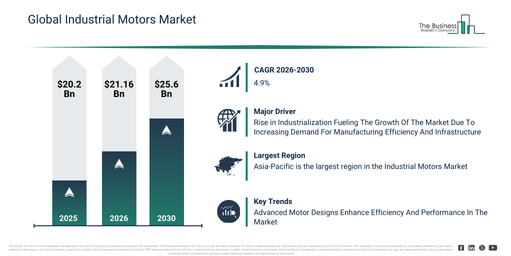
The industrial motors market size has experienced consistent growth in recent years. This market is set to expand from $20.2 billion in 2025 to $21.16 billion in 2026, achieving a compound annual growth rate (CAGR) of 4.8%. Historically, this growth has been driven by factors such as industrial electrification, the increase in manufacturing plants, the demand for continuous operations, a reliance on induction motors, and the mechanization of production processes.
The industrial motors market is projected to experience consistent expansion in the coming years, reaching $25.6 billion by 2030, exhibiting a compound annual growth rate (CAGR) of 4.9%. This anticipated growth during the forecast period is driven by factors such as energy efficiency regulations, the increasing adoption of electric mobility, the proliferation of smart factories, the demand for predictive maintenance, and the need to replace aging motors. Key trends during this period encompass a rising demand for energy-efficient motors, the broader expansion of automation equipment, the increased adoption of variable speed drives, the integration of smart motor monitoring systems, and their expanding application in heavy industries.
Access A Free Sample Of The Latest Industrial Motors Market Analysis:
Why Is The Industrial Motors Market Growing? The Key Demand Driver Explained
The anticipated growth of the industrial motors market is expected to be propelled by the ongoing rise in industrialization. Industrialization is defined as the economic transformation from a predominantly agricultural base to one focused on manufacturing goods and services. This increase in industrialization is driven by the escalating global demand for manufactured products, which in turn stimulates investment in factories and production infrastructure to meet consumption needs and economic targets. Industrial motors are critical to industrialization, as they power machinery and enable automation, thus boosting productivity and efficiency in manufacturing operations. The expansion of industrialization will consequently fuel the development of the industrial motors market.
What Are The Main Segments Of The Industrial Motors Market?
The industrial motors market covered in this report is segmented –
1) By Product: Alternating Current Motor, Direct Current Motor
2) By Sales Channel: Direct To Original Equipment Manufacturer (OEM), Direct To End-User, Distributor To End-User, Distributor To Original Equipment Manufacturer (OEM), Direct To System Integrator, Distributor To System Integrator
3) By Application: Compressors, Pumps And Fans, Conveyors, Crushers, Extruders, Other Applications
4) By End-User: Heating, Ventilation, And Air Conditioning (HVAC), Food And Beverage, Power Generation, Mining And Metal Processing, Paper And Paperboard, Automotive, Oil And Gas, Packaging, Other End Users
Subsegments:
1) By Alternative Current Motor: Squirrel Cage Induction Motor, Wound Rotor Induction Motor, Synchronous AC Motor, Three-Phase AC Motor
2) By Direct Current Motor: Brushless DC Motor (BLDC), Permanent Magnet DC Motor
Industrial Motors Market Trend Analysis: Where Leading Companies Are Focusing
Major companies operating in the industrial motors market are prioritizing the creation of innovative products utilizing advanced technologies, including permanent magnet synchronous reluctance technology, to enhance energy efficiency, minimize operational losses, and improve performance across a broad spectrum of speeds and loads. Permanent magnet synchronous reluctance (PMSynRM) combines permanent magnets and synchronous reluctance components, boosting efficiency by decreasing energy losses and improving torque density, making it well-suited for high-performance, energy-efficient industrial applications.
Which Companies Are Major Players In The Industrial Motors Market?
Major companies operating in the industrial motors market are Siemens AG, Schneider Electric SE, Mitsubishi Electric Corporation, GE Vernova LLC, ABB Ltd., Toshiba Corporation, Eaton Corporation plc, Nidec Corporation, Rockwell Automation Inc., WEG S.A., Regal Rexnord Corporation, SEW-Eurodrive GmbH And Co KG, Ingeteam S.A., ZIEHL-ABEGG SE, IDEC Corporation, Franklin Electric Co. Inc., Lafert Group, Brook Crompton UK Ltd., Nanotec Electronic GmbH And Co. KG, Roboteq Inc.
Get The Complete Industrial Motors Market Analysis Here:
Which Region Held The Largest Share Of The Industrial Motors Market In 2025?
Asia-Pacific was the largest region in the industrial motors market in 2025. North America is expected to be the fastest-growing region in the forecast period. The regions covered in the industrial motors market report are Asia-Pacific, South East Asia, Western Europe, Eastern Europe, North America, South America, Middle East, Africa
Reach Out To Our Team:
The Business Research Company: https://www.thebusinessresearchcompany.com/
Americas: +1 310-496-7795
Asia: +44 7882 955267 & +91 8897263534
Europe: +44 7882 955267
Email us at: marketing@tbrc.info
Follow us on:
LinkedIn: https://in.linkedin.com/company/the-business-research-company
YouTube: https://www.youtube.com/channel/UC24_fI0rV8cR5DxlCpgmyFQ
Global Market Model: https://www.thebusinessresearchcompany.com/global-market-model

Wasay has over a decade of experience in market research, data modelling, and analytics, with prior experience at GlobalData and Decision Tree Consulting Services. At The Business Research Company , he leads research operations across syndicated studies, customized consulting engagements, and the Global Market Model platform. His professional experience includes supporting organizations such as Boston Consulting Group, KPMG, and Ernst & Young. Wasay holds a degree in Electronics and Communications Engineering, postgraduate management qualifications from International Management Institute Belgium and Indian School of Business and Entrepreneurship, and completed the Integrated Program in Business Analytics from Indian Institute of Management Indore.