The Business Research Company’s 2026 market reports are designed to deliver research that is more actionable and strategically valuable. Key offerings include market attractiveness scoring, total addressable market sizing, company benchmarking matrices, interactive Excel dashboards, deeper supply chain intelligence, emerging startup tracking, and granular product-level insights.
Industrial Robots Market Size, Growth Rate And Key Forecast Highlights For 2026–2030
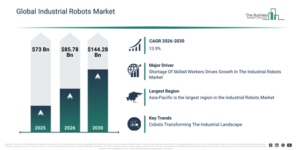
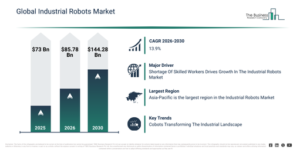
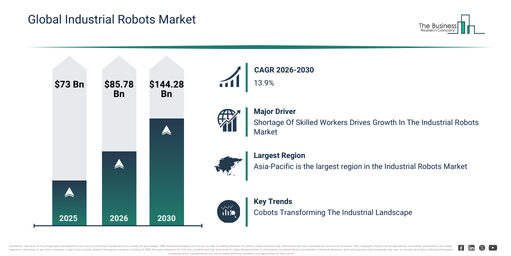
The industrial robots market has shown substantial expansion in recent years. Its value is expected to rise from $73 billion in 2025 to $85.78 billion in 2026, achieving a compound annual growth rate (CAGR) of 17.5%. This historical growth can be attributed to influences such as labor cost pressures, the necessity for consistent quality, advancements in automotive automation, increasing industrial productivity requirements, and improvements in manufacturing safety.
The industrial robots market is projected to experience substantial expansion in the coming years. This market is anticipated to reach $144.28 billion by 2030, demonstrating a compound annual growth rate (CAGR) of 13.9%. Factors driving this growth during the forecast period include the uptake of advanced manufacturing techniques, a scarcity of skilled workers, automation powered by AI, the need for production customization, and the proliferation of smart factories. Key developments expected in this period encompass the growing use of collaborative robots, the broadening of automated production lines, the incorporation of AI-driven robot control, an escalating need for precise assembly, and the development of adaptable production systems.
See What’s Inside The Industrial Robots Market Report With A Free Sample:
Industrial Robots Market Expansion: The Major Factor Driving Growth
The lack of available skilled workers is a significant factor contributing to the growth of the industrial robot market. With increasing production requirements and high demand, manufacturers are finding it challenging to meet supply due to an insufficient number of skilled personnel. This shortage of skilled labor primarily stems from two reasons: the presence of unskilled workers and skilled workers being unavailable for employment. Consequently, producers are opting for the installation of robots to maintain high supply levels. Industrial robots enhance a company’s overall productivity, efficiency, and effectiveness, thereby creating opportunities for integrating robots into the workforce as a response to labor scarcity.
Understanding Industrial Robots Market Segmentation For Strategic Planning
The industrial robots market covered in this report is segmented –
1) By Product Type: Articulated Robots, Linear Robots, Cylindrical Robots, Parallel Robots, Scara Robots, Other Product Types
2) By Application: Pick And Plane, Wielding And Soldering, Material Handling, Assembling, Cutting And Processing, Other Applications
3) By End-User Industry: Automotive, Electrical And Electronics, Healthcare And Pharmaceuticals, Food And Beverages, Rubber And Plastics, Metals And Machinery, Other End-User Industries
Subsegments:
1) By Articulated Robots: Multi-Joint Robots With Rotary Axes, Used In Assembly, Welding, And Material Handling
2) By Linear Robots: Also Known As Cartesian Robots, Operate Along Linear Axes For Pick-And-Place Tasks
3) By Cylindrical Robots: Robots With A Cylindrical Coordinate System, Used In Assembly And Spot Welding
4) By Parallel Robots: Robots With Parallel Kinematic Chains, Used In High-Speed, Precision Tasks Like Packaging
5) By Scara Robots: Selective Compliance Articulated Robot Arms, Ideal For Pick-And-Place, Assembly, And Packaging
6) By Others: Collaborative Robots (Cobots), Delta Robots For High-Speed Tasks, Spherical Robots For Specific Applications
Key Industrial Robots Market Trends To Watch In 2026
Key companies in the industrial robots market are innovating technologies, such as cobots, to secure a competitive advantage. Cobots, which are short for collaborative robots, are a specific kind of industrial robot built to operate alongside human workers in shared environments.
Key Companies Active In The Industrial Robots Market
Major companies operating in the industrial robots market are ABB Ltd, FANUC Corporation, Yaskawa Electric Corporation, Mitsubishi Electric Corporation, Kawasaki Heavy Industries, Ltd., KUKA AG, Denso Corporation, Siasun, Estun, JAKA, Epson India, Omron Corporation, Nachi-Fujikoshi Corp., Agile Robots, Youibot, Fruitcore Robotics, Campetella Robotic Center, Seiko Epson Corporation, Codian Robotics B.V., Mecademic, Schubert UK Ltd, Boston Dynamics, Wandelbots, Proviti, Rinf.tech, Effort, MIP Robotics, Servnews, Multivac UK, Mech-Mind Robotics, Bluewrist Inc., Yuanda Robotics, Simplex Robotics
Explore Detailed Industrial Robots Market Research And Forecasts:
Which Geography Dominates The Industrial Robots Market?
Asia-Pacific was the largest region in the industrial robots in 2025. Western Europe was the second largest region in the global industrial robot market. The regions covered in the industrial robots market report are Asia-Pacific, South East Asia, Western Europe, Eastern Europe, North America, South America, Middle East, Africa
Reach Out To Our Team:
The Business Research Company: https://www.thebusinessresearchcompany.com/
Americas: +1 310-496-7795
Asia: +44 7882 955267 & +91 8897263534
Europe: +44 7882 955267
Email us at: marketing@tbrc.info
Follow us on:
LinkedIn: https://in.linkedin.com/company/the-business-research-company
YouTube: https://www.youtube.com/channel/UC24_fI0rV8cR5DxlCpgmyFQ
Global Market Model: https://www.thebusinessresearchcompany.com/global-market-model

Wasay has over a decade of experience in market research, data modelling, and analytics, with prior experience at GlobalData and Decision Tree Consulting Services. At The Business Research Company , he leads research operations across syndicated studies, customized consulting engagements, and the Global Market Model platform. His professional experience includes supporting organizations such as Boston Consulting Group, KPMG, and Ernst & Young. Wasay holds a degree in Electronics and Communications Engineering, postgraduate management qualifications from International Management Institute Belgium and Indian School of Business and Entrepreneurship, and completed the Integrated Program in Business Analytics from Indian Institute of Management Indore.