
With a focus on actionable insights and strategic value, The Business Research Company’s 2026 market reports include market attractiveness scoring, total addressable market sizing, company benchmarking matrices, interactive Excel dashboards, deeper supply chain intelligence, emerging startup tracking, and granular product-level insights.
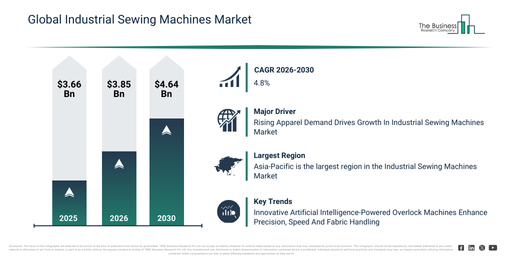
Industrial Sewing Machines Market Size Forecast Points To $4.64 Billion In Revenue By 2030
The industrial sewing machines market size has demonstrated robust growth in recent years. This market is projected to increase from $3.66 billion in 2025 to $3.85 billion in 2026, at a compound annual growth rate (CAGR) of 5.1%. The expansion observed historically can be attributed to the growth of apparel manufacturing, the expansion of textile exports, the demand for mass production sewing, the industrialization of garment units, and a rise in upholstery production.
The industrial sewing machines market is anticipated to experience consistent expansion over the upcoming years. It is expected to reach $4.64 billion in 2030, demonstrating a compound annual growth rate (CAGR) of 4.8%. This projected growth during the forecast period is largely driven by factors such as increased automation in textile production, the rising need for tailored apparel, the expansion of automotive upholstery, significant investments in smart factory technologies, and improvements in labor efficiency. Key trends anticipated over this period encompass a surging demand for high-speed sewing equipment, the expanding integration of computer-controlled sewing systems, the development of automated apparel manufacturing lines, an increasing utilization of specialized sewing apparatus, and an emphasis on achieving uniform stitching quality.
Get A Free Industrial Sewing Machines Market Sample Covering Drivers, Trends And Key Players:
Industrial Sewing Machines Market Driver Analysis: Key Factor Supporting Revenue Growth
The escalating demand for apparel products is expected to propel the expansion of the industrial sewing machines market in the foreseeable future. Apparel products include various clothing items and accessories designed for wear, such as shirts, pants, dresses, and outerwear, along with related items like hats, belts, and scarves. This increased appetite for apparel stems from shifting fashion trends, higher disposable incomes, enhanced convenience of online shopping, global market expansion, and a rising emphasis on customized and environmentally friendly fashion. Industrial sewing machines are essential in apparel manufacturing, facilitating the efficient creation of high-quality, durable garments through rapid and precise stitching. Hence, the growing demand for apparel products is a key driver for the industrial sewing machines market’s growth.
Industrial Sewing Machines Market Segmentation Framework: Major Segments At A Glance
The industrial sewing machines market covered in this report is segmented –
1) By Product: Flat Bed Sewing Machine, Cylinder Bed Sewing Machine, Post Bed Sewing Machines, Long Arm Sewing Machine, Other Products
2) By Operation: Manual Sewing Machine, Automatic Sewing Machine, Computer Controlled Sewing Machine
3) By Sales Channel: Direct Channel, Indirect Channel
4) By Application: Apparel, Non-Apparel
Subsegments:
1) By Flat Bed Sewing Machine: Single-Needle Flat Bed Sewing Machines, Multi-Needle Flat Bed Sewing Machines
2) By Cylinder Bed Sewing Machine: Single-Needle Cylinder Bed Sewing Machines, Multi-Needle Cylinder Bed Sewing Machines
3) By Post Bed Sewing Machines: Single-Needle Post Bed Sewing Machines, Multi-Needle Post Bed Sewing Machines
4) By Long Arm Sewing Machine: Quilting Long Arm Sewing Machines, Heavy-Duty Long Arm Sewing Machines
5) By Other Products: Overlock Sewing Machines, Blind Stitch Sewing Machines, Chain Stitch Sewing Machines, Embroidery Sewing Machines
Latest Industrial Sewing Machines Market Developments And Emerging Trends
Leading companies in the industrial sewing machine market are concentrating on developing innovative products, such as advanced artificial intelligence (AI)-powered overlock sewing machines, to maintain their market presence. These next-generation AI-powered overlock sewing machines utilize sophisticated artificial intelligence to improve stitching precision, automate adjustments, and optimize fabric handling, resulting in superior sewing efficiency and quality.
Which Companies Are Shaping The Industrial Sewing Machines Market?
Major companies operating in the industrial sewing machines market are Brother Industries, JUKI Corporation, Pegasus Sewing Machine Mfg, Yamato Sewing Machine Mfg, Seiko Sewing Machine, Mitsubishi Electric, Jack Sewing Machine, Typical Sewing Equipment, Zoje Sewing Machine, SunStar Machinery, Kansai Special, Durkopp Adler, Pfaff Industrial, Bernina International, Toyota Industries, Siruba Sewing Machine, Tajima Industries, Highlead Sewing Machine, Feiyue Sewing Machine, Maqi Sewing Machine, ZSK Stickmaschinen, Richpeace
Dive Deeper Into The Industrial Sewing Machines Market With The Full Report:
Industrial Sewing Machines Market Regional Distribution: Where Is Revenue Concentrated?
Asia-Pacific was the largest region in the industrial sewing machines market in 2025. The regions covered in the industrial sewing machines market report are Asia-Pacific, South East Asia, Western Europe, Eastern Europe, North America, South America, Middle East, Africa
Reach Out To Our Team:
The Business Research Company: https://www.thebusinessresearchcompany.com/
Americas: +1 310-496-7795
Asia: +44 7882 955267 & +91 8897263534
Europe: +44 7882 955267
Email us at: marketing@tbrc.info
Follow us on:
LinkedIn: https://in.linkedin.com/company/the-business-research-company
YouTube: https://www.youtube.com/channel/UC24_fI0rV8cR5DxlCpgmyFQ
Global Market Model: https://www.thebusinessresearchcompany.com/global-market-model

Wasay has over a decade of experience in market research, data modelling, and analytics, with prior experience at GlobalData and Decision Tree Consulting Services. At The Business Research Company , he leads research operations across syndicated studies, customized consulting engagements, and the Global Market Model platform. His professional experience includes supporting organizations such as Boston Consulting Group, KPMG, and Ernst & Young. Wasay holds a degree in Electronics and Communications Engineering, postgraduate management qualifications from International Management Institute Belgium and Indian School of Business and Entrepreneurship, and completed the Integrated Program in Business Analytics from Indian Institute of Management Indore.

