Enhanced with market attractiveness analysis, total addressable market evaluation, company benchmarking matrices, interactive Excel dashboards, expanded supply chain intelligence, emerging startup coverage, and detailed product insights, The Business Research Company’s 2026 market reports deliver more actionable and strategically valuable research.
Integrated Visual Augmentation System Market Revenue Outlook: What CAGR Is Expected Through 2030?
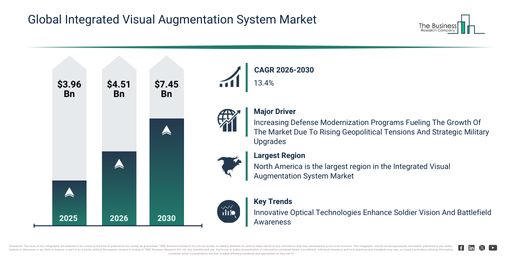
The integrated visual augmentation system market size has seen rapid expansion in recent years. This market is set to expand from $3.96 billion in 2025 to $4.51 billion in 2026, achieving a compound annual growth rate (CAGR) of 13.9%. The notable growth observed historically stems from several factors, including the modernization of soldier equipment, the escalating demand for battlefield awareness, ongoing defense digitization programs, critical night combat requirements, and evolving tactical communication needs.
The market for integrated visual augmentation systems is projected to experience swift expansion in the coming years. This market is forecast to reach $7.45 billion by 2030, exhibiting a compound annual growth rate (CAGR) of 13.4%. Factors driving this expansion during the projection period include a rise in defense expenditure, the implementation of smart soldier initiatives, AI-driven threat detection, the merging with autonomous platforms, and the need for real-time command solutions. Key developments anticipated in this timeframe encompass the merging of augmented reality (AR) with night vision technology, improvements in soldier situational awareness, the deployment of multi-sensor data fusion systems, the introduction of lightweight wearable military displays, and capabilities for real-time battlefield data visualization.
Download A Free Sample Report For Comprehensive Market Insights:
Integrated Visual Augmentation System Market Expansion Supported By Key Demand Factors
The integrated visual augmentation system market is projected to experience growth fueled by increasing defense modernization programs. These programs are defined as organized initiatives undertaken by a nation’s military to upgrade and enhance its capabilities by adopting advanced technologies, improving infrastructure, and updating equipment and systems. The rise in defense modernization programs is largely driven by escalating geopolitical tensions, as nations aim to strengthen their military capabilities and maintain strategic superiority. The integrated visual augmentation system enhances these modernization efforts by providing advanced augmented reality capabilities, which improve soldier situational awareness and decision-making. It further supports mission effectiveness through real-time data, sensor integration, and seamless communication on the battlefield. For instance, in March 2023, according to the European Security and Defence College, a Belgium-based autonomous institution, the ongoing US Army modernization program is set to field 35 new future force systems by 2030, forming the core of more than 500 development, acquisition, or upgrade initiatives currently underway. Therefore, the expansion of defense modernization programs is a significant driver for the growth of the integrated visual augmentation system market.
Integrated Visual Augmentation System Market Segmentation And Category Breakdown
The integrated visual augmentation system market covered in this report is segmented –
1) By Component Type: Displays, Sensors, Software, Controllers
2) By Product: Helmet-Mounted Display, Night Vision Device
3) By Technology: Augmented Reality (AR), Mixed Reality (MR), Thermal And Low-Light Imaging, Other Technologies
4) By Application: Situational Awareness, Navigation And Mapping, Target Acquisition And Engagement, Other Applications
5) By End Use: Defense, Homeland Security And Border Protection
Subsegments:
1) By Displays: Head-Mounted Displays (HMDs), Augmented Reality (AR) Lenses, Retinal Projection Displays
2) By Sensors: Environmental Sensors, Motion And Position Sensors, Eye-Tracking Sensors, Thermal And Night Vision Sensors
3) By Software: Augmented Reality Software, Target Recognition And Tracking Algorithms, Navigation And Mapping Software, Simulation And Training Modules
4) By Controllers: Wearable Input Devices, Gesture Recognition Controllers, Voice Command Interfaces, Tactile Feedback Devices
#Integrated Visual Augmentation System Market Growth Trends: What Is Influencing The Future Outlook?
Companies operating within the integrated visual augmentation system (IVAS) market are concentrating on developing innovative solutions, such as advanced optical filter assemblies, to improve visual clarity, sensor performance, and augmented reality (AR) integration in combat situations. These specialized optical filter assemblies are components designed to enhance image clarity, sensor accuracy, and AR display performance across various lighting conditions. For instance, in April 2024, Optex Systems Inc., a US-based defense optics manufacturer, announced its support for the Integrated Visual Augmentation System (IVAS) Filter Assembly. This is a next-generation optical component specifically developed for military-grade augmented reality systems. The IVAS filter assembly features precision-engineered coatings that allow for selective light filtering, offer high-impact durability, and provide environmental resistance. Its integration aids AR-enabled headsets used by the U.S. Army, ensuring superior battlefield vision in diverse light and weather conditions, while also maintaining compatibility with thermal imaging and head-up display overlays.
Integrated Visual Augmentation System Market Competitive Analysis Of Major Industry Participants
Major companies operating in the integrated visual augmentation system market are Microsoft Corporation, RTX Corporation, Lockheed Martin Corporation, BAE Systems plc, Thales Group, CACI International Inc., Elbit Systems Ltd., ASELSAN Elektronik Sanayi ve Ticaret A.S., Gentex Corporation, Anduril Industries Inc., FLIR Systems Inc., Magic Leap Inc., Kopin Corporation, RealWear Inc., Thermoteknix Systems Ltd., Optex Systems Inc., InVeris Training Solutions Inc., Vuzix Corporation, Rivet Industries LLC, InfivR Labs Pvt. Ltd.
Access The Complete Integrated Visual Augmentation System Market Report:
Integrated Visual Augmentation System Market Geographic Analysis: Where Is Demand Growing The Fastest?
North America was the largest region in the integrated visual augmentation system market in 2025. Asia-Pacific is expected to be the fastest-growing region in the forecast period. The regions covered in the integrated visual augmentation system market report are Asia-Pacific, South East Asia, Western Europe, Eastern Europe, North America, South America, Middle East, Africa
Get in touch with us:
The Business Research Company: https://www.thebusinessresearchcompany.com/
Americas: +1 310-496-7795
Asia: +44 7882 955267 & +91 8897263534
Europe: +44 7882 955267
Email us at: marketing@tbrc.info
Follow us on:
LinkedIn: https://in.linkedin.com/company/the-business-research-company
YouTube: https://www.youtube.com/channel/UC24_fI0rV8cR5DxlCpgmyFQ
Global Market Model: https://www.thebusinessresearchcompany.com/global-market-model

Wasay has over a decade of experience in market research, data modelling, and analytics, with prior experience at GlobalData and Decision Tree Consulting Services. At The Business Research Company , he leads research operations across syndicated studies, customized consulting engagements, and the Global Market Model platform. His professional experience includes supporting organizations such as Boston Consulting Group, KPMG, and Ernst & Young. Wasay holds a degree in Electronics and Communications Engineering, postgraduate management qualifications from International Management Institute Belgium and Indian School of Business and Entrepreneurship, and completed the Integrated Program in Business Analytics from Indian Institute of Management Indore.