
Built to provide research that’s more actionable and strategically valuable, The Business Research Company’s 2026 market reports include market attractiveness analysis, total addressable market sizing, company benchmarking matrices, interactive Excel dashboards, broader supply chain intelligence, emerging startup tracking, and in-depth product insights.
Koji Cultivation Equipment Market Value Growth And Long-Term Outlook
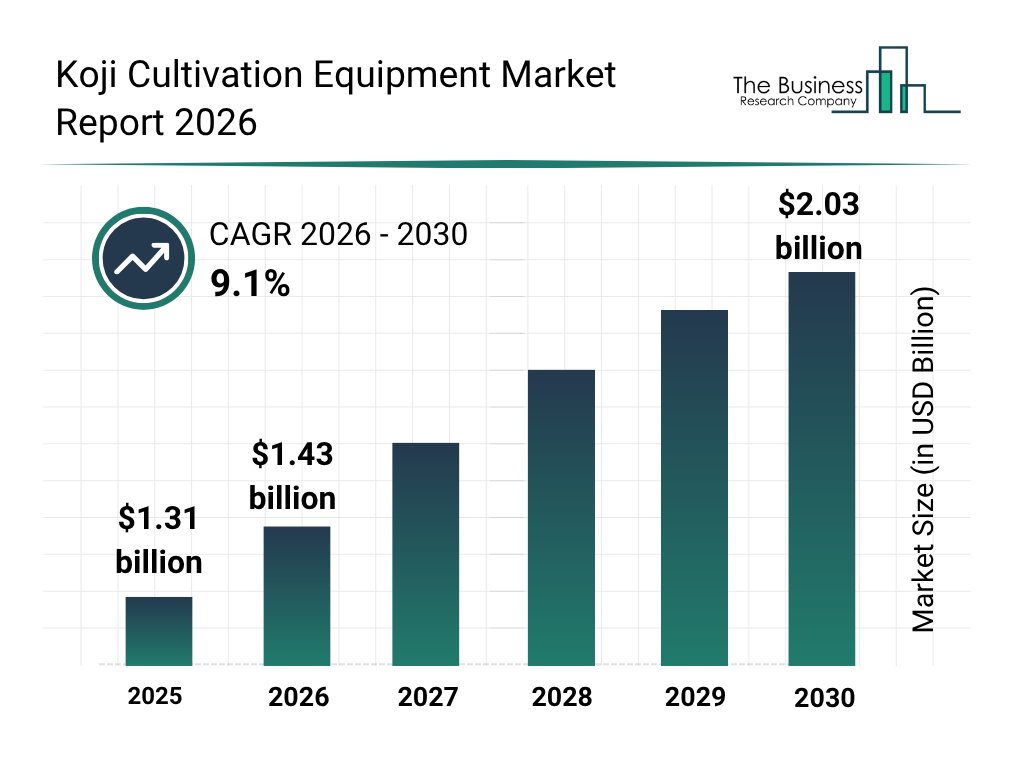
The koji cultivation equipment market size has seen robust expansion in recent years. It is anticipated to expand from $1.31 billion in 2025 to $1.43 billion in 2026, achieving a compound annual growth rate (CAGR) of 8.9%. This historical growth can be attributed to the escalating demand for traditional fermented foods, the integration of mechanized incubation systems, the rise in soy sauce and miso production, increasing consciousness regarding food safety standards, and the proliferation of small-scale fermentation businesses.
The koji cultivation equipment market size is projected for substantial expansion in the coming years, reaching $2.03 billion by 2030, exhibiting a compound annual growth rate (CAGR) of 9.1%. This anticipated growth during the forecast period stems from factors such as increasing demand for large-scale koji manufacturing, the implementation of fully automated cultivation setups, the expansion of the biotechnology and functional food industries, the incorporation of IoT-based monitoring in fermentation, and a rise in the export of fermented food items. Key developments expected during this period involve progress in controlled-environment systems, the incorporation of automated koji cultivation machinery, enhanced measures for hygiene and contamination control, an increase in industrial-level fermentation capacities, and a growing emphasis on product consistency and quality in fermented goods.
Get A Free Sample Report With In-Depth Market Insights:
Koji Cultivation Equipment Market Industry Drivers: What’s Behind The Revenue Growth?
The increasing embrace of automation within food manufacturing operations is anticipated to stimulate the expansion of the koji cultivation equipment market in the future. This automation involves employing mechanical systems, electronics, sensors, computer controls, and software to execute and oversee manufacturing activities with limited human involvement. The growing preference for consistent product quality, heightened food safety standards, and greater production efficiency are key factors contributing to the rising implementation of automation in food production. Koji cultivation equipment plays a crucial role in automated food production, facilitating precise management of vital environmental elements like temperature, humidity, and airflow throughout the fermentation process. For example, data from AgFunderNews, a US-based online publication specializing in agrifood technology and investment trends, indicated that global robotic installations in the food and beverage sector saw an 18% year-over-year increase by October 2024, with the United States at the forefront of this trend. Consequently, the expanding use of automation in food production processes is a primary impetus for the growth of the koji cultivation equipment market.
Koji Cultivation Equipment Market Segment Breakdown: Which Categories Lead On Revenue?
The koji cultivation equipment market covered in this report is segmented –
1) By Product Type: Incubators, Fermentation Chambers, Humidity Controllers, Temperature Controllers, Trays And Racks, Other Product Types
2) By Technology: Manual Systems, Automated Systems, Hybrid Systems
3) By Distribution Channel: Direct Sales, Distributors, Online Retail, Other Distribution Channels
4) By Application: Food And Beverage, Pharmaceuticals, Biotechnology, Other Applications
5) By End-User: Commercial, Industrial, Research Institutes, Other End-Users
Subsegments:
1) By Incubators: Batch Incubators, Continuous Incubators, Programmable Incubators, Industrial Scale Incubators
2) By Fermentation Chambers: Static Fermentation Chambers, Dynamic Fermentation Chambers, Controlled Atmosphere Chambers, Multi Stage Fermentation Chambers
3) By Humidity Controllers: Digital Humidity Controllers, Analog Humidity Controllers, Integrated Humidity Control Systems, Standalone Humidity Control Units
4) By Temperature Controllers: Digital Temperature Controllers, Programmable Temperature Controllers, Multi Zone Temperature Controllers, Automatic Temperature Control Systems
5) By Trays And Racks: Stainless Steel Trays, Food Grade Plastic Trays, Adjustable Racks, Stackable Racks
6) By Other Product Types: Cleaning And Sanitization Equipment, Mixing Equipment, Grinding Equipment, Packaging Equipment
#Koji Cultivation Equipment Market Growth Trends: What’s Shaping The Future Outlook?
Leading companies operating in the koji cultivation equipment market are intensifying their efforts on advancements within automated humidity control technologies, such as static equal dehumidification cultivation systems. This is driven by the escalating demand for uniform and high-quality fermentation processes spanning food and beverage production, biotechnology, and industrial enzyme manufacturing. Static equal dehumidification cultivation systems are specifically engineered to maintain a consistent humidity distribution throughout the cultivation medium, employing sensor-based monitoring and regulated airflow, thereby moving away from manual adjustments or unstable ambient conditions. As an illustrative example, in August 2024, Fujiwara Techno-Art Co., Ltd., a Japan-based producer of brewing and fermentation machinery, unveiled the Rotary Ginjo Automatic Koji Making Device “FEDY.” This automated koji production system integrates a patented static equal humidity cultivation technology, enabling the reliable, large-scale manufacturing of ginjo-class koji. The FEDY system includes a rotary, automated koji-making chamber with sophisticated humidity control, ensuring consistent mold development across deep grain layers between 180 and 250 mm.
Koji Cultivation Equipment Market Top Companies Driving Competitive Growth
Major companies operating in the koji cultivation equipment market are Thermo Fisher Scientific Inc., Alfa Laval AB, Panasonic Healthcare Co. Ltd., Nihon Seiki Co. Ltd., SPX Flow Inc., Kojiya Co. Ltd., Takara Bio Inc., Hisaka Works Ltd., Amano Enzyme Inc., Nihon Jyozo Kogyo Co. Ltd., Memmert GmbH & Co. KG, Eppendorf AG, Yamato Sanko Co. Ltd., Shinagawa Machinery Works Co. Ltd., Shikoku Kakoki Co. Ltd., Fujiwara Techno-Art Co. Ltd., Fermentec Co. Ltd., Kikkoman Biochemifa Co. Ltd., Takagi Corporation, Nagata Brewing Machinery Co. Ltd., Nippon Jozo, Chang Rong Group, Guangdong Tianniang Intelligent Equipment Co. Ltd.
View The Full Koji Cultivation Equipment Market Report:
Koji Cultivation Equipment Market Global Footprint: Which Region Leads The Market?
Asia-Pacific was the largest region in the koji cultivation equipment market in 2025. Europe is expected to be the highest-growth region in the forecast period. The regions covered in the koji cultivation equipment market report are Asia-Pacific, South East Asia, Western Europe, Eastern Europe, North America, South America, Middle East, Africa.
Reach Out To Our Team:
The Business Research Company: https://www.thebusinessresearchcompany.com/
Americas: +1 310-496-7795
Asia: +44 7882 955267 & +91 8897263534
Europe: +44 7882 955267
Email us at: marketing@tbrc.info
Follow us on:
LinkedIn: https://in.linkedin.com/company/the-business-research-company
YouTube: https://www.youtube.com/channel/UC24_fI0rV8cR5DxlCpgmyFQ
Global Market Model: https://www.thebusinessresearchcompany.com/global-market-model

Wasay has over a decade of experience in market research, data modelling, and analytics, with prior experience at GlobalData and Decision Tree Consulting Services. At The Business Research Company , he leads research operations across syndicated studies, customized consulting engagements, and the Global Market Model platform. His professional experience includes supporting organizations such as Boston Consulting Group, KPMG, and Ernst & Young. Wasay holds a degree in Electronics and Communications Engineering, postgraduate management qualifications from International Management Institute Belgium and Indian School of Business and Entrepreneurship, and completed the Integrated Program in Business Analytics from Indian Institute of Management Indore.