Built to provide research that’s more actionable and strategically valuable, The Business Research Company’s 2026 market reports include market attractiveness analysis, total addressable market sizing, company benchmarking matrices, interactive Excel dashboards, broader supply chain intelligence, emerging startup tracking, and in-depth product insights.
Manufacturing Operations Management Software Market Growth Potential: How Will Market Size Shift Through 2030?
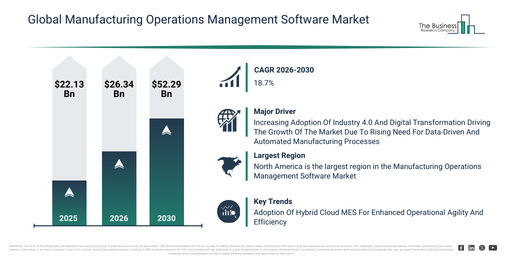
The manufacturing operations management software market size has observed substantial growth in recent years. The market is projected to expand from $22.13 billion in 2025 to $26.34 billion in 2026, exhibiting a compound annual growth rate (CAGR) of 19.0%. This historical growth is driven by several factors, including the expansion of digital manufacturing initiatives, the rising complexity of production operations, an increased demand for production transparency, the adoption of factory automation systems, and the growth of data-driven manufacturing practices.
The manufacturing operations management software market is projected to experience substantial expansion in the coming years, reaching $52.29 billion by 2030, driven by a compound annual growth rate (CAGR) of 18.7%.
Several factors are expected to fuel this growth during the forecast period, including the quickening pace of smart factory implementations, a heightened need for operational flexibility, the expanding application of predictive analytics, the broadening of industrial IoT environments, and an intensified emphasis on sustainability and optimal resource utilization.
Key developments anticipated during the forecast period encompass a greater uptake of cloud-based MOM platforms, increased integration with MES and ERP systems, a broader deployment of real-time production analytics, the widening scope of AI-powered quality and performance tracking, and a strengthened emphasis on complete production visibility from start to finish.
Get A Free Sample Report With In-Depth Market Insights:
Manufacturing Operations Management Software Market Demand Drivers Opening New Revenue Streams
The future expansion of the manufacturing operations management software market is anticipated to be fueled by the rising embrace of Industry 4.0 and digital transformation. These concepts involve incorporating sophisticated digital technologies, including automation, artificial intelligence, cloud computing, and the Internet of Things, into manufacturing operations to establish intelligent and interconnected production frameworks. The surge in adoption stems from an increasing demand for automation and real-time data analysis to boost operational efficiency. Manufacturing operations management software facilitates Industry 4.0 and digital transformation by enabling the integration and automation of production processes via real-time data and analytics. For illustration, data from Eurostat, the European Union’s statistical office in Luxembourg, indicated in April 2025 that 13% of EU businesses utilized artificial intelligence (AI) technologies in 2024, an increase from 8% in 2023. Concurrently, the number of information and communication technology (ICT) specialists grew to over 10 million, accounting for 5% of total EU employment, up from 4.8% in 2023, underscoring the swift progress of digital transformation across various sectors. Consequently, the growing embrace of Industry 4.0 and digital transformation is propelling the expansion of the manufacturing operations management software market.
Manufacturing Operations Management Software Market Segmentation: How Does The Market Break Down By Category?
The manufacturing operations management software market covered in this report is segmented –
1) By Component: Software, Services
2) By Function: Labor Management, Planning And Scheduling, Process And Production Intelligence, Quality Process Management, Other Functions
3) By Deployment Outlook: Cloud, On-Premise
4) By Enterprise: Large Enterprises, Small And Medium Enterprises
5) By End-Use: Aerospace, Automotive, Pharmaceuticals, Medical Equipment, Chemicals, Food And Beverages, Consumer Goods, Other End-Uses
Subsegments:
1) By Software: Manufacturing Execution Systems (MES), Quality Management Systems (QMS), Advanced Planning And Scheduling (APS), Manufacturing Intelligence (MI), Inventory Management Software, Workforce Management Software, Product Lifecycle Management (PLM) Integration, Performance Analysis And Reporting Tools
2) By Services: Implementation And Integration Services, Consulting Services, Support And Maintenance Services, Training And Education Services, Managed Services, Upgradation And Migration Services
Manufacturing Operations Management Software Market Transformation Trends: What Innovations Are Driving Change?
Leading companies within the manufacturing operations management software market are concentrating on creating hybrid cloud-based MES solutions that incorporate AI, analytics, and live data visibility. This focus aims to improve operational efficiency, agility, and sustainability across extensive manufacturing networks. A hybrid cloud MES functions as a digital platform, linking on-premise production systems with cloud-based data analytics, thereby enabling manufacturers to optimize performance, enhance collaboration, and utilize AI-driven insights throughout their multi-site operations. For instance, in April 2024, AVEVA, a UK-based industrial software firm, unveiled its hybrid cloud manufacturing execution system (MES) at Hannover Messe to increase operational visibility and agility across multi-site manufacturing operations. The solution integrates edge-based MES capabilities with cloud-powered data, analytics, and visualization via the AVEVA CONNECT platform. This method assists manufacturers in dismantling data silos, boosting efficiency, minimizing waste, and strengthening sustainability. Furthermore, the hybrid MES supports agile supply chains by providing enterprise-wide visibility and facilitating faster, data-driven decisions across global operations.
Manufacturing Operations Management Software Market Competitive Overview And Top Companies
Major companies operating in the manufacturing operations management software market are Siemens AG, Oracle Corporation, Schneider Electric SE, Honeywell International Inc., SAP SE, GE Vernova Inc., ABB Ltd., Emerson Electric Co., Rockwell Automation Inc., Dassault Systèmes SE, Dürr Aktiengesellschaft (Dürr AG), AVEVA Solutions Limited, Epicor Software Corporation, Aspen Technology Inc., Aptean Inc., Plex Systems Inc., Critical Manufacturing S.A., Tulip Interfaces Inc., iBASEt Inc., General Electric Company, Aegis Industrial Software Corporation
View The Full Manufacturing Operations Management Software Market Report:
Manufacturing Operations Management Software Market Global Footprint: Which Region Leads The Market?
North America was the largest region in the manufacturing operations management software market in 2025. Asia-Pacific is expected to be the fastest-growing region in the forecast period. The regions covered in the manufacturing operations management software market report are Asia-Pacific, South East Asia, Western Europe, Eastern Europe, North America, South America, Middle East, Africa
Reach Out To Our Team:
The Business Research Company: https://www.thebusinessresearchcompany.com/
Americas: +1 310-496-7795
Asia: +44 7882 955267 & +91 8897263534
Europe: +44 7882 955267
Email us at: marketing@tbrc.info
Follow us on:
LinkedIn: https://in.linkedin.com/company/the-business-research-company
YouTube: https://www.youtube.com/channel/UC24_fI0rV8cR5DxlCpgmyFQ
Global Market Model: https://www.thebusinessresearchcompany.com/global-market-model

Wasay has over a decade of experience in market research, data modelling, and analytics, with prior experience at GlobalData and Decision Tree Consulting Services. At The Business Research Company , he leads research operations across syndicated studies, customized consulting engagements, and the Global Market Model platform. His professional experience includes supporting organizations such as Boston Consulting Group, KPMG, and Ernst & Young. Wasay holds a degree in Electronics and Communications Engineering, postgraduate management qualifications from International Management Institute Belgium and Indian School of Business and Entrepreneurship, and completed the Integrated Program in Business Analytics from Indian Institute of Management Indore.