The Business Research Company’s 2026 market reports combine market attractiveness scoring, total addressable market sizing, company benchmarking matrices, interactive Excel dashboards, deeper supply chain intelligence, emerging startup tracking, and granular product-level insights to deliver research that is more actionable and strategically valuable.
Membrane Air Dryer Market Size Review: What Shaped Past Growth And What Will Drive Future Expansion?
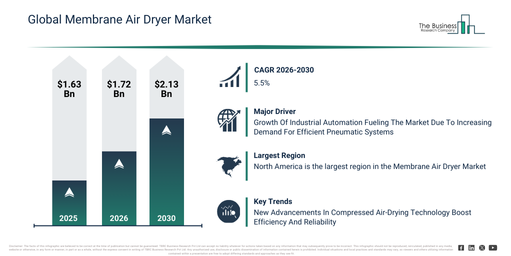
The membrane air dryer market has experienced robust growth in recent years. Projections indicate a rise from $1.63 billion in 2025 to $1.72 billion in 2026, demonstrating a compound annual growth rate (CAGR) of 5.5%. Historically, this expansion has stemmed from factors such as industrial automation growth, the expansion of compressed air systems, increasing equipment corrosion issues, the growth in manufacturing facilities, and the demand for low maintenance air treatment solutions.
The membrane air dryer market size is anticipated to experience robust expansion over the next few years, projected to reach $2.13 billion by 2030, demonstrating a compound annual growth rate (CAGR) of 5.5%. This growth in the forecast period is driven by factors such as more stringent air quality standards, an increase in process automation, the growing adoption of oil-free compressed air systems, a heightened focus on energy efficiency, and the expansion of electronics and medical manufacturing industries. Key trends during this period are expected to include the increasing embrace of energy-efficient compressed air drying solutions, a rising preference for maintenance-free air drying technologies, the expanding application of membrane dryers in remote and off-grid operations, a growing demand for corrosion prevention in compressed air systems, and the broadening of clean air requirements across industrial processes.
Access Free Sample Pages From The Membrane Air Dryer Market Report 2026:
Understanding The Main Driver Of The Membrane Air Dryer Market
The increasing trend of industrial automation is projected to stimulate the expansion of the membrane air dryer market in the future. Industrial automation involves utilizing control systems, such as robots and computer software, to manage machinery and manufacturing processes without human involvement. This growth in industrial automation is attributed to factors like advancements in AI and IoT, the necessity for higher productivity, and the rising demand for precision and efficiency in production. The proliferation of industrial automation consequently boosts the need for membrane air dryers, which are essential for providing dry, clean compressed air, thereby protecting pneumatic systems by eliminating moisture, preventing corrosion, and enhancing operational effectiveness. Thus, the escalating industrial automation is a primary driver for the growth of the membrane air dryer market.
Membrane Air Dryer Market Segment Mapping For 2026 And Beyond
The membrane air dryer market covered in this report is segmented –
1) By Product: Porous, Non-Porous
2) By Pressure Rating: Low, Medium, High
3) By Application: Plant Air Or Shop Air, Instrument Air, Process Air, Breathing Air, Other Applications
4) By End-User: Chemical, Oil And Gas, Medical, Food Beverage, Electronics, General Manufacturing, Other End-Users
Subsegments:
1) By Porous: Micro-Porous Membrane Air Dryers, Hollow Fiber Membrane Dryers
2) By Non-Porous: Dense Membrane Air Dryers, Polymeric Non-Porous Membrane Dryers
What Key Trend Is Expected To Shape The Membrane Air Dryer Market Over The Forecast Period?
Leading companies in the membrane air dryer market are concentrating on developing sophisticated compressed air dryers to meet the increasing demand for efficient moisture elimination in industrial settings. Compressed air dryers aid in air treatment by ensuring low dew points, preventing moisture-related damage, enhancing equipment performance, and improving overall air quality.
Membrane Air Dryer Market Major Players And Industry Competition Overview
Major companies operating in the membrane air dryer market are Parker Hannifin Corporation, Atlas Copco AB, SMC Corporation, Donaldson Company, Inc., KAESER KOMPRESSOREN SE, BEKO Technologies GmbH, Pneumatech, Pentair plc, CKD Corporation, OMEGA AIR d.o.o. Ljubljana, Hankison (SPX FLOW Brand), FST GmbH Filtration Separating Technology, DRI-AIR Industries, Inc., Altec AIR LLC, Oxair Gas Systems, Ingersoll Rand Inc., Van Air Systems, Wilkerson Corporation, Zeks Compressed Air Solutions, Aircel LLC, Norgren Ltd. (IMI plc), Sullair LLC
Full Membrane Air Dryer Market Report: Market Size, Trends, Segments And Key Players:
Membrane Air Dryer Market Geographic Segmentation: Regions Covered In The Report
North America was the largest region in the membrane air dryer market in 2025. Asia-Pacific is expected to be the fastest-growing region in the forecast period. The regions covered in the membrane air dryer market report are Asia-Pacific, South East Asia, Western Europe, Eastern Europe, North America, South America, Middle East, Africa
Reach Out To Our Team:
The Business Research Company: https://www.thebusinessresearchcompany.com/
Americas: +1 310-496-7795
Asia: +44 7882 955267 & +91 8897263534
Europe: +44 7882 955267
Email us at: marketing@tbrc.info
Follow us on:
LinkedIn: https://in.linkedin.com/company/the-business-research-company
YouTube: https://www.youtube.com/channel/UC24_fI0rV8cR5DxlCpgmyFQ
Global Market Model: https://www.thebusinessresearchcompany.com/global-market-model

Wasay has over a decade of experience in market research, data modelling, and analytics, with prior experience at GlobalData and Decision Tree Consulting Services. At The Business Research Company , he leads research operations across syndicated studies, customized consulting engagements, and the Global Market Model platform. His professional experience includes supporting organizations such as Boston Consulting Group, KPMG, and Ernst & Young. Wasay holds a degree in Electronics and Communications Engineering, postgraduate management qualifications from International Management Institute Belgium and Indian School of Business and Entrepreneurship, and completed the Integrated Program in Business Analytics from Indian Institute of Management Indore.