Built to provide research that’s more actionable and strategically valuable, The Business Research Company’s 2026 market reports include market attractiveness analysis, total addressable market sizing, company benchmarking matrices, interactive Excel dashboards, broader supply chain intelligence, emerging startup tracking, and in-depth product insights.
Modular Automation Market CAGR Outlook And Future Development
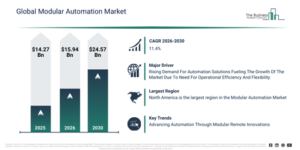
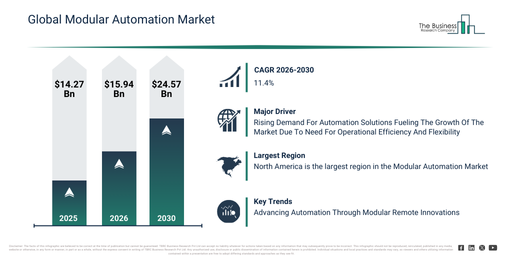
The modular automation market has seen significant growth in recent years. This market is expected to expand from $14.27 billion in 2025 to $15.94 billion in 2026, achieving a compound annual growth rate (CAGR) of 11.7%. The historical increase in market size is due to factors such as the embrace of industrial automation, the requirement for enhanced manufacturing efficiency, the rise of mass customization, the demand for quicker production changeovers, and a reduced dependence on labor.
The modular automation market is projected to experience substantial expansion in the coming years, reaching a valuation of $24.57 billion by 2030, propelled by a compound annual growth rate (CAGR) of 11.4%. This anticipated growth during the forecast period stems from factors such as the incorporation of AI-powered automation, the expansion of smart manufacturing practices, the increasing need for modular production capabilities, a surge in investments towards digital factories, and broader adoption by small and medium enterprises. Furthermore, key trends identified for the upcoming period encompass a greater embrace of flexible manufacturing systems, a heightened demand for plug-and-play automation solutions, an increased emphasis on scalable production lines, the proliferation of smart factory implementations, and a preference for solutions that offer reduced installation times and minimize downtime.
Get A Free Sample Report With In-Depth Market Insights:
Modular Automation Market Demand Drivers Opening New Revenue Streams
The growing need for automation solutions is anticipated to drive the expansion of the modular automation market in the future. Automation solutions are defined as technologies, systems, or services designed to perform tasks with minimal human interaction, thereby improving efficiency, accuracy, and productivity across various industries. The rise in automation solutions is primarily attributed to the increasing emphasis on operational efficiency, as businesses aim to decrease costs, minimize mistakes, and enhance productivity through intelligent and streamlined workflows. Modular automation further refines automation solutions by providing flexible, scalable, and easily adjustable systems that can rapidly adapt to evolving production demands and technological innovations. For example, in September 2025, the International Federation of Robotics, a Germany-based non-profit research and industry association, stated that the total number of industrial robots actively used worldwide reached 4,664,000 units in 2024, which was a 9 percent increase compared to the previous year. Therefore, the heightened demand for automation solutions is a key driver for the growth of the modular automation market.
Modular Automation Market Breakdown By Product Type And Application
The modular automation market covered in this report is segmented –
1) By Type: Modular Control Systems, Modular Production & Assembly Systems, Modular Process Automation Systems, Modular Material Handling Systems, Modular Robotics & Automation Cells
2) By Technology: Industrial Internet Of Things (IIoT), Robotics
3) By Enterprise Size: Small And Medium Enterprises, Large Enterprises
4) By Application: Assembly, Inspection, Testing, Material Handling, Packaging
5) By End-User Industry: Manufacturing, Healthcare, Aerospace And Defense, Energy And Utilities
Subsegments:
1) By Modular Control Systems: Modular PLC & PAC Systems, Distributed I/O & Remote Terminal Modules, Modular Safety Control Systems, Scalable Motion Control Modules, Software-Configurable Control Platforms
2) By Modular Production & Assembly Systems: Modular Assembly Stations, Reconfigurable Production Lines, Standardized Workcell Modules, Plug-and-Play Assembly Units, Flexible Transfer & Indexing Modules
3) By Modular Process Automation Systems: Process Skid-Mounted Automation Units, Standardized Process Equipment Modules, Modular Batch Processing Units, Pre-Engineered Process Automation Skids, Distributed Process Control Modules
4) By Modular Material Handling Systems: Modular Conveyor Systems, Automated Guided Vehicle (AGV) Modules, Autonomous Mobile Robot (AMR) Modules, Modular Palletizing & Depalletizing Units, Reconfigurable Sorting & Routing Modules
5) By Modular Robotics & Automation Cells: Robot Workcell Modules, Collaborative Robot (Cobot) Cells, Vision-Integrated Robotics Modules, Pick-and-Place Automation Cells, End-of-Line Robotic Packaging Cells
Modular Automation Market Transformation Trends: What Innovations Are Driving Change?
Companies at the forefront of the modular automation market are prioritizing the development of technological advancements, such as modular remote units, to improve system flexibility, enable faster deployment, and enhance operational efficiency across diverse industrial applications. A modular remote unit is a configurable, self-contained instrument utilized in automation systems to execute control, monitoring, or data acquisition functions remotely, thereby supporting flexible system expansion and decentralized operation. For instance, in May 2025, WEG S.A., a Brazil-based motors and generators company, unveiled the RUW200, a next-generation modular remote unit crafted to optimize device integration and operational performance in industrial automation environments. Designed as a compact and scalable offering, the RUW200 features advanced connectivity through dual Ethernet ports and supports key industrial communication protocols, including EtherNet or IP, Modbus-TCP, and MQTT, establishing it as fully IoT-ready. The unit facilitates expansion with up to eight I/O modules, providing adaptability for various automation requirements, and ensures full interoperability with WEG’s existing PLC platforms, such as the PLC200, PLC410, and PLC500.
Modular Automation Market Company Landscape And Competitive Strategy
Major companies operating in the modular automation market are Siemens AG, General Electric Company (GE), Mitsubishi Electric Corporation, Schneider Electric SE, Honeywell International Inc., ABB Ltd, Toshiba Corporation, Emerson Electric Co., Bosch Rexroth AG, Rockwell Automation Inc., Keyence Corporation, FANUC Corporation, Phoenix Contact GmbH & Co. KG, Festo Inc., Yokogawa Electric Corporation, Beckhoff Automation GmbH & Co. KG, Ascential Technologies Inc., Pilz GmbH & Co. KG, HIMA Paul Hildebrandt GmbH, Modular Automation Ltd.
View The Full Modular Automation Market Report:
Modular Automation Market Regional Analysis: Which Geography Leads On Revenue?
North America was the largest region in the modular automation market in 2025. Asia-Pacific is expected to be the fastest-growing region in the forecast period. The regions covered in the modular automation market report are Asia-Pacific, South East Asia, Western Europe, Eastern Europe, North America, South America, Middle East, Africa
Reach Out To Our Team:
The Business Research Company: https://www.thebusinessresearchcompany.com/
Americas: +1 310-496-7795
Asia: +44 7882 955267 & +91 8897263534
Europe: +44 7882 955267
Email us at: marketing@tbrc.info
Follow us on:
LinkedIn: https://in.linkedin.com/company/the-business-research-company
YouTube: https://www.youtube.com/channel/UC24_fI0rV8cR5DxlCpgmyFQ
Global Market Model: https://www.thebusinessresearchcompany.com/global-market-model

Wasay has over a decade of experience in market research, data modelling, and analytics, with prior experience at GlobalData and Decision Tree Consulting Services. At The Business Research Company , he leads research operations across syndicated studies, customized consulting engagements, and the Global Market Model platform. His professional experience includes supporting organizations such as Boston Consulting Group, KPMG, and Ernst & Young. Wasay holds a degree in Electronics and Communications Engineering, postgraduate management qualifications from International Management Institute Belgium and Indian School of Business and Entrepreneurship, and completed the Integrated Program in Business Analytics from Indian Institute of Management Indore.