Featuring market attractiveness scoring, total addressable market sizing, company benchmarking matrices, interactive Excel dashboards, deeper supply chain intelligence, emerging startup tracking, and granular product-level insights, The Business Research Company’s 2026 market reports are built to deliver research that is both more actionable and more strategically valuable.
Nanorobotics Market Set To Climb From $8.79 Billion In 2026 To $13.11 Billion By 2030
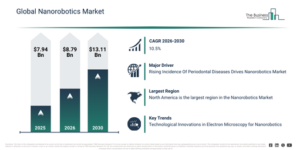
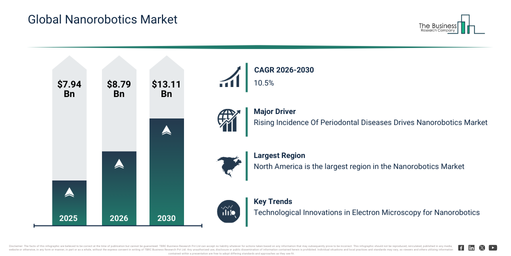
The nanorobotics market has witnessed rapid growth in its size over recent years. Projections indicate a growth from $7.94 billion in 2025 to $8.79 billion in 2026 for this market, with a compound annual growth rate (CAGR) of 10.7%. Factors contributing to its historical growth include breakthroughs in nanotechnology research, the nascent stages of electron microscopy tool development, an increase in biomedical research funding, a growing need for medical solutions that are minimally invasive, and developments in molecular biology.
The nanorobotics market is projected to experience swift expansion in the coming years. Its valuation is set to reach $13.11 billion by 2030, demonstrating a compound annual growth rate (CAGR) of 10.5%. This anticipated growth is driven by factors such as a growing need for precision medicine, increased investment into nanomedicine research, developments in AI-powered nanosystems, the expansion of targeted cancer treatments, and increased cooperation between academic institutions and industry. Key trends expected during this period involve enhancements in bionanorobotic design, a heightened emphasis on precise drug delivery, the incorporation of nanorobots with imaging technologies, the proliferation of magnetically guided nanorobots, and the creation of autonomous nanoscale robots.
Get A Free Sample Report With In-Depth Market Insights:
Nanorobotics Market Growth Factors: What’s Supporting Expansion?
The increasing occurrence of periodontal diseases is anticipated to boost the nanorobotics market. These diseases involve infections and inflammation affecting the gums and bones that support and surround teeth. Expanding interest in nanotechnology’s dental uses has fostered the emergence of Nano dentistry. Efforts are underway to create dental nanorobots, guided by computers, capable of eradicating agents that cause caries or mending tooth imperfections where decay begins. For example, as reported in March 2025 by the World Health Organization (WHO), a Switzerland-based international public health agency, nearly 3.7 billion people globally suffered from oral diseases, with periodontal diseases ranking among the most prevalent oral conditions. Consequently, the growing prevalence of periodontal diseases is stimulating the expansion of the nanorobotics market.
Nanorobotics Market Driver: Rising Focus On Regenerative Medicine Drives The Nanorobotics Market
An increased emphasis on regenerative medicine is predicted to stimulate the nanorobotics market’s expansion. This interdisciplinary medical field concentrates on creating novel treatments and methods to mend, substitute, or restore compromised or damaged cells, tissues, and organs in humans. Leveraging the capabilities of nanorobotics, scientists and medical professionals are furthering the creation of cutting-edge regenerative therapies, which present significant opportunities for tissue repair and regeneration, thereby boosting market growth. For example, a report from June 2024 by Centre for Commercialization of Regenerative Medicine (CCRM), a Canada-based nonprofit specializing in regenerative medicine, indicated a global count of 2,848 cell and gene therapy (CGT) developers, representing an 11% rise since Q4 2023. Consequently, the heightened focus on regenerative medicine is fueling the growth of the nanorobotics market.
Nanorobotics Market Segment Analysis Spotlighting Growth Areas
The nanorobotics market covered in this report is segmented –
1) By Type: Nanomanipulator, Bio-Nanorobotics, Magnetically Guided, Bacteria-Based
2) By Operation Mode: Self-driven, Remote Controlled
3) By Application: Nanomedicine, Biomedical, Mechanical, Other Applications
Subsegments:
1) By Nanomanipulator: Mechanical Nanomanipulators, Optical Nanomanipulators, Electrostatic Nanomanipulators
2) By Bio-Nanorobotics: DNA-Based Nanorobots, Protein-Based Nanorobots, Cellular Nanorobots
3) By Magnetically Guided: Magnetic Nanoparticle-Based Systems, Magnetic Field-Controlled Delivery Systems
4) By Bacteria-Based: Engineered Bacteria Nanorobots, Motile Bacteria For Drug Delivery, Bacterial Swimmers For Targeted Therapy
Nanorobotics Market Trends Shaping Long-Term Demand
Key companies in the nanorobotics market are developing technologically advanced solutions, such as electron microscopes, to achieve significantly higher resolution. Electron microscopes function as powerful imaging tools, employing a beam of electrons to generate high-resolution images of samples at microscopic and nanoscale levels, thereby facilitating detailed observation of their internal structures and surfaces. For instance, in May 2024, Hitachi High-Tech Corporation, a Japan-based electronics company, introduced the SU3900SE and SU3800SE High-Resolution Schottky Scanning Electron Microscopes. These microscopes enable highly accurate and efficient observation of large and heavy specimens at the nanoscale. The SU3900SE specimen stage specifically allows operators to examine heavy specimens weighing up to 5 kg. This stage is notably the largest among Hitachi High-Tech’s scanning electron microscope (SEM) models, accommodating specimens up to 300 mm in diameter and 130 mm in height, which is approximately 1.5 times larger than its SU5000 predecessor. This enhanced capability reduces the necessity for additional specimen preparations, such as cutting, consequently improving overall process efficiency. Furthermore, a 5-axis motorized stage (X, Y, Z, tilt, and rotation) is used to manipulate the specimen.
Nanorobotics Market Leading Companies: Who Holds The Strongest Market Presence?
Major companies operating in the nanorobotics market are Ginkgo Bioworks, Imina Technologies SA, Thermo Fisher Scientific Inc., Klocke Nanotechnik GmbH, Oxford Instruments plc, Bruker Corporation, JEOL Ltd., Nanonics Imaging Ltd., Toronto Nano Instrumentation Inc., Nanosurf AG, Nanotec Electronica S.L., SmarAct GmbH, Novascan Technologies, Hummingbird Scientific, Agilent Technologies Inc., Park Systems, Angstrom Advanced Inc., NT-MDT Spectrum Instruments, Zyvex Labs LLC, Nanobiotix, Nanospectra Biosciences Inc.
View The Full Nanorobotics Market Report:
Nanorobotics Market Regional Split: Which Areas Are Fueling Growth?
North America was the largest region in the nanorobotics market in 2025. Asia-Pacific is expected to be the fastest-growing region in the forecast period. The regions covered in the nanorobotics market report are Asia-Pacific, South East Asia, Western Europe, Eastern Europe, North America, South America, Middle East, Africa
Reach Out To Our Team:
The Business Research Company: https://www.thebusinessresearchcompany.com/
Americas: +1 310-496-7795
Asia: +44 7882 955267 & +91 8897263534
Europe: +44 7882 955267
Email us at: marketing@tbrc.info
Follow us on:
LinkedIn: https://in.linkedin.com/company/the-business-research-company
YouTube: https://www.youtube.com/channel/UC24_fI0rV8cR5DxlCpgmyFQ
Global Market Model: https://www.thebusinessresearchcompany.com/global-market-model

Wasay has over a decade of experience in market research, data modelling, and analytics, with prior experience at GlobalData and Decision Tree Consulting Services. At The Business Research Company , he leads research operations across syndicated studies, customized consulting engagements, and the Global Market Model platform. His professional experience includes supporting organizations such as Boston Consulting Group, KPMG, and Ernst & Young. Wasay holds a degree in Electronics and Communications Engineering, postgraduate management qualifications from International Management Institute Belgium and Indian School of Business and Entrepreneurship, and completed the Integrated Program in Business Analytics from Indian Institute of Management Indore.