Built to provide research that’s more actionable and strategically valuable, The Business Research Company’s 2026 market reports include market attractiveness analysis, total addressable market sizing, company benchmarking matrices, interactive Excel dashboards, broader supply chain intelligence, emerging startup tracking, and in-depth product insights.
Next-Generation Robotics In Automotive Manufacturing Market Poised To Hit $24.87 Billion By 2030 With A 14.3% CAGR
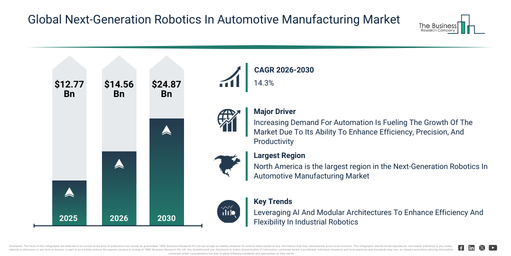
The market for next-generation robotics in automotive manufacturing has experienced rapid expansion in recent years. It is anticipated to increase from $12.77 billion in 2025 to $14.56 billion in 2026, achieving a compound annual growth rate (CAGR) of 14.1%. Historically, this market’s expansion can be linked to factors such as rising automotive production volumes, the need for precision in welding and painting, escalating labor costs within manufacturing hubs, an emphasis on minimizing production defects, and the initial integration of industrial automation into automotive facilities.
The market size for next-generation robotics in automotive manufacturing is expected to experience rapid expansion over the next few years. It is forecast to grow to $24.87 billion in 2030, achieving a compound annual growth rate (CAGR) of 14.3%. This growth during the projection period can be attributed to the rise of electric vehicle manufacturing lines, the demand for flexible production systems for multiple vehicle models, advancements in AI-enabled vision systems, an increased focus on worker safety and the deployment of cobots, and the need for smart factories with real-time data monitoring. Major trends identified for the forecast period include human-robot collaborative workcells on assembly lines, flexible robotic platforms for multi-model vehicle production, the integration of vision-based robotic quality inspection, modular robotic cells enabling rapid line reconfiguration, and the adoption of robotics to reduce labor dependency and errors.
Get A Free Sample Report With In-Depth Market Insights:
Next-Generation Robotics In Automotive Manufacturing Market Expansion Drivers: What’s Shaping Future Growth?
The escalating demand for automation is projected to foster the expansion of next-generation robotics within the automotive manufacturing market moving forward. Automation signifies the application of technology, machinery, or software to execute tasks with minimal human participation, thereby improving operational efficiency, precision, and consistency. The surge in the need for automation arises from the pursuit of greater productivity and cost-effectiveness, compelling various industries to swap manual methods with automated systems to streamline processes and reduce mistakes. Next-generation robotics in automotive manufacturing facilitates automation by enabling highly precise, adaptable, and rapid production techniques that enhance efficiency, quality oversight, and scalability in vehicle manufacturing. For example, in October 2025, the Pew Research Center, a US-based nonpartisan fact tank, stated that over 21% of U.S. workers reported that at least some of their job functions were completed with artificial intelligence (AI) in 2023, an increase from 16% in the previous year. Consequently, the growing demand for automation is driving the progress of next-generation robotics in the automotive manufacturing market.
Next-Generation Robotics In Automotive Manufacturing Market Segment Trends And Revenue Contributors
The next-generation robotics in automotive manufacturing market covered in this report is segmented –
1) By Robot Type: Articulated Robots, Selective Compliance Assembly Robot Arm Robots, Cartesian Robots, Collaborative Robots, Autonomous Mobile Robots
2) By Component: Hardware, Software, Services
3) By Vehicle Type: Passenger Vehicles, Commercial Vehicles, Electric Vehicles
4) By Application: Welding And Soldering, Painting And Coating, Assembly And Disassembly, Material Handling And Packaging, Inspection And Quality Control
5) By End User: Original Equipment Manufacturer (OEM) Manufacturers, Tier-1 Suppliers, Contract Assemblers
Subsegments:
1) By Articulated Robots: Six Axis Robots, Five Axis Robots, Three Axis Robots
2) By Selective Compliance Assembly Robot Arm Robots: Two Finger Grippers, Three Finger Grippers, Vacuum Grippers
3) By Cartesian Robots: Gantry Robots, Linear Robots, Portal Robots
4) By Collaborative Robots: Palletizing Robots, Assembly Robots, Inspection Robots
5) By Autonomous Mobile Robots: Automated Guided Vehicles, Driverless Transport Vehicles, Indoor Delivery Robots
Next-Generation Robotics In Automotive Manufacturing Market Strategic Trends: What Defines The Next Growth Phase?
Major companies in the next-generation robotics market are prioritizing the development of advanced control platforms to elevate automation, precision, and efficiency in manufacturing operations. These platforms incorporate artificial intelligence, sensors, and modular software architectures, enabling faster, more autonomous, and energy-efficient processes. For instance, in June 2024, ABB Ltd., a Switzerland-based industrial robotics company, introduced OmniCore, its next-generation robotics control platform, which originated from a $170 million strategic investment. This platform, crafted to empower automation across diverse industries, integrates ABB’s full spectrum of hardware and software, enhancing motion accuracy to less than 0.6 mm, allowing multiple robots to operate at high speeds, and supporting applications such as automotive press tending, arc welding, and laser cutting, thereby fostering increased productivity and flexibility in next-generation robotics deployment.
Next-Generation Robotics In Automotive Manufacturing Market Company Landscape And Competitive Strategy
Major companies operating in the next-generation robotics in automotive manufacturing market are NVIDIA Corporation, Panasonic Welding Systems Co. Ltd., Denso Robotics, Mitsubishi Electric Corporation, ABB Ltd., Yamaha Motor Co. Ltd., Kawasaki Heavy Industries Ltd., Epson America Inc., Rockwell Automation Inc, Omron Adept Technologies Inc., FANUC America Corporation, Dürr AG, KUKA AG, Yaskawa America Inc., Stäubli International AG, Nachi-Fujikoshi Corp., Comau S.p.A., Cognex Corporation, Harmonic Drive Systems Inc., Universal Robots A/S, Boston Dynamics Inc, AubO Robotics, HD Hyundai Robotics,
View The Full Next-Generation Robotics In Automotive Manufacturing Market Report:
Next-Generation Robotics In Automotive Manufacturing Market Largest Region: Which Geography Holds The Biggest Share?
North America was the largest region in the next-generation robotics in automotive manufacturing market in 2025. Asia-Pacific is expected to be the fastest-growing region in the forecast period. The regions covered in the next-generation robotics in automotive manufacturing market report are Asia-Pacific, South East Asia, Western Europe, Eastern Europe, North America, South America, Middle East, Africa.
Reach Out To Our Team:
The Business Research Company: https://www.thebusinessresearchcompany.com/
Americas: +1 310-496-7795
Asia: +44 7882 955267 & +91 8897263534
Europe: +44 7882 955267
Email us at: marketing@tbrc.info
Follow us on:
LinkedIn: https://in.linkedin.com/company/the-business-research-company
YouTube: https://www.youtube.com/channel/UC24_fI0rV8cR5DxlCpgmyFQ
Global Market Model: https://www.thebusinessresearchcompany.com/global-market-model

Wasay has over a decade of experience in market research, data modelling, and analytics, with prior experience at GlobalData and Decision Tree Consulting Services. At The Business Research Company , he leads research operations across syndicated studies, customized consulting engagements, and the Global Market Model platform. His professional experience includes supporting organizations such as Boston Consulting Group, KPMG, and Ernst & Young. Wasay holds a degree in Electronics and Communications Engineering, postgraduate management qualifications from International Management Institute Belgium and Indian School of Business and Entrepreneurship, and completed the Integrated Program in Business Analytics from Indian Institute of Management Indore.