Designed to make market research more actionable and strategically valuable, The Business Research Company’s 2026 market reports feature market attractiveness scoring, total addressable market sizing, company benchmarking matrices, interactive Excel dashboards, deeper supply chain intelligence, emerging startup tracking, and granular product-level insights.
How Big Is The Oil And Gas Sensors Market In 2026, And How Fast Will It Grow?
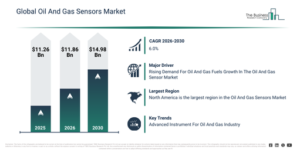
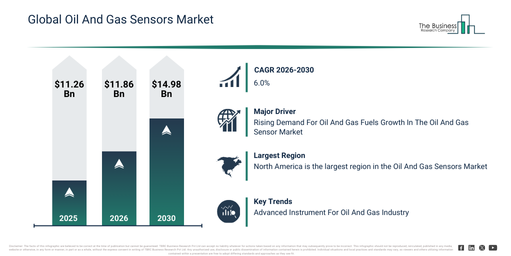
The oil and gas sensors market has experienced robust expansion in recent years. Its value is projected to climb from $11.26 billion in 2025 to $11.86 billion in 2026, exhibiting a compound annual growth rate (CAGR) of 5.3%. This historical growth can be attributed to several factors, including heightened oil and gas exploration activities, the expansion of pipeline infrastructure, the critical need for process safety monitoring, the adoption of automation within production facilities, and an increase in offshore drilling operations.
The oil and gas sensors market is projected to experience substantial growth over the coming years. This market is forecast to expand to $14.98 billion by 2030, demonstrating a compound annual growth rate (CAGR) of 6.0%. This anticipated growth is driven by factors such as more stringent environmental and safety regulations, the push for digital oilfield initiatives, the expansion of LNG infrastructure, increasing demand for predictive maintenance solutions, and greater investment in midstream monitoring. Key trends emerging during this forecast period involve the increased use of remote monitoring sensors, wider adoption of wireless sensor networks, a heightened emphasis on leak detection and safety surveillance, the proliferation of condition-based maintenance systems, and a greater need for highly accurate and durable sensors.
Download A Free Oil And Gas Sensors Market Sample Report With Size And Forecast Data:
Oil And Gas Sensors Market Growth Driver: The Key Factor Behind Rising Demand
The rising need for oil and gas is anticipated to fuel the expansion of the oil and gas sensor market in the future. As crucial natural resources, oil and gas are vital for energy generation and various industrial uses. By identifying the existence and levels of diverse dangerous gases and vapors, oil and gas sensors facilitate secure and efficient industrial operations. Consequently, this escalating demand for oil and gas is fostering the expansion of the oil and gas sensors market.
Oil And Gas Sensors Market Segmentation: Key Segments And Subsegments Covered
The oil and gas sensors market covered in this report is segmented –
1) By Type: Gas Sensor, Ultrasonic Sensor, Pressure Sensor, Temperature Sensor, Flow Sensor, Level Sensor, Other Types
2) By Connectivity: Wired, Wireless
3) By Sector: Upstream, Midstream, Downstream
4) By Application: Remote Monitoring, Condition Monitoring, Analysis And Simulation
Subsegments:
1) By Gas Sensor: Infrared Gas Sensors, Electrochemical Gas Sensors, Catalytic Gas Sensors
2) By Ultrasonic Sensor: Ultrasonic Level Sensors, Ultrasonic Flow Sensors, Ultrasonic Thickness Gauges
3) By Pressure Sensor: Absolute Pressure Sensors, Gauge Pressure Sensors, Differential Pressure Sensors
4) By Temperature Sensor: Thermocouples, RTDs (Resistance Temperature Detectors), Infrared Temperature Sensors
5) By Flow Sensor: Coriolis Flow Meters, Turbine Flow Meters, Magnetic Flow Meters
6) By Level Sensor: Capacitive Level Sensors, Optical Level Sensors, Radar Level Sensors
7) By Other Types: Vibration Sensors, Acoustic Sensors, PH Sensors
Oil And Gas Sensors Market Trends: Key Developments Shaping 2026 And Beyond
Key players in the oil and gas sensors market are prioritizing the development of sophisticated instruments that incorporate IoT technology, such as IoT-enabled sensors, for use in the oil and gas industry to enhance their market revenues. IoT-enabled sensors are devices embedded with Internet of Things capabilities for collecting and transmitting data across various applications.
Leading Companies Operating In The Oil And Gas Sensors Market
Major companies operating in the oil and gas sensors market are Robert Bosch GmbH, Siemens AG, General Electric Company, Honeywell International Inc., ABB Ltd., Emerson Electric Co., TE Connectivity Ltd., Rockwell Automation Inc., Fortive Corp., BD Technologies, Indutrade AB, Lord Corporation, Stellar Technology Solutions LLC, Cubic Sensor and Instrument Co. Ltd., BEI Sensors SAS, 3M Gas And Flame Detection, AlphaSense Inc., OpSens Solutions Inc., RKI Instruments Inc., SGX Sensortech Limited, Nemoto & Co. Ltd., Control Instruments Corp., Oxsensis Ltd., Membrapor AG, Nevada Nanotech Systems Inc., Temposonics GmbH & Co. KG, Thermometrics Corporation
Access The Full Oil And Gas Sensors Market Research Report:
Oil And Gas Sensors Market Regional Analysis: Largest Region And Key Geographies Covered
North America was the largest region in the oil and gas sensors market in 2025. Asia-Pacific is expected to be the fastest-growing region in the forecast period. The regions covered in the oil and gas sensors market report are Asia-Pacific, South East Asia, Western Europe, Eastern Europe, North America, South America, Middle East, Africa
Reach Out To Our Team:
The Business Research Company: https://www.thebusinessresearchcompany.com/
Americas: +1 310-496-7795
Asia: +44 7882 955267 & +91 8897263534
Europe: +44 7882 955267
Email us at: marketing@tbrc.info
Follow us on:
LinkedIn: https://in.linkedin.com/company/the-business-research-company
YouTube: https://www.youtube.com/channel/UC24_fI0rV8cR5DxlCpgmyFQ
Global Market Model: https://www.thebusinessresearchcompany.com/global-market-model

Wasay has over a decade of experience in market research, data modelling, and analytics, with prior experience at GlobalData and Decision Tree Consulting Services. At The Business Research Company , he leads research operations across syndicated studies, customized consulting engagements, and the Global Market Model platform. His professional experience includes supporting organizations such as Boston Consulting Group, KPMG, and Ernst & Young. Wasay holds a degree in Electronics and Communications Engineering, postgraduate management qualifications from International Management Institute Belgium and Indian School of Business and Entrepreneurship, and completed the Integrated Program in Business Analytics from Indian Institute of Management Indore.