Market attractiveness scoring, total addressable market sizing, company benchmarking matrices, interactive Excel dashboards, deeper supply chain intelligence, emerging startup tracking, and granular product-level insights are among the key offerings featured in The Business Research Company’s 2026 market reports, designed to deliver more actionable and strategically valuable research.
Optical Sorter Market Size Overview: From Historical Performance To The 2030 Forecast
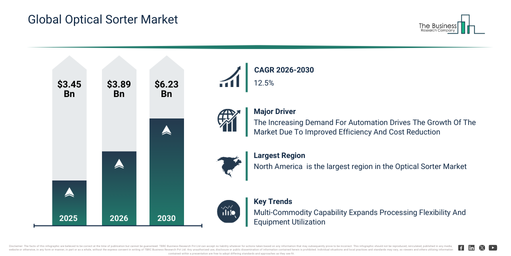
The optical sorter market has experienced swift expansion in recent years. Its value is expected to rise from $3.45 billion in 2025 to $3.89 billion in 2026, reflecting a compound annual growth rate (CAGR) of 12.8%. This historical growth can be primarily linked to factors such as the inefficiencies of manual sorting, an increase in recycling initiatives, the rising demand for quality in food processing, pressures related to labor costs, and the broader adoption of industrial automation.
The optical sorter market size is anticipated to experience substantial growth over the next few years, with projections indicating it will expand to $6.23 billion by 2030, achieving a compound annual growth rate (CAGR) of 12.5%. This growth in the forecast period is driven by factors such as circular economy initiatives, stricter regulations for waste sorting, advancements in AI vision, the expansion of smart recycling plants, and the demand for contamination-free products. Prominent trends for this period include increasing automation in material sorting, greater adoption in recycling operations, the broader application of optical sorting in food processing, the integration of AI-based vision systems, and a rising need for high throughput sorting capabilities.
Get A Free Sample Of The Business Research Company’s Optical Sorter Market Report:
What Factor Is Increasing Demand In The Optical Sorter Market?
The escalating requirement for automation is projected to fuel the advancement of the optical sorter market moving forward. Automation refers to the application of technology, systems, or machines to carry out tasks with minimal or no human intervention, with the aim of boosting efficiency, accuracy, and productivity. The rising demand for automation is attributed to its capability to significantly reduce operational costs through improved efficiency, minimized errors, and optimized resource utilization. Optical sorters enhance automation by enabling swift, precise, and consistent sorting processes that diminish manual intervention and elevate overall operational efficiency. Thus, the increasing demand for automation is propelling the growth of the optical sorter market.
Which Segments Make Up The Optical Sorter Market?
The optical sorter market covered in this report is segmented –
1) By Type: Camera Sorter, Lasers Sorter, Near Infrared (NIR) Sorter, Hyperspectral Cameras And Combined Sorter, Other Types
2) By Platform: Hybrid Platform, Lane Platform, Freefall Platform, Belt Platform
3) By Application: Recycling, Food, Mining
4) By End-User: Food And Beverages, Waste Recycling, Mining, Pharmaceutical, Other End Users
Subsegments:
1) By Camera Sorter: Monochromatic Cameras, Red Green Blue (RGB) Cameras, Line-Scan Cameras, Area-Scan Cameras
2) By Lasers Sorter: Visible Spectrum Lasers, Ultraviolet (UV) Lasers, Infrared (IR) Lasers, Multi-Wavelength Lasers
3) By Near Infrared (NIR) Sorter: Short-Wave Infrared (SWIR), Medium-Wave Infrared (MWIR), Long-Wave Infrared (LWIR)
4) By Hyperspectral Cameras And Combined Sorter: Hyperspectral Imaging Systems, Multispectral Imaging Systems, Combined Laser And Camera Systems, Combined Near Infrared (NIR) And Hyperspectral Systems
5) By Other Types: X-Ray Sorters, Metal Detectors With Optical Integration, Ultraviolet (UV) Sorters
Optical Sorter Market Emerging Trends: What Are Industry Leaders Focusing On?
Leading companies in the optical sorter market are concentrating on developing advanced solutions, such as multi-commodity processing, to enable processors to handle diverse product types on a single platform. This approach benefits the optical sorter by expanding the addressable customer base, as one machine can sort multiple products like grains, pulses, nuts, and spices. It further enhances return on investment for processors through increased equipment utilization, reducing the need for multiple dedicated machines, and lowering overall capital and operating costs.
Major Companies To Know In The Optical Sorter Market
Major companies operating in the optical sorter market are Allgaier Werke GmbH, Anzai Manufacturing Co. Ltd., Binder+Co AG, Bühler Group, CP Manufacturing Inc., Daewon GSI Co. Ltd., General Inspection LLC, GREEFA (Greenhouse Equipment Factory), Hefei Meyer Optoelectronic Technology Inc., Cimbria A/S, Hefei Taihe Optoelectronic Technology Co. Ltd., National Recovery Technologies LLC, Orange Sorting Machines (India) Pvt. Ltd., Pellenc Selective Technologies, PETKUS Technologie GmbH, Raytec Vision S.p.A., REDWAVE Solutions US LLC., Satake Corporation, STEINERT GmbH, TOMRA Systems ASA
Read The In-Depth Optical Sorter Market Report:
Optical Sorter Market Regional Landscape: Largest Region In 2025
North America was the largest region in the optical sorter market in 2025. Asia-Pacific is expected to be the fastest-growing region in the forecast period. The regions covered in the optical sorter market report are Asia-Pacific, South East Asia, Western Europe, Eastern Europe, North America, South America, Middle East, Africa
Reach Out To Our Team:
The Business Research Company: https://www.thebusinessresearchcompany.com/
Americas: +1 310-496-7795
Asia: +44 7882 955267 & +91 8897263534
Europe: +44 7882 955267
Email us at: marketing@tbrc.info
Follow us on:
LinkedIn: https://in.linkedin.com/company/the-business-research-company
YouTube: https://www.youtube.com/channel/UC24_fI0rV8cR5DxlCpgmyFQ
Global Market Model: https://www.thebusinessresearchcompany.com/global-market-model

Wasay has over a decade of experience in market research, data modelling, and analytics, with prior experience at GlobalData and Decision Tree Consulting Services. At The Business Research Company , he leads research operations across syndicated studies, customized consulting engagements, and the Global Market Model platform. His professional experience includes supporting organizations such as Boston Consulting Group, KPMG, and Ernst & Young. Wasay holds a degree in Electronics and Communications Engineering, postgraduate management qualifications from International Management Institute Belgium and Indian School of Business and Entrepreneurship, and completed the Integrated Program in Business Analytics from Indian Institute of Management Indore.