Through market attractiveness analysis, total addressable market evaluation, company benchmarking matrices, interactive Excel dashboards, expanded supply chain intelligence, emerging startup coverage, and detailed product insights, The Business Research Company’s 2026 market reports provide more actionable and strategically valuable research.
Plant Factory Market Forecast: What Market Value Is Expected By 2030?
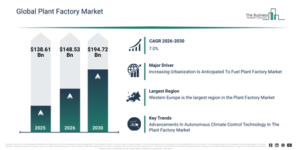
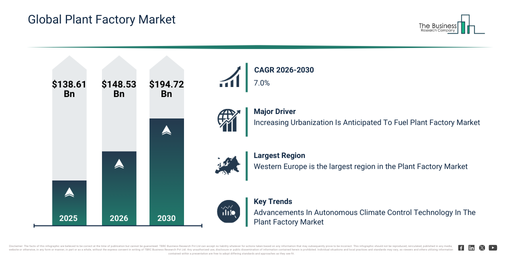
The plant factory market size has seen significant expansion in recent years. It is forecast to grow from $138.61 billion in 2025 to $148.53 billion in 2026, achieving a compound annual growth rate (CAGR) of 7.2%. The historical increase can be ascribed to elements such as urbanization leading to less arable land, the demand for consistent crop yields, climate variability impacting traditional farming, the early adoption of hydroponic systems, and the necessity for pesticide-free produce.
The plant factory market size is projected to experience substantial expansion in the coming years, with expectations to reach $194.72 billion by 2030, driven by a compound annual growth rate (CAGR) of 7.0%. This growth throughout the forecast period stems from factors such as increasing global food demand, the development of urban farming initiatives, technological progress in controlled environment systems, a heightened focus on food security, and investments in sustainable agriculture solutions. Significant trends foreseen during this period include the wider adoption of fully controlled environment agriculture, the increasing deployment of vertical and indoor farming systems, greater reliance on artificial lighting for continuous year-round production, the broadening of high-density crop cultivation models, and a strong emphasis on resource-efficient food production methods.
Download A Free Sample Report For Comprehensive Market Insights:
#Plant Factory Market Growth Factors: Which Forces Are Supporting Market Expansion?
Growing urbanization is anticipated to propel the plant factory market going forward. Urbanization is defined as the process where rural areas transition into urban ones due to economic development and industrialization. This rise in urbanization is primarily linked to increasing industrialization, as the growth of industries creates more job opportunities in cities, attracting people from rural areas seeking employment and improved living standards. Plant factories enable urban areas to produce fresh crops locally, which reduces transportation costs and addresses food security concerns. For instance, in April 2023, the US-based World Bank Group reported that currently, more than half of the global population resides in urban regions. By 2045, this urban population is projected to surge to 6 billion, marking a 1.5 times increase. Therefore, increasing urbanization is driving the plant factory market.
#Plant Factory Market Segment Landscape And Growth Potential
The plant factory market covered in this report is segmented –
1) By Facility Type: Greenhouse, Indoor Farms
2) By Light Type: Sunlight, Full Artificial Light
3) By Growing System: Non-Soil-Based, Soil-Based, Hybrid
4) By Crop type: Fruits, Vegetables, Flower And Ornamental, Other Crop Types
Subsegments:
1) By Greenhouse: Hydroponic Greenhouses, Aeroponic Greenhouses, Soil-Based Greenhouses
2) By Indoor Farms: Vertical Farms, Container Farms, Controlled Environment Agriculture (CEA) Systems
#Plant Factory Market Trends Influencing Long-Term Demand
Major companies within the plant factory market are engaged in the development of autonomous climate control technology. This technology encompasses self-regulating systems designed to maintain optimal environmental conditions, such as temperature and humidity, without human involvement. For example, in June 2023, IUNU, a US-based firm specializing in horticultural technology, unveiled a new autonomous climate control solution named Intelligent Setpoint Control for LUNA AI. This closed-loop system for automated temperature management in horticulture cross-references actual, meticulously collected data with climatic data, and then compares that data against experiments conducted on real plants and within virtual simulations. Employing computer vision, the system takes agricultural strategy into account and effectively puts the plant in charge of its environment.
Plant Factory Market Competitive Landscape: Who Are The Leading Companies?
Major companies operating in the plant factory market are AeroFarms LLC, BrightFarms Inc., Gotham Greens Holdings LLC, Bowery Farming Inc., AppHarvest Inc., Lufa Farms, Beijing IEDA Protected Horticulture Co. Ltd., Green Sense Farms Holdings Inc., Plenty Unlimited Inc., Mirai Co. Ltd., Farminova Plant Factory, Urban Crops Solutions, Sky Greens, Kalera Inc., TruLeaf Sustainable Agriculture, Wulian, Crop One Holdings Inc., Vertical Harvest Farms, Heliospectra AB, Infarm GmbH, Intelligent Growth Solutions, LettuceGrow, Light Science Technologies, MechaFarm, Phytoponics, SmartFarm Systems, Vertical Greens
Access The Complete Plant Factory Market Report:
Plant Factory Market Regional Distribution: Which Areas Drive Market Expansion?
Western Europe was the largest region in the plant factory market in 2025. The regions covered in the plant factory market report are Asia-Pacific, South East Asia, Western Europe, Eastern Europe, North America, South America, Middle East, Africa
Get in touch with us:
The Business Research Company: https://www.thebusinessresearchcompany.com/
Americas: +1 310-496-7795
Asia: +44 7882 955267 & +91 8897263534
Europe: +44 7882 955267
Email us at: marketing@tbrc.info
Follow us on:
LinkedIn: https://in.linkedin.com/company/the-business-research-company
YouTube: https://www.youtube.com/channel/UC24_fI0rV8cR5DxlCpgmyFQ
Global Market Model: https://www.thebusinessresearchcompany.com/global-market-model

Wasay has over a decade of experience in market research, data modelling, and analytics, with prior experience at GlobalData and Decision Tree Consulting Services. At The Business Research Company , he leads research operations across syndicated studies, customized consulting engagements, and the Global Market Model platform. His professional experience includes supporting organizations such as Boston Consulting Group, KPMG, and Ernst & Young. Wasay holds a degree in Electronics and Communications Engineering, postgraduate management qualifications from International Management Institute Belgium and Indian School of Business and Entrepreneurship, and completed the Integrated Program in Business Analytics from Indian Institute of Management Indore.