Through market attractiveness analysis, total addressable market evaluation, company benchmarking matrices, interactive Excel dashboards, expanded supply chain intelligence, emerging startup coverage, and detailed product insights, The Business Research Company’s 2026 market reports provide more actionable and strategically valuable research.
Protein Analyzer Market Expansion Outlook: What Revenue Opportunities Lie Ahead?
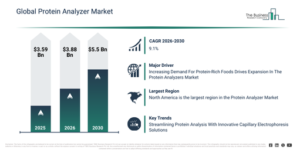
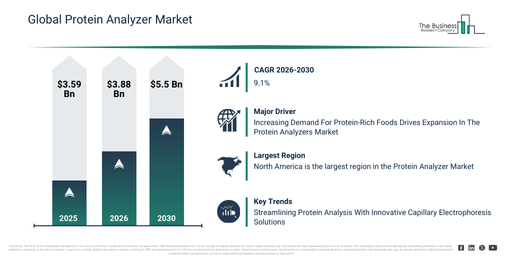
The protein analyzer market size has experienced significant growth in recent years. Looking ahead, it is projected to expand from $3.59 billion in 2025 to $3.88 billion in 2026, at a compound annual growth rate (CAGR) of 8.2%. The historical growth of this market can be linked to the growth in biochemical research activities, the expansion of food and feed testing laboratories, the adoption of kjeldahl and dumas methods, increasing protein consumption analysis needs, and the development of laboratory analytical instruments.
The protein analyzer market is projected to experience substantial growth in the coming years, reaching a valuation of $5.5 billion by 2030, driven by a compound annual growth rate (CAGR) of 9.1%. This anticipated expansion during the forecast period is fueled by several factors, including an increase in biotechnology and life sciences research, a surge in demand for protein-enriched food products, the broadening of pharmaceutical research and development activities, the integration of swift and automated testing methodologies, and a heightened emphasis on food safety and quality regulations. Key trends expected during this period involve the increasing embrace of automated protein analysis systems, the expanding application of protein analyzers in assessing food quality, a rising need for precise and quick protein quantification, the wider availability of portable and benchtop protein analyzers, and the incorporation of sophisticated spectroscopic and chromatographic techniques.
Download A Free Sample Report For Comprehensive Market Insights:
Protein Analyzer Market Growth Factors Supporting Long-Term Expansion
The increasing need for protein-rich foods is anticipated to fuel the expansion of the protein analyzers market moving forward. These foods encompass dairy items, nuts and seeds, various meats like beef, and other food products containing substantial protein, an essential component for human health. Protein analyzers are primarily utilized in food and beverage laboratories, as well as restaurants, to assess the protein content and overall nutritional worth of items such as meat, milk, and eggs. For example, a report released by the Food and Agriculture Organization, an Italy-based specialized agency, indicated in 2024 that by 2033, the consumption of protein-rich foods like poultry, pig meat, beef, and sheep meat is projected to rise by 16%, 8%, 11%, and 16%, respectively. Furthermore, per capita meat consumption is forecast to increase by 2% within the same timeframe. Consequently, the heightened demand for protein-rich diets is a key factor propelling the expansion of the protein analyzer market.
Protein Analyzer Market Segment Breakdown: Which Categories Generate The Most Revenue?
The protein analyzer market covered in this report is segmented –
1) By Analyzer Type: Automated Protein Analyzers, Semi-Automated Protein Analyzers, Manual Or Standalone Protein Analysis Instruments, High-Throughput Protein Analyzers
2) By Analytical Technique: Chromatography-Based Protein Analyzers, Electrophoresis-Based Protein Analyzers, Spectroscopy-Based Protein Analyzers, Mass Spectrometry-Based Protein Analyzers, Light Scattering And Particle-Based Protein Analyzers
3) By Mode of Operation: Benchtop Protein Analyzers, Floor-Standing Protein Analyzers, Integrated Or Modular Protein Analysis Systems
4) By Application: Biochemistry Research, Molecular Biology Research, Proteomics, Biopharmaceutical Development And Quality Control, Clinical And Diagnostic Research
5) By End User: Academic And Research Institutes, Biopharmaceutical And Biotechnology Companies, Clinical Research Laboratories, Contract Research Organizations (CROs), Government And Regulatory Laboratories
Subsegments:
1) By Automated Protein Analyzers: Fully Automated Protein Quantification Systems, Automated Chromatography-Based Protein Analyzers, Automated Electrophoresis-Based Protein Analyzers, Integrated Multi-Parameter Protein Analysis Systems
2) By Semi-Automated Protein Analyzers: Manual Sample-Loading Protein Analyzers, Semi-Automated Chromatography Protein Systems, Semi-Automated Electrophoresis Protein Analyzers
3) By Manual Or Standalone Protein Analysis Instruments: Standalone UV-Visible Protein Analyzers, Gel Electrophoresis & Protein Imaging Systems, Standalone Light-Scattering Protein Analyzers
4) By High-Throughput Protein Analyzers: Multi-Sample Parallel Protein Analysis Systems, Automated Plate-Based Protein Analyzers, Robotic-Integrated High-Throughput Protein Analysis Platforms
Protein Analyzer Market Strategic Trends: What Is Defining The Next Phase Of Growth?
Leading companies within the protein analyzers market are concentrating on developing technologically advanced solutions, exemplified by the agilent proteoAnalyzer system, to enhance the accuracy and efficiency of protein analysis. The Agilent ProteoAnalyzer system serves as an innovative automated parallel capillary electrophoresis platform aimed at boosting protein analysis efficiency. For instance, in January 2024, Agilent Technologies, a US-based company offering a broad array of instruments, software, services, and consumables, introduced the agilent proteoAnalyzer system. This Agilent ProteoAnalyzer system is a sophisticated automated parallel capillary electrophoresis platform engineered for effective protein analysis, with the capacity to process up to 12 samples simultaneously in about 30 minutes. By utilizing capillary electrophoresis with sodium dodecyl sulfate (CE-SDS), it adeptly separates proteins varying from 10 to 240 kDa, making it highly suitable for the examination of monoclonal antibodies, biosimilars, and crude cell lysates.
Protein Analyzer Market Key Players And Strategic Industry Positioning
Major companies operating in the protein analyzer market are Thermo Fisher Scientific Inc., Agilent Technologies, Inc., Bruker Corporation, Shimadzu Corporation, PerkinElmer, Inc., Waters Corporation, Danaher Corporation (including Cytiva and SCIEX protein analysis platforms), Bio-Rad Laboratories, Inc., GE HealthCare Technologies Inc., Sartorius Aktiengesellschaft, Merck KGaA, Revvity, Inc., LECO Corporation, Elementar Analysensysteme GmbH, CEM Corporation, Malvern Panalytical Ltd., Advanced Analytical Technologies, Inc., ProteinSimple, Analytik Jena GmbH, HORIBA, Ltd., Sepax Technologies, Inc., Tosoh Bioscience GmbH
Access The Complete Protein Analyzer Market Report:
Protein Analyzer Market Geographic Analysis: Where Is Demand Growing The Fastest?
North America was the largest region in the protein analyzers market in 2025. Asia-Pacific is expected to be the fastest-growing region in the global protein analyzers market report during the forecast period. The regions covered in the protein analyzer market report are Asia-Pacific, South East Asia, Western Europe, Eastern Europe, North America, South America, Middle East, Africa
Get in touch with us:
The Business Research Company: https://www.thebusinessresearchcompany.com/
Americas: +1 310-496-7795
Asia: +44 7882 955267 & +91 8897263534
Europe: +44 7882 955267
Email us at: marketing@tbrc.info
Follow us on:
LinkedIn: https://in.linkedin.com/company/the-business-research-company
YouTube: https://www.youtube.com/channel/UC24_fI0rV8cR5DxlCpgmyFQ
Global Market Model: https://www.thebusinessresearchcompany.com/global-market-model

Wasay has over a decade of experience in market research, data modelling, and analytics, with prior experience at GlobalData and Decision Tree Consulting Services. At The Business Research Company , he leads research operations across syndicated studies, customized consulting engagements, and the Global Market Model platform. His professional experience includes supporting organizations such as Boston Consulting Group, KPMG, and Ernst & Young. Wasay holds a degree in Electronics and Communications Engineering, postgraduate management qualifications from International Management Institute Belgium and Indian School of Business and Entrepreneurship, and completed the Integrated Program in Business Analytics from Indian Institute of Management Indore.