Market attractiveness scoring, total addressable market sizing, company benchmarking matrices, interactive Excel dashboards, deeper supply chain intelligence, emerging startup tracking, and granular product-level insights are among the key offerings featured in The Business Research Company’s 2026 market reports, designed to deliver more actionable and strategically valuable research.
What Is The Radiometric Dating Machine Market Size In 2026, And Where Is It Heading By 2030?
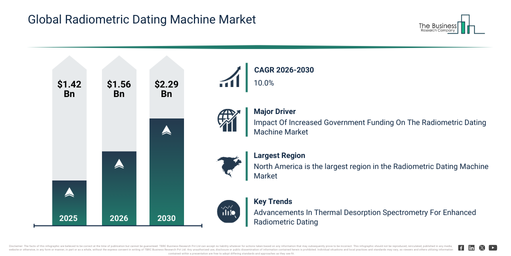
The radiometric dating machine market has experienced significant expansion recently. Forecasts indicate that it will rise from $1.42 billion in 2025 to $1.56 billion in 2026, demonstrating a compound annual growth rate (CAGR) of 10.3%. Historically, this growth has been driven by factors such as geological research expansion, archaeological discoveries, nuclear research development, increased academic funding, and demand for environmental analysis.
The radiometric dating machine market is anticipated to experience substantial expansion over the coming years. This market is projected to reach $2.29 billion by 2030, exhibiting a compound annual growth rate (CAGR) of 10.0%. Key drivers for this growth during the forecast period include climate research initiatives, advancements in planetary science exploration, increased demand for advanced isotope analysis, significant government investments in research, and ongoing technology upgrades within laboratories. Prominent trends expected over the forecast period encompass improvements in mass spectrometry accuracy, the incorporation of automated sample processing, wider adoption of high sensitivity detectors, a broader application in multidisciplinary research, and the development of portable analytical systems.
Request Your Free Radiometric Dating Machine Market Sample With Segment And Regional Data:
Radiometric Dating Machine Market Growth Drivers And Their Impact On Future Demand
Future expansion of the radiometric dating machine market is anticipated due to a rise in government investment allocated for geological exploration. This funding refers to government financial aid designated for examining Earth’s geology, encompassing its structural features, resources, and constituent elements. The primary factor behind this enhanced government spending on geological exploration is the escalating need for crucial minerals and resources essential for technological progress, energy generation, and national economic stability. Such government support facilitates the utilization and refinement of radiometric dating machines, thereby fostering research and innovation and improving the accuracy and efficiency of dating geological samples. Consequently, the expanded government financial commitment to geological exploration is stimulating the growth within the radiometric dating machine market.
What Categories Define The Radiometric Dating Machine Market?
The radiometric dating machine market covered in this report is segmented –
1) By Type: Alpha Counting, Beta Counting, Gamma Counting, Mass Spectrometry
2) By Method: Radiocarbon Dating, Potassium-Argon Dating, Uranium-Lead System
3) By End-User: Archaeologists, Geologists, Paleontologists, Other End Users
Subsegments:
1) By Alpha Counting: Gas Flow Detectors, Solid-State Detectors, Scintillation Detectors
2) By Beta Counting: Liquid Scintillation Counters, Gas Proportional Counters, Plastic Scintillation Detectors
3) By Gamma Counting: NaI(Tl) Scintillation Detectors, High-Purity Germanium Detectors
4) By Mass Spectrometry: Thermal Ionization Mass Spectrometry (TIMS), Inductively Coupled Plasma Mass Spectrometry (ICP-MS), Secondary Ion Mass Spectrometry (SIMS), Accelerator Mass Spectrometry (AMS)
What New Developments Are Emerging In The Radiometric Dating Machine Market?
Leading companies in radiometric dating machine operations are concentrating on developing advanced thermal desorption spectrometry systems. These systems aim to deliver more precise age determinations and offer enhanced insights into geological and archaeological samples. Thermal desorption spectrometry functions by heating materials to release volatile compounds, which are then analyzed using mass spectrometry.
Major Players Driving Competition In The Radiometric Dating Machine Market
Major companies operating in the radiometric dating machine market are Thermo Fisher Scientific Inc., Agilent Technologies Inc., Bruker Corporation, Shimadzu Corporation, JEOL Ltd., PerkinElmer Inc., Oxford Instruments plc, Rigaku Corporation, AMETEK Inc., ORTEC (Ametek brand but ORTEC itself is a company), IonPlus AG, IsotopX Ltd., Nu Instruments Ltd., Spectromat Massenspektrometer GmbH, Canberra Industries Inc., Kromek Group plc, Bertin Instruments, Radiation Monitoring Devices Inc., Ludlum Measurements Inc., Malvern Panalytical Ltd., Hitachi High-Tech Corporation, Horiba Ltd.
View The Comprehensive Radiometric Dating Machine Market Analysis:
Radiometric Dating Machine Market Regional Leaders: Insights From The 2026 Report
North America was the largest region in the radiometric dating machine market in 2025. The regions covered in the radiometric dating machine market report are Asia-Pacific, South East Asia, Western Europe, Eastern Europe, North America, South America, Middle East, Africa
Reach Out To Our Team:
The Business Research Company: https://www.thebusinessresearchcompany.com/
Americas: +1 310-496-7795
Asia: +44 7882 955267 & +91 8897263534
Europe: +44 7882 955267
Email us at: marketing@tbrc.info
Follow us on:
LinkedIn: https://in.linkedin.com/company/the-business-research-company
YouTube: https://www.youtube.com/channel/UC24_fI0rV8cR5DxlCpgmyFQ
Global Market Model: https://www.thebusinessresearchcompany.com/global-market-model

Wasay has over a decade of experience in market research, data modelling, and analytics, with prior experience at GlobalData and Decision Tree Consulting Services. At The Business Research Company , he leads research operations across syndicated studies, customized consulting engagements, and the Global Market Model platform. His professional experience includes supporting organizations such as Boston Consulting Group, KPMG, and Ernst & Young. Wasay holds a degree in Electronics and Communications Engineering, postgraduate management qualifications from International Management Institute Belgium and Indian School of Business and Entrepreneurship, and completed the Integrated Program in Business Analytics from Indian Institute of Management Indore.