The Business Research Company’s 2026 market reports combine market attractiveness scoring, total addressable market sizing, company benchmarking matrices, interactive Excel dashboards, deeper supply chain intelligence, emerging startup tracking, and granular product-level insights to deliver research that is more actionable and strategically valuable.
Robotic Lawn Mower Market Revenue Forecast: $3.56 Billion In 2026 Rising To $6.25 Billion In 2030
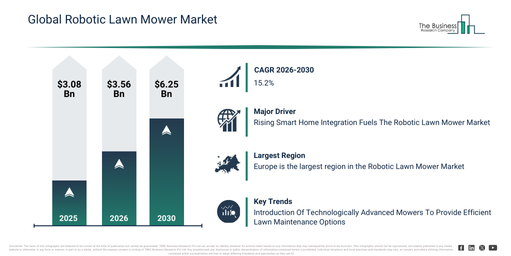
The robotic lawn mower market has experienced substantial growth in recent years. This market is projected to expand from $3.08 billion in 2025 to $3.56 billion in 2026, demonstrating a compound annual growth rate (CAGR) of 15.4%. Historically, this expansion has been driven by factors such as an increase in residential lawn ownership, escalating labor expenses for lawn care, the growing embrace of battery-powered garden tools, a consumer inclination towards convenience-focused appliances, and the early integration of automated mowing solutions.
The robotic lawn mower market is projected for significant expansion in the coming years. By 2030, its valuation is expected to reach $6.25 billion, propelled by a compound annual growth rate (CAGR) of 15.2%. This anticipated growth during the forecast period stems from several factors, including the proliferation of smart home ecosystems, an increasing call for environmentally friendly outdoor tools, progress in AI-driven navigation technologies, heightened uptake by commercial landscaping operations, and greater automation in sports facilities and golf courses. Key developments expected throughout this period involve a surge in fully autonomous lawn care systems, enhanced integration of intelligent navigation and obstacle avoidance features, a growing preference for quiet and emission-free lawn equipment, the widespread availability of app-managed and internet-connected robotic mowers, and an intensified emphasis on safety attributes and anti-theft mechanisms.
Free Sample Report: Robotic Lawn Mower Market Size, Trends And Forecast To 2030:
Robotic Lawn Mower Market Growth Catalyst: What Is Creating New Demand?
The expanding integration of smart homes is anticipated to advance the robotic lawn mower market. Smart home integration involves linking and coordinating various household devices and systems to allow for centralized management and automation via a unified interface. This growth in smart home integration is propelled by several elements, including heightened consumer awareness, increasing demand for home automation, and growing concerns regarding home security. When applied to robotic lawn mowers, smart home integration allows users to remotely manage and observe their lawn care through existing smart home systems, such as mobile phones or voice-activated assistants. These robotic devices come equipped with cellular or Wi-Fi connectivity, facilitating their integration with smart home devices for streamlined lawn maintenance tasks. Consequently, the rising integration of smart homes is a key factor propelling the robotic lawn mower market’s expansion.
Robotic Lawn Mower Market Segment Overview: Categories Covered In The 2026 Report
The robotic lawn mower market covered in this report is segmented –
1) By Lawn Area: Small Sized, Medium Sized, Large Sized
2) By Technology: Non-Smart, Smart
3) By Distribution Channel: Offline, Online
4) By End-User: Residential, Professional Landscaping Services, Sports Field And Golf Courses, Other End Users
Subsegments:
1) By Small-Sized: Up To 500 m², 501 m² To 1,000 m²
2) By Medium-Sized: 1,001 m² To 3,000 m²
3) By Large-Sized: 3,001 m² To 5,000 m²
How Are Leading Companies Shaping Robotic Lawn Mower Market Trends?
Major companies operating in the robotic lawn mower market are concentrating on delivering technologically advanced mowers, such as AI-based robotic lawn mowers, to gain a competitive advantage. AI-based robotic lawn mowers are described as robotic lawn mowing devices incorporating artificial intelligence (AI) capabilities, allowing them to autonomously navigate, adapt, and operate effectively across various lawn environments.
Robotic Lawn Mower Market Players: Key Companies Shaping Competition
Major companies operating in the robotic lawn mower market are Husqvarna Group, GARDENA Manufacturing GmbH, Zucchetti Centro Sistemi S.p.A., iRobot Corporation, STIGA S.p.A., AL-KO Geräte GmbH, Robomow Ltd., McCulloch Motors Corporation, Positec Tool Corporation, Kress Robotics Ltd., Kobi Company Ltd., Segway Inc., Mammotion Technology Co., Ltd., EcoFlow Technology Limited, Honda Motor Co., Ltd., SUMEC Machinery & Electric Co., Ltd., Greenworks Tools, Robert Bosch Power Tools GmbH, Cramer Tools GmbH, Sunseeker Robotics Co., Ltd.
Access Complete Robotic Lawn Mower Market Data, Forecasts And Competitive Insights:
Robotic Lawn Mower Market Regional Performance And Geographic Coverage
Europe was the largest region in the robotic lawn mower market in 2025. It is expected to be the fastest-growing region in the forecast period. The regions covered in the robotic lawn mower market report are Asia-Pacific, South East Asia, Western Europe, Eastern Europe, North America, South America, Middle East, Africa
Reach Out To Our Team:
The Business Research Company: https://www.thebusinessresearchcompany.com/
Americas: +1 310-496-7795
Asia: +44 7882 955267 & +91 8897263534
Europe: +44 7882 955267
Email us at: marketing@tbrc.info
Follow us on:
LinkedIn: https://in.linkedin.com/company/the-business-research-company
YouTube: https://www.youtube.com/channel/UC24_fI0rV8cR5DxlCpgmyFQ
Global Market Model: https://www.thebusinessresearchcompany.com/global-market-model

Wasay has over a decade of experience in market research, data modelling, and analytics, with prior experience at GlobalData and Decision Tree Consulting Services. At The Business Research Company , he leads research operations across syndicated studies, customized consulting engagements, and the Global Market Model platform. His professional experience includes supporting organizations such as Boston Consulting Group, KPMG, and Ernst & Young. Wasay holds a degree in Electronics and Communications Engineering, postgraduate management qualifications from International Management Institute Belgium and Indian School of Business and Entrepreneurship, and completed the Integrated Program in Business Analytics from Indian Institute of Management Indore.