Enhanced with market attractiveness analysis, total addressable market evaluation, company benchmarking matrices, interactive Excel dashboards, expanded supply chain intelligence, emerging startup coverage, and detailed product insights, The Business Research Company’s 2026 market reports deliver more actionable and strategically valuable research.
Selective Laser Melting Market Growth Potential: How Will Market Size Change Through 2030?
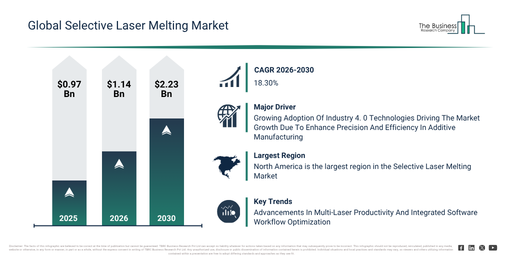
The market for selective laser melting has experienced swift expansion in recent years. Its valuation is projected to rise from $0.97 billion in 2025 to $1.14 billion in 2026, reflecting a compound annual growth rate (CAGR) of 18.0%. This historical growth has been driven by several factors, including the growing uptake of additive manufacturing for aerospace prototyping, a heightened demand for lightweight metal parts within the automotive industry, the initial advancement of laser powder bed fusion techniques, an increased utilization of rapid prototyping in industrial design, and the broader shift from CNC to additive manufacturing processes in metalworking sectors.
The selective laser melting industry is anticipated to experience significant expansion in the coming years. By 2030, the market is projected to reach $2.23 billion, reflecting a compound annual growth rate (CAGR) of 18.3%. This upward trajectory during the forecast period is driven by several factors, including the scaling up of metal 3D printing for mass production within aerospace and defense sectors, a heightened demand for custom-designed medical implants and prosthetics, growing financial backing for premium metal powders and alloys, the integration of AI-based systems that optimize manufacturing, and the spread of decentralized, on-demand production networks. Key trends shaping this period encompass the use of AI to refine process parameters in selective laser melting systems, sophisticated multi-laser powder bed fusion techniques enabling high-throughput metal additive manufacturing, the emergence of hybrid workflows that combine additive and subtractive methods to produce precise metal parts, a rising adoption of lightweight lattice structures for aerospace applications made possible by SLM technology, and improved in-situ monitoring along with defect detection capabilities in metal powder bed fusion processes.
Download A Free Sample Report For Comprehensive Market Insights:
Selective Laser Melting Market Expansion Supported By Key Demand Factors
The expanding use of industry 4.0 technologies is expected to drive future growth in the selective laser melting market. These technologies encompass advanced digital and automation systems like the Internet of Things (IoT), artificial intelligence (AI), robotics, cloud computing, and smart sensors, which facilitate highly interconnected, automated, and data-centric manufacturing processes. Their adoption is on the rise as manufacturers aim to modernize production, boost operational efficiency, and sustain a competitive advantage in the industrial sector. Such technologies enhance selective laser melting by supporting real-time monitoring, data-driven process optimization, and the seamless integration of automation and smart sensors, collectively improving precision, reducing errors, and boosting efficiency in additive manufacturing operations. For example, in March 2024, Rockwell Automation Inc., a US-based automation firm, reported that manufacturers view AI as the primary capability for achieving substantial business impact, with 83% expecting to adopt generative AI (GenAI) in their operations. Additionally, 95% of manufacturers are currently using or evaluating smart manufacturing technologies, an increase from 84% in 2023. Consequently, the rising adoption of industry 4.0 technologies is fostering growth in the selective laser melting market.
Selective Laser Melting Market Segment Breakdown: Which Categories Generate The Most Revenue?
The selective laser melting market covered in this report is segmented –
1) By Laser Type: Single Laser, Multiple Laser
2) By Material Type: Aluminum, Titanium, Nickel, Stainless Steel, Cobalt Chrome, Other Material Types
3) By End User: Aerospace, Automotive, Medical, Industrial, Research And Development, Other End Users
Subsegments:
1) By Single Laser: Standard Single Laser, High-Power Single Laser, Fine Beam Or Precision Single Laser
2) By Multiple Laser: Dual Laser Systems, Quad Laser Systems, Multi-Laser Systems
Selective Laser Melting Market Growth Trends Influencing Competitive Dynamics
Key industry players within the selective laser melting sector are increasingly prioritizing the creation of cutting-edge solutions, including software for additive manufacturing workflows, aimed at boosting printing efficiency and enhancing part quality. This type of workflow software is designed to manage and optimize the preparation and execution of 3D printing jobs, thereby streamlining processes, minimizing mistakes, coordinating multi-laser systems, and elevating both part quality and production output. For example, in November 2025, Renishaw plc, a precision engineering and additive manufacturing firm based in the UK, partnered with Materialise NV, a Belgium-headquartered provider of additive manufacturing and medical software tools along with 3D printing services, to introduce the next-generation Build Processor (NxG BP). This advanced software solution is specifically tailored to refine selective laser melting workflows. The processor facilitates the direct export of build files from Materialise Magics to Renishaw RenAM systems using the QuantAM file format, which removes the need for manual file handling and significantly cuts down on errors. Moreover, it integrates features like swim lane laser control for improved coordination across multiple lasers, built-in inspection tools for real-time validation, and compatibility with implicit modelling workflows, ultimately enhancing both build efficiency and the quality of produced parts.
Selective Laser Melting Market Key Players And Strategic Industry Positioning
Major companies operating in the selective laser melting market are GE Company, Trumpf Group, DMG MORI AG, Han’s Laser Technology Industry Group Co. Ltd., GKN Additive Limited, XDM 3D Printing, Renishaw plc, Farsoon Technologies Co. Ltd., EOS GmbH, ERMAKSAN Makina Sanayi ve Ticaret A. S., AMCM GmbH, Sisma S. p. A., Eplus3D Inc., Aurora Labs Limited, Kings 3D Printing, FastForm 3D Technology Co. Ltd., Xact Metal Inc., Bright Laser Technologies (BLT), Emachineshop Inc., Aconity3D GmbH
Access The Complete Selective Laser Melting Market Report:
https://www.thebusinessresearchcompany.com/report/selective-laser-melting-market-report
Selective Laser Melting Market Regional Analysis And Leading Geography
North America was the largest region in the selective laser melting market in 2025. Asia Pacific is expected to be the fastest-growing region in the forecast period. The regions covered in the selective laser melting market report are Asia-Pacific, South East Asia, Western Europe, Eastern Europe, North America, South America, Middle East and Africa.
Access a Customized Selective Laser Melting Market Report for Deeper Competitive Insights
Get in touch with us:
The Business Research Company: https://www.thebusinessresearchcompany.com/
Americas: +1 310-496-7795
Asia: +44 7882 955267 & +91 8897263534
Europe: +44 7882 955267
Email us at: marketing@tbrc.info
Follow us on:
LinkedIn: https://in.linkedin.com/company/the-business-research-company
YouTube: https://www.youtube.com/channel/UC24_fI0rV8cR5DxlCpgmyFQ
Global Market Model: https://www.thebusinessresearchcompany.com/global-market-model

Wasay has over a decade of experience in market research, data modelling, and analytics, with prior experience at GlobalData and Decision Tree Consulting Services. At The Business Research Company , he leads research operations across syndicated studies, customized consulting engagements, and the Global Market Model platform. His professional experience includes supporting organizations such as Boston Consulting Group, KPMG, and Ernst & Young. Wasay holds a degree in Electronics and Communications Engineering, postgraduate management qualifications from International Management Institute Belgium and Indian School of Business and Entrepreneurship, and completed the Integrated Program in Business Analytics from Indian Institute of Management Indore.