Built to provide research that’s more actionable and strategically valuable, The Business Research Company’s 2026 market reports include market attractiveness analysis, total addressable market sizing, company benchmarking matrices, interactive Excel dashboards, broader supply chain intelligence, emerging startup tracking, and in-depth product insights.
Semiconductor Capital Equipment Market Size Outlook: How Quickly Will Revenue Expand Through 2030?
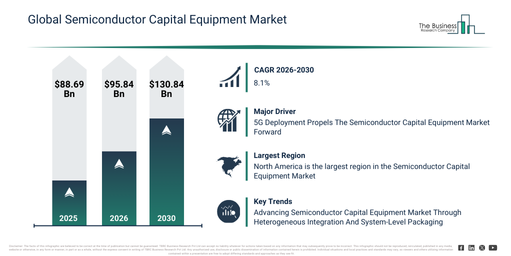
The semiconductor capital equipment market has seen substantial growth recently. Its valuation is set to increase from $88.69 billion in 2025 to $95.84 billion in 2026, progressing at a compound annual growth rate (CAGR) of 8.1%. This historical growth can be attributed to factors such as increased consumer electronics demand, the proliferation of semiconductor fabrication facilities, the escalating complexity of integrated circuits, greater investments in data centers, and the continuous need for improved chip performance.
The semiconductor capital equipment market is projected to experience robust expansion over the coming years, with its valuation set to reach $130.84 billion by 2030, demonstrating an 8.1% compound annual growth rate (CAGR). Factors contributing to this growth during the forecast period include the rise of artificial intelligence and high-performance computing, the expanding demand for semiconductors in electric vehicles, the wider embrace of cutting-edge packaging technologies, increased capital deployment in local semiconductor production, and the ongoing reduction in size of semiconductor nodes. Key trends anticipated during this period encompass the greater integration of sophisticated wafer fabrication machinery, a surge in the need for highly precise lithography and etching instruments, heightened investment in automated assembly and packaging setups, the proliferation of advanced process control and metrology offerings, and an intensified emphasis on enhancing yield and minimizing defects.
Get A Free Sample Report With In-Depth Market Insights:
Semiconductor Capital Equipment Market Opportunity Drivers: What’s Unlocking New Revenue Potential?
The swift implementation of 5G technology is anticipated to boost the semiconductor capital equipment market’s expansion. This technology represents the fifth generation of mobile networks, providing notably quicker data speeds, reduced latency, and enhanced connectivity compared to earlier versions. The rising need for 5G technology stems from its capability to facilitate rapid data speeds and low latency, which are vital for new applications like autonomous vehicles, smart cities, and augmented reality. Semiconductor capital equipment plays a critical role in deploying 5G technology by enabling the manufacturing of sophisticated chips and components required for high-speed data processing and communication infrastructure. For example, in March 2024, as reported by 5G Americas, a US-based industry trade organization, worldwide 5G connections dramatically rose to 1.76 billion by the end of 2023, showing a 66% year-over-year increase with an extra 700 million connections added. This upward trend is expected to intensify, with predictions suggesting 7.9 billion 5G connections by 2028. Consequently, the rapid deployment of 5G technology is fueling the growth of the semiconductor capital equipment market.
Semiconductor Capital Equipment Market Segment Analysis: What Are The Core Market Categories?
The semiconductor capital equipment market covered in this report is segmented –
1) By Type: Wafer Manufacturing Equipment, Assembly And Packaging Equipment, Test Equipment, Other Types
2) By Application: Wafer Processing, Surface Conditioning, Assembly And Packaging
3) By Industry: Consumer Electronics, Healthcare, Automotive, Information Technology (IT) And Telecommunication, Other Industries
Subsegments:
1) By Wafer Manufacturing Equipment: Photolithography Equipment, Etching Equipment, Deposition Equipment, Ion Implantation Equipment, Chemical Mechanical Planarization (CMP) Equipment, Cleaning Equipment
2) By Assembly And Packaging Equipment: Die Bonders, Wire Bonders, Pick And Place Equipment, Packaging Materials And Tools, Testing And Inspection Equipment
3) By Test Equipment: Wafer Test Equipment, Final Test Equipment, Automated Test Equipment (ATE), Test Handlers
4) By Other Types: Mask Or Etch Lithography Equipment, Thin Film Deposition Equipment, Sputtering Equipment, Process Control And Metrology Equipment
Semiconductor Capital Equipment Market Innovation Trends: What Developments Are Reshaping The Industry?
Major companies within the semiconductor capital equipment market are directing their efforts towards adopting heterogeneous chip integration and system-level packaging methods, such as hybrid bonding. This shift aims to improve performance, increase functionality, and satisfy the growing demand for advanced, high-efficiency semiconductor solutions. Hybrid bonding facilitates the connection of semiconductor chips by forming a direct bond between their surfaces, typically involving a metallic and an insulating layer. For example, in July 2023, Applied Materials, a US-based semiconductor equipment company, revealed new materials, technologies, and systems designed to assist chipmakers in incorporating chiplets into advanced 2.5D and 3D packages through hybrid bonding and through-silicon vias (TSVs). These innovations further enhance Applied’s extensive portfolio of technologies for heterogeneous integration (HI). Heterogeneous integration allows semiconductor manufacturers to combine chiplets with varying functions, technology nodes, and sizes into a unified package, enabling them to operate as a single unit. This strategy addresses the challenges faced by the industry, driven by the escalating demand for transistors in high-performance computing and artificial intelligence. With traditional 2D scaling of transistors proving increasingly costly and less effective, HI presents a strategic solution to improve chip performance, power efficiency, area cost, and time to market (PPACt).
Semiconductor Capital Equipment Market Top Companies Driving Competitive Growth
Major companies operating in the semiconductor capital equipment market are Applied Materials, Inc., ASML Holding N.V., Lam Research Corporation, Tokyo Electron Limited, KLA Corporation, Nikon Corporation, Hitachi High-Technologies Corporation, Advantest Corporation, MKS Instruments, Inc., Teradyne, Inc., SCREEN Holdings Co., Ltd., Bruker Corporation, ASM International N.V., DISCO Corporation, Kulicke and Soffa Industries, Inc., Edwards Vacuum LLC, Cohu, Inc., Veeco Instruments, Inc., Rudolph Technologies, Inc., Mattson Technology, Inc., BE Semiconductor Industries N.V., AIXTRON SE
View The Full Semiconductor Capital Equipment Market Report:
Semiconductor Capital Equipment Market Geographic Landscape: Which Region Leads Industry Growth?
North America was the largest region in the semiconductor capital equipment market in 2025. The regions covered in the semiconductor capital equipment market report are Asia-Pacific, South East Asia, Western Europe, Eastern Europe, North America, South America, Middle East, Africa
Reach Out To Our Team:
The Business Research Company: https://www.thebusinessresearchcompany.com/
Americas: +1 310-496-7795
Asia: +44 7882 955267 & +91 8897263534
Europe: +44 7882 955267
Email us at: marketing@tbrc.info
Follow us on:
LinkedIn: https://in.linkedin.com/company/the-business-research-company
YouTube: https://www.youtube.com/channel/UC24_fI0rV8cR5DxlCpgmyFQ
Global Market Model: https://www.thebusinessresearchcompany.com/global-market-model

Wasay has over a decade of experience in market research, data modelling, and analytics, with prior experience at GlobalData and Decision Tree Consulting Services. At The Business Research Company , he leads research operations across syndicated studies, customized consulting engagements, and the Global Market Model platform. His professional experience includes supporting organizations such as Boston Consulting Group, KPMG, and Ernst & Young. Wasay holds a degree in Electronics and Communications Engineering, postgraduate management qualifications from International Management Institute Belgium and Indian School of Business and Entrepreneurship, and completed the Integrated Program in Business Analytics from Indian Institute of Management Indore.